
Black and white footage of Mary Hopkin in the studio (Peter Asher in the control booth) recording the Spanish version of "Those Were the Days" ("Que Tiempo Tan Feliz"). At the end of the video, the Beatles' promo video for "Revolution" is shown, with what sounds like to me more of the "live" audio than most versions that later circulated (which largely overdub the official recording).
Showing posts with label mary hopkin. Show all posts
Showing posts with label mary hopkin. Show all posts
Friday, December 17, 2010

Wednesday, November 17, 2010
Wednesday, May 26, 2010
Monday, March 01, 2010
Mary Hopkin on Getting Signed to Apple Records
"I was on a television show called Opportunity Knocks when I was eighteen. It was sort of a national talent contest. After the first appearance, I was contacted by Peter Brown of Apple Records. At the time I had never heard of Apple. The only thing I'd heard of was the Apple shop in London. After the call, I didn't think much of it, but Peter rang back again and I found out that it was Paul McCartney who wanted me to come to London. I was totally shocked. Anyway, I went up to London and Paul asked if I was interested in signing with Apple. He showed me 'Those Were the Days,' which was a song he'd had around for a few years. He had played it to various people, but hadn't found anyone to record it. So he thought I was suitable. About two months later we recorded and released it, and it all happened from there."
Friday, January 01, 2010
Paul McCartney on Recording Mary Hopkin and "Those Were the Days"
"I phoned Mary Hopkin and she came down and I listened to her sing in the recording studio. She was sensational, so I decided to record her. I had heard 'Those Were the Days' about two years earlier when I was out at a nightclub feasting on steak and lettuce. These two people came on and they sang this song. I think I was there about two nights that weekend. I heard the song twice, and it was one of those things I couldn't get out of my head. So I started playing it on my guitar. I always thought, you know, that it would be a hit song. But no one ever did it. I tried to get the Moody Blues to do it. They nearly did it, but it never worked out for them. It's better that they didn't actually because Graham Edge was saying to me the other day that if they had done it, they wouldn't have been into this thing they're into now. They would have had a mammoth hit and been pop stars all over again. So I recorded Mary Hopkin and she had the hit with it."
Friday, August 07, 2009
"Goodbye" Lyrics
by John Lennon and Paul McCartney
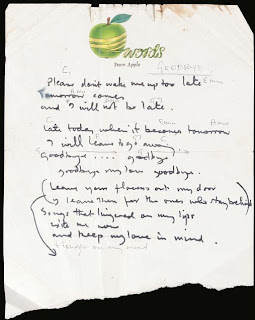 Original Manuscript on Apple Stationery (1969)
C E min
Please don't wake me up too late
A min
Tomorrow comes
F D min G7
and I will not be late
C E min A min
Late today when it becomes tomorrow
F G7 C
I will leave to go away
G G
Goodbye . . . . goodbye
goodbye my love goodbye.
Leave your flowers at my door
leave them for the ones who stay behind
Songs that lingered on my lips
excite me now
and keep my love in mind
+ linger on my mind
As Recorded by Paul McCartney (Demo 1969)
Please don't wake me up too late
Tomorrow comes and I will not be late
Late today when it becomes tomorrow
I will leave and go away
Goodbye, goodbye
Goodbye, goodbye
Goodbye, goodbye my love, goodbye
Songs that lingered on my lips
Excite me now and linger on my mind
Leave your flowers at my door
I leave them for the one who waits behind
Goodbye, goodbye
Goodbye, goodbye
Goodbye, goodbye my love, goodbye
Ba da da da ba ba ba
Ba ba ba ba
Bam bam bam bam bam bam
Ba da da da ba ba ba
Bam bam bam bam
Bam bam bam bam bam bam
Goodbye, goodbye
Goodbye, goodbye
Goodbye, goodbye my love, goodbye
Far away my lover sings a lonely song
And calls me to his side
Where the sound of lonely drums invites me on
I must be by his side
Goodbye, goodbye
Goodbye, goodbye
Goodbye, goodbye my love, goodbye
Goodbye, bye bye
As Released by Mary Hopkin (1969)
Please don't wake me up too late
Tomorrow comes and I will not be late
Late today when it becomes tomorrow
I will leave to go away
Goodbye
Goodbye
Goodbye, goodbye my love, goodbye
Songs that lingered on my lips
Excite me now and linger on my mind
Leave your flowers at my door
I leave them for the one who waits behind
Goodbye
Goodbye
Goodbye, goodbye my love, goodbye
Do do do do do do do
Do do do do
Do do do do do do
Do do do do do do do
Do do do do
Do do do do do do
Goodbye
Goodbye
Goodbye, goodbye my love, goodbye
Far away my lover sings a lonely song
And calls me to his side
When the song of lonely love invites me on
I must go to his side
Goodbye
Goodbye
Goodbye, goodbye my love, goodbye
 Original Manuscript on Apple Stationery (1969)
C E min
Please don't wake me up too late
A min
Tomorrow comes
F D min G7
and I will not be late
C E min A min
Late today when it becomes tomorrow
F G7 C
I will leave to go away
G G
Goodbye . . . . goodbye
goodbye my love goodbye.
Leave your flowers at my door
leave them for the ones who stay behind
Songs that lingered on my lips
excite me now
+ linger on my mind
As Recorded by Paul McCartney (Demo 1969)
Please don't wake me up too late
Tomorrow comes and I will not be late
Late today when it becomes tomorrow
I will leave and go away
Goodbye, goodbye
Goodbye, goodbye
Goodbye, goodbye my love, goodbye
Songs that lingered on my lips
Excite me now and linger on my mind
Leave your flowers at my door
I leave them for the one who waits behind
Goodbye, goodbye
Goodbye, goodbye
Goodbye, goodbye my love, goodbye
Ba da da da ba ba ba
Ba ba ba ba
Bam bam bam bam bam bam
Ba da da da ba ba ba
Bam bam bam bam
Bam bam bam bam bam bam
Goodbye, goodbye
Goodbye, goodbye
Goodbye, goodbye my love, goodbye
Far away my lover sings a lonely song
And calls me to his side
Where the sound of lonely drums invites me on
I must be by his side
Goodbye, goodbye
Goodbye, goodbye
Goodbye, goodbye my love, goodbye
Goodbye, bye bye
As Released by Mary Hopkin (1969)
Please don't wake me up too late
Tomorrow comes and I will not be late
Late today when it becomes tomorrow
I will leave to go away
Goodbye
Goodbye
Goodbye, goodbye my love, goodbye
Songs that lingered on my lips
Excite me now and linger on my mind
Leave your flowers at my door
I leave them for the one who waits behind
Goodbye
Goodbye
Goodbye, goodbye my love, goodbye
Do do do do do do do
Do do do do
Do do do do do do
Do do do do do do do
Do do do do
Do do do do do do
Goodbye
Goodbye
Goodbye, goodbye my love, goodbye
Far away my lover sings a lonely song
And calls me to his side
When the song of lonely love invites me on
I must go to his side
Goodbye
Goodbye
Goodbye, goodbye my love, goodbye
Friday, July 24, 2009
White Album and Mad Day Out, 1968
 It's handy having Paul's house so near the EMI studios. Sometimes if we're feeling a bit peckish by midnight or thereabouts, we troop round to his place for a nosh break. George is getting great at cooking fry-up suppers and his specialty in the kitchen line is a hearty blend of eggs, bacon, tomatoes and fried bread, which stimulates everyone in readiness for the rest of the night's recording!
Incidentally, talking about George reminds me about the fabulous new guitar he gave to our great little Apple singer, Mary Hopkin. Mary came along to one of the LP sessions and, on the spur of the moment, George decided to go out and get her a guitar as a gift. It was a really good one, too. When he came back to the studio with it he must have felt a bit shy about handing it over. So, when we were leaving I gave Mary the guitar saying, very simple, "It's a present from George." She couldn't say "thank you," but her six-foot-deep smile seemed to fit the bill.
Before I finish off for this month I must tell you a bit about the very special photo session we had one Sunday just a few weekends ago. The idea was to get together a whole new collection of pictures, really good ones, from which the fan clubs could have fresh supplies. This time the Beatles were determined to do something a bit better than just putting their four heads together in front of a wall. After all, a selection of pictures would be going all the way round the world to more than 40 different branches of the Beatles Fan Club, so it was worth a bit of special effort to turn out good ones.
 We met at Paul's house around lunchtime and set out in a little cavalcade of vehicles. John came with me in my car and I'd brought my small son Gary along for the ride. The others piled into Ringo's white Mercedes and a van carrying all the different costumes and clothes trailed behind us as we crossed London from St. John's Wood through the West End to Fleet Street and beyond. First stop was the Sunday Times building where we used the roof to do the first set of pictures. And we used a wind machine to get nice effects on the fellows' hair. In fact I think it helped to produce some of the first group photographs to show all four Beatle foreheads uncovered beneath wind-swept hair!
Next we turned West again and headed for Bayswater. Our destination was a little place called the Mercury Theatre which is situated not too far from the headquarters of The Beatles Monthly. Good job it was a Sunday with all this town travelling to be done. To try criss-crossing London by road on a weekday would have meant spending half the afternoon getting out of traffic jams!
At the Mercury we dug out loads of strange costumes, had tea in the theatre bar and then did some more pictures. A zoological man brought along a brightly-coloured parrot which settled peacefully upon Ringo's left shoulder and didn't mind having his picture taken!
From there we went East again stopping in a suburban residential area to do a few street shots in front of houses before heading for the London Docks.
Finally, we returned to St. John's Wood and Paul's house for more tea and the last lot of photographs. This time Paul's massive dog Martha got into the act like she always does. Not that anyone minded because she's a great dog and very photogenic what's more!
Paul had the ideal spot for picture-taking. We trooped down to the foot of his garden. There, hidden away behind all the trees, Paul has this fantastic glass-domed sun-thingy. I know there's a special word for it but I'm sure you know what I mean, anyway! It's quite high, a square building at the bottom with glass walls. Four pillars go right up to the glass roof and there's a round hydraulic lift. You just stand on the step and up you go into the dome. Got some great pictures up there with Paul, Ringo and Martha, plus a few shots of all the four fellows. Anyway, if and when you start collceting the new set of photographs which the Fan Club is offering, you'll know all about the background to them. Oh yes . . . and the ones in goggles and crash helmets were done on the Sunday Times roof, too. So now you know!
MAL EVANS
Friday, July 10, 2009
The Eighteenth Single
 How the Beatles recorded their new single
By Mal Evans
"Hey Jude" and "Revolution" has become the Beatles' eighteenth single, their very first to be released on their own Apple label almost five years to the day after "She Loves You," which came out at the end of August 1963.
So here are some statistics to start you off. "Revolution" was John's idea--one of the songs he started work on while he was at the Maharishi's place in India--and if you can say this recording has a lead vocalist then it must be John.
"Hey Jude" is a more recent number, based on one of Paul's ideas, but worked on with much joint effort from both John and Paul before it reached the recording studios.
The first version of "Revolution" was put on tape more than three months ago. At that stage it lasted a little over ten minutes. If you read the July issue of The Beatles Monthly you will remember that there was the first exclusive report about "Revolution" in there. At one point it looked as if this might be the main side of the new single. But three further versions of "Revolution" were recorded before the Beatles were thoroughly happy about the finished production.
Work was started on Version Number Three on Tuesday, July 9. That night Ringo arrived at EMI earlier than the rest of the fellows. So he dropped in on a session in one of the other studios and did a bit of hand-clapping on a record Solomon King was making! As usual the first job was to lay down on tape the initial layers of the accompaniment. In other words to make the backing tracks. Nothing extraordinary was used in the way of instrumentation--just the normal line-up of three guitars and drums. Then, when there was a break Paul, Ringo, and I trotted off to a nearby pub for toasted cheese sandwiches.
Before the end of the month there were four completed variations of "Revolution" to choose from, and it's the fourth and final one which went onto the "B"-side of the single.
Meantime there was plenty of other studio activity. Album numbers were being worked on very busily. Ringo was adding a bit of piano-playing to his own item called "Don't Pass Me By." Paul was getting going on a Calypso-type song he'd written.
By the end of July a total of seven recordings had been completed for the next Beatles LP album. In addition the fellows had been getting pretty involved with some of the other Apple singles. George had been supervising the recording of Jackie Lomax's "Sour Milk Sea" and "Eagle Laughs At You." Paul had been producing the Mary Hopkin single, "Those Were The Days" and "Turn, Turn, Turn." And there had been the first sessions with yet another Apple discovery, James Taylor. All this work had been done at studios we had never used before, Trident in Wardour Street. The basement studio there is just great. Large enough to give plenty of scope, but small enough to be comfortable and informal. Although they had all been along there, the Beatles had yet to arrange one of their own group sessions at the Trident Studio.
Tuesday, June 23, 2009
Beatle People: Mary Hopkin
 Mary Hopkin (born 3 May 1950, Pontardawe, Wales) is a Welsh folk singer. She is best known as one of the first musicians to sign to The Beatles' Apple label, and for her 1968 single "Those Were the Days", which was a top-ten hit in both the UK and the U.S.
Early singing career
Hopkin was born in to a Welsh speaking family, and began her musical career as a folk singer with a local group called the Selby Set and Mary. She released an EP of Welsh language songs for a local record label called Cambrian, which was based in her home town, before signing to The Beatles' Apple Records. The model Twiggy saw her winning the British ITV television talent show, Opportunity Knocks, and recommended her to Paul McCartney. She became one of the first artists to record on the Beatles' Apple record label.
Her debut single, "Those Were the Days", produced by Paul McCartney, was released in the UK on 30 August 1968 (catalogue number APPLE 2). Despite competition from a well-established star, Sandie Shaw, who released her version of the same song as a single that same year, Hopkin's version became a number one hit in the UK Singles Chart, and reached #2 in the U.S. Billboard Hot 100. On 2 October 1968 Hopkin appeared at St Paul's Cathedral, London for the 'Pop Experience' where she sang "Morning Of My Life", "Turn Turn Turn" and "Plaisir D'amour."
In December 1968 the NME music magazine reported that Hopkin was 'sympathetically considering' a lead acting role in Stanley Baker's forthcoming film, Where's Jack?. Ultimately she instead sang the title song.
 On 21 February 1969 her debut album, Postcard, also produced by McCartney, was released. It included covers of three songs from Donovan, who also played on the album, and one song each from George Martin and Harry Nilsson. It reached number three on the UK Albums Chart, although it proved to be her solitary success story in that particular chart. In the United States Postcard reached #28 on the Billboard albums chart.
The next single was "Goodbye," written by Paul McCartney (but credited to Lennon/McCartney), released on 28 March 1969 (APPLE 10); it reached #2 in the UK Singles Chart. It was kept off the top of the charts by the Beatles' single "Get Back". "Goodbye" has never been officially released by the Beatles, although a demo version can be found on some of the Beatles' bootlegs.
She represented the United Kingdom in the 1970 Eurovision Song Contest singing "Knock Knock, Who's There?". Author and historian John Kennedy O'Connor notes in The Eurovision Song Contest — The Official History that she gave a very comfortable performance and sang in a crystal clear voice, but despite being the pre-contest favourite, Hopkin came second to "All Kinds of Everything", performed by Irish singer Dana.
"Knock Knock, Who's There?" was released as a single on 23 March 1970, reaching #2 again in the UK. Her second album, Earth Song, Ocean Song, was released by Apple on 1 October 1971. The record was produced by her husband Tony Visconti and included cover versions of songs written by Cat Stevens, Gallagher and Lyle, and Ralph McTell.
 After the hit singles
After marrying Visconti in 1971, Hopkin withdrew from the pop music scene to have a family. Although reportedly unhappy with show business, Hopkin did not stop recording. She travelled to Australia with Visconti in January 1972 and performed at a large outdoor rock festival in South Australia, as well as giving concerts in several major cities. With the help of Visconti, 1972 saw the release of the Christmas song "Mary Had a Baby" / "Cherry Tree Carol" on Regal Zonophone Records, which was re-released in 1973. Later that year, the single "Summertime Summertime" / "Sweet And Low" was released on Bell Records under the name of Hobby Horse.
Although no other singles or albums came out in her name until 1976, she sang on numerous recordings that her husband Visconti produced, such as those featuring Tom Paxton, Ralph McTell, David Bowie (Low), Bert Jansch, The Radiators From Space, Thin Lizzy, Carmen, Sarstedt Brothers, Osibisa, Sparks, Hazel O'Connor and Elaine Paige.
On all of these recordings (and also on her husband's own album Inventory) she is credited as Mary Visconti. During this time, she also appeared on various TV shows such as Cilla Black's and various radio programmes.
Return to recording
In 1976, she returned to recording under her own name, and released the single "If You Love Me (I Won't Care)" (originally recorded by Édith Piaf), which reached #32 in the UK chart. The B-side, "Tell Me Now", was an original composition by Hopkin. Her next single was "Wrap Me In Your Arms", with the B-side again written by Hopkin ("Just A Dreamer"). These singles came out on Visconti's Good Earth Records label. Several songs recorded for an album at the time have now been released under Hopkin's own label, Mary Hopkin Music.
Two members of Steeleye Span (Bob Johnson and Pete Knight) chose Hopkin to play "Princess Lirazel" on their concept album The King of Elfland's Daughter. She also appeared at the Cambridge Folk Festival with Bert Jansch. 1976 also saw the birth of her second child. Before the 1970s ended, Decca released a compilation album of Hopkin's Cambrian recordings, The Welsh World of Mary Hopkin.
1980s
 Hopkin's first project in the 1980s was a well-reviewed stint playing the Virgin Mary in Rock Nativity at the Hexagon Theatre in Reading, Berkshire. After this, Mike Hurst (record producer and formerly of The Springfields) asked her to sing lead in a new group named Sundance that he had formed with Mike de Albuquerque of ELO. Their only single, "What's Love", allowed them to tour the UK with Dr. Hook, but Hopkin quickly left the group, dissatisfied with the gigs. In 2002, Hurst released recordings from this time on the Angel Air label.
Hopkin and Visconti divorced in 1981. The following year she provided melismatic vocals on "Rachael's Song" for the Vangelis soundtrack of Blade Runner. Around 1984, Peter Skellern asked her to join him and Julian Lloyd Webber in a band called Oasis. Their album Oasis was released on WEA along with two singles. A tour of the UK was planned but was brought to an abrupt end because Hopkin became ill. The group disbanded shortly afterwards.
During the 1980s Hopkin appeared in several charity shows, including an appearance at the London Palladium with Ralph McTell. In 1988, she took part in George Martin's production of Dylan Thomas' Under Milk Wood. She played the character Rosie Probert and notably performed a piece called "Love Duet" with Freddie Jones as Captain Cat. The making of the record was filmed and made into a special edition of The South Bank Show, where Hopkin and Jones were shown rehearsing and recording "Love Duet". In 1992, the cast reunited for a performance of the play as a tribute to Thomas in the presence of Prince Charles for The Prince's Trust.
Hopkin recorded an album called Spirit in 1989. This was released on the Trax label and is a collection of light classical songs and featured the single "Ave Maria". The record was produced by Benny Gallagher of Gallagher and Lyle, who had contributed songs to her during her days at Apple Records.
 1990s to present
Early in 1990, she was asked to sing with The Chieftains at the London Palladium in a charity show, and later joined them on a tour of the UK.
She continued to do projects of her choosing, working with people like Julian Colbeck, she wrote the lyrics and performed a song on his CD Back to Bach. Also, there was Marc Cerrone's The Collector, a stage play/opera, for which she performed two tracks on the CD and video. She worked again with her old guitarist Brian Willoughby and Dave Cousins (of Strawbs) on their CD The Bridge. Hopkin also appeared on a Beatles' tribute album by RAM Pietsch.
Around 1996, the Welsh label Sain bought Cambrian's back catalogue and released all Hopkin's Welsh recordings on a CD called The Early Years, which removed the overdubbed drums found in the Decca recordings.
In 1999, she was again invited to join The Chieftains on their UK tour, and later that year performed a few concerts in Scotland with Benny Gallagher and Jim Diamond. More recently there have been three TV documentaries about her, one each for HTV, BBC Television and S4C.
She made a guest appearance on The Crocketts' album The Great Brain Robbery, sang the theme song for Billy Connolly's BBC TV series The World Tour, and re-recorded "Those Were The Days" with Robin Williams rapping. She also appeared in the Sarah Sugarman film Very Annie Mary and duetted with Dolly Parton on her 2005 album, Those Were the Days, which went to #48 on the U.S. Billboard 200 chart (#9 U.S. Country) and number 35 in the UK.
In September 2005 she released a retrospective album on her own label, Mary Hopkin Music, entitled Live at the Royal Festival Hall. It was followed in December 2006 by a Christmas recording, "Snowed Under", released as an mp3 download on the Welsh online store, Disaudio.
In 2007 to celebrate her 57th birthday, she released an album called Valentine, on her new eponymous label. It included 12 previously unheard tracks dating from 1972 to 1980, three of which were written by Hopkin. In 2008, a new album, Recollections, was released on her own label. It included eleven tracks that were originally recorded between 1970 and 1986, alongside a CD of three Christmas songs, which included "Mary Had a Baby" and "Cherry Tree Carol" (these tracks were first released on Regal Zonophone in 1972) and "Snowed Under", which was released in 2006 as a download only.
Discography
Chart singles
- "Those Were The Days" (1968)
- "Goodbye" (1969)
- "Temma Harbour" (1970)
- "Knock Knock, Who's There?" (1970)
- "Que Sera, Sera (Whatever Will Be, Will Be)" (1970)
- "Think About Your Children" (1970)
- "Let My Name Be Sorrow" (1971)
- "Water, Paper & Clay" (1972)
- "If You Love Me (I Won't Care)" (1976)
Tuesday, January 13, 2009
The Beatles - No. 3 Abbey Road N.W.8
Label: Vigotone, VT-116
Paul McCartney and Donovan recorded during the sessions for Mary Hopkin's Postcard LP November 1968 - January 1969
1 How Do You Do 2:07
2 Blackbird 2:47
3 The Unicorn 1:05
4 Lalena 3:27
5 Heather 2:03
6 Mr. Wind 1:32
7 The Walrus And The Carpenter 1:07
8 Land Of Gish 0:49
Early mono mixes (except No. 16) and takes recorded April to August 1969 at EMI for the Abbey Road LP.
9 Octopus's Garden take 32, early mix July 17, 1969 2:46
10 Her Majesty take 3, recorded July 2, 1969 0:44
11 Golden Slumbers, Carry That Weight early take, recoded July 2, 1969 2:49
12 You Never Give Me Your Money unreleased take, recorded May 6, 1969 5:53
13 Oh! Darling early version, recorded April 20-26, 1969 3:21
14 Maxwell's Silver Hammer early mix, recorded July 9-11, 1969 3:37
15 Something reduction take 37, mixed July 11, 1969 5:31
16 Because take 16, early version, recorded August 1-4, 1969 2:15
17 A Huge Melod (part one) early assembly and mix, July 30, 1969 10:56
18 A Huge Melody (part two) early assembly and mix, July 30, 1969 5:12
Paul McCartney and Donovan recorded during the sessions for Mary Hopkin's Postcard LP November 1968 - January 1969
1 How Do You Do 2:07
2 Blackbird 2:47
3 The Unicorn 1:05
4 Lalena 3:27
5 Heather 2:03
6 Mr. Wind 1:32
7 The Walrus And The Carpenter 1:07
8 Land Of Gish 0:49
Early mono mixes (except No. 16) and takes recorded April to August 1969 at EMI for the Abbey Road LP.
9 Octopus's Garden take 32, early mix July 17, 1969 2:46
10 Her Majesty take 3, recorded July 2, 1969 0:44
11 Golden Slumbers, Carry That Weight early take, recoded July 2, 1969 2:49
12 You Never Give Me Your Money unreleased take, recorded May 6, 1969 5:53
13 Oh! Darling early version, recorded April 20-26, 1969 3:21
14 Maxwell's Silver Hammer early mix, recorded July 9-11, 1969 3:37
15 Something reduction take 37, mixed July 11, 1969 5:31
16 Because take 16, early version, recorded August 1-4, 1969 2:15
17 A Huge Melod (part one) early assembly and mix, July 30, 1969 10:56
18 A Huge Melody (part two) early assembly and mix, July 30, 1969 5:12
Wednesday, July 30, 2008
Those Were The Days: An Unofficial History Of The Beatles' Organization 1967-2001
by Stefan Granados
This is the first complete telling of the Apple story, culled from exclusive interviews with the recording artists, staff and business associates who helped make Apple a fascinating chapter in the history of both the Beatles and pop music in general.
Today, the Apple office is remembered as a place where almost anyone could come in off the street and meet one of the Beatles, get funding for an outlandish art project, or just drop in to the Apple Press Office for a drink and a quick smoke. For less well-intentioned visitors, Apple was where one could go to pinch and electric typewriter, a box of LPs, or quite literally the lead off the roof of the Apple building at 3 Saville Row. But Apple was also the company that the Beatles used to discover and develop many deserving artists, including such stars as Mary Hopkin, James Taylor, Bad Finger, Hot Chocolate, Billy Preston and Mercury-award winning classical composer, John Tavener. Even a teenage Richard Branson figures in the Apple story..
Those Were The Days: An Unofficial History Of The Beatles Apple Organization 1967-2001 details the colourful history of Apple, from its inception to its current incarnation as the sole protector of the Beatles legacy.
Stefan Granados has diligently been researching this project now for several years and the book also contains many very rare previously unseen photographs.
Excerpt
1967 - The Nems years
Life in post-war England was relatively simple back in 1962. For aspiring professional entertainers like The Beatles - a four-man rock and roll band from Liverpool - a career in music promised little more than weekly engagements at local dances and youth clubs, and if they were lucky, perhaps a chance to cut a record that might get one or two spins on Radio Luxembourg or the BBC. Of course, fate held something quite different in store for The Beatles. Six months after their debut single Love Me Do became a minor hit, The Beatles sparked off a tidal wave of fan hysteria the intensity of which had never before been seen in popular music. During the halcyon days of 1963 and 1964, Beatlemania swept unchecked across the world. Show business, popular music and the world itself were changed forever.
Guiding The Beatles throughout the turbulent Beatlemania era was their manager, Brian Epstein. From 1962 to 1967, The Beatles were managed exclusively by Epstein and his artist management firm, Nems Ltd - an organization that Epstein himself had set up shortly after meeting The Beatles in 1962. Coming from an affluent Liverpool family, the mild-mannered Epstein was quite unlike the typical "pop" managers of the era. Prior to becoming the group's manager, Epstein's music industry experience had been limited to running the record department of his parents' Liverpool department store. But given that he was one of the few people in Liverpool to have actually conducted business with the London-based record companies, Epstein's decision to venture into artist management was not as far-fetched as it might have seemed at the outset. The Beatles were certainly impressed with Epstein's modest music industry connections and with his genuine enthusiasm for the band, so they signed a five-year management contract with him in January 1962. From that point onwards, all of the money generated by The Beatles was funnelled directly through Nems. In exchange, the four Beatles were each given a salary and had their living expenses paid by the company.
Initially, Epstein's management duties focused on securing a record contract for the group, polishing their professional presentation and overseeing the group's live bookings. But once the full force of Beatlemania took hold in 1963, The Beatles became increasingly reliant on Epstein and Nems to take care of almost every aspect of their personal and professional lives.
Receiving a 25% share of The Beatles' gross income, Epstein was certainly very well compensated for his efforts. But Epstein served the band with a remarkable sense of care and devotion and it was obvious that he regarded The Beatles as much more than just a once-in-a-lifetime business opportunity. In the early days of Beatlemania, Epstein's name was synonymous with The Beatles. Due in large part to the remarkable success of the group, Epstein was able to build Nems into a high-powered management company that would become the dominant force behind the Liverpool music scene.
Having seen what Epstein had done for The Beatles, almost all of the performers in Liverpool rushed to align themselves with Nems. From 1963 onwards, Nems Enterprises managed the careers of artists such as Cilla Black, Gerry and The Pacemakers, The Fourmost and Billy J. Kramer, as well as several lesser-known Liverpool groups.
Under Epstein's skilful direction, Nems developed a diverse and initially highly successful client roster, but it was clear to all of the other Nems artists that The Beatles were Epstein's one true passion. Whether charged with finding a house for one of The Beatles, negotiating television appearances or quietly settling such personal matters as threatened paternity suits, Epstein handled his duties in an efficient, dignified manner and all four Beatles considered him to be not only a manager, but a friend. When it came to The Beatles, no matter was too trivial to be given Epstein's full attention.
In retrospect, Epstein's only real professional shortcoming was his marked lack of business acumen. Still, while much of The Beatles' success can, and should, be attributed to their immense talent, it was Epstein's music industry contacts and his careful handling of the group's image and presentation that transformed The Beatles from a rough, leather-clad rock and roll band from "up North" into a polished, international show business phenomenon.
Today, Epstein's significant contributions to launching The Beatles' career are often overshadowed by the embarrassingly poor business deals that he negotiated on behalf of the group. The original recording agreement Epstein signed with EMI in 1962 was a one-year contract that gave EMI the option of extending The Beatles' contract for three successive years. In return, the band would get one penny of recording royalties for each single sold and precious little more for each album sold in the UK. For any Beatles recordings licensed to record companies outside of the UK, the group would receive only half of the UK royalty rate. Epstein would somewhat rectify matters when it was time to renegotiate The Beatles' EMI contract in January 1967. In exchange for re-signing to EMI until 1976, The Beatles would receive 10% of the wholesale price of a British album and 17.5% of the wholesale price of each album sold in America.
In Epstein's defence, the deals he negotiated for the group were fairly common by music industry standards in 1962. He would fare far worse with the non-music deals that he set up for the group. Epstein's most celebrated fiasco was the 10% royalty rate he negotiated for the American rights to manufacture and sell such seemingly trivial Beatles merchandise as wigs, shampoo, trading cards and the countless other items that flooded into American discount stores during 1964 and 1965. When Epstein entered into these deals in 1964, the 30 year-old ex-furniture and record salesman from Liverpool was no match for the quick-talking New York City businessmen who appeared to be offering him thousands of dollars in exchange for the simple use of The Beatles' name on what he perceived to be insignificant teen-oriented products. Due to the limited scope of his business experience, Epstein practically gave away the rights to The Beatles' American merchandising - a move that would ultimately cost The Beatles millions of dollars of revenue.
To be fair to Epstein, few music industry professionals at that time - let alone a music industry novice like Epstein - ever imagined just how much money music merchandising could generate. To Epstein, any revenue from the sale of such ancillary "Beatles products" was just "found money" to supplement The Beatles' live and recording income.
Never considered to be a great negotiator, Epstein's true strengths were his well-developed organizational abilities, his unflinching honesty and his conservative, reliable stewardship of The Beatles' finances. With Epstein overseeing the group's affairs, the four Beatles enjoyed a relatively carefree existence when it came to financial matters. If they wanted any item - be it a car, a house, or new clothes - they simply charged it to Nems and the bill would be paid with no questions asked. With Nems so thoroughly involved with managing their finances, the four Beatles made very few personal investments during the peak years of Beatlemania. The investment activities of the individual Beatles were limited to Ringo Starr's interest in a high-end construction company and Paul McCartney's decision (unbeknownst to the other three Beatles) to buy additional shares in Northern Songs, the music publishing company that held the rights to The Beatles' songs. In general, The Beatles seemed content to simply let Nems take care of business.
In addition to the money earned from live performances and record and music publishing royalties, The Beatles had several other sources of revenue prior to 1967. Their most significant collective investment was Subafilms, the Nems-run film company that controlled the group's share of The Beatles' film projects, responsible for producing Beatles promotional films (in the days before video) for television.
As well as owning Subafilms, all four Beatles held shares in Northern Songs Music Publishing, the company that held the publishing rights to The Beatles' songs. Although Northern Songs founder Dick James retained a majority interest in the company, The Beatles and Nems each held significant portions of Northern Songs. In addition to their Northern Songs stock, Lennon and McCartney were also co-owners of a company formed on 4 February 1965 named Maclen Music Ltd. Theoretically, Maclen licensed the rights to publish Lennon and McCartney songs to Dick James' Northern Songs with Maclen collecting 50% of the publishing royalties due to Lennon and McCartney from Northern Songs. The remaining 50% of the publishing revenue went to Northern Songs.
Dick James had been unusually fair to The Beatles (by industry standards of the day) when he set up Northern Songs in February 1963. Recommended to Brian Epstein by Beatles producer George Martin, James had a tremendous amount of respect for The Beatles and their music. Though The Beatles were little more than a talented group with one minor hit (Love Me Do) to their credit when James first met them in early 1963, James, a failed pop singer and then struggling music publisher, knew that the songs of Lennon and McCartney had the potential to become major hits.
In exchange for the publishing rights to The Beatles' second single, Please Please Me, James used his music industry connections to secure The Beatles a coveted spot on the BBC television programme Thank Your Lucky Stars. Impressed by his ability to get The Beatles on television, Epstein decided that The Beatles would sign with Dick James Music.
In a highly unusual move in an era in which songwriters would often sign away their songwriting royalties for an advance of twenty pounds or less, James set up a subsidiary company, Northern Songs, for the sole purpose of publishing the songs of Lennon and McCartney. As part of the deal James offered the group, the two songwriting Beatles and Nems were given shares in Northern Songs that represented almost 50% of the company's worth. By 1967, Northern Songs had been re-structured and had gone public, so in addition to having received significant cash payments between 1964 and 1966 for a portion of their equity in the company, Lennon and McCartney each still owned roughly 15% of Northern Songs' stock. George Harrison and Ringo Starr owned 1.6 % of Northern Songs stock between them.
But outside of investments like Subafilms and Northern Songs, all four Beatles seemed to be perfectly willing to let their royalties pile up in their Nems account and draw a weekly wage. It would not be until the mid-sixties that The Beatles, George Harrison and Paul McCartney in particular, began taking an increased interest in the group's business affairs.
In the innocent era during which The Beatles had emerged, it was generally accepted that artists were responsible for creating the music and that professional managers took care of business. Out of all of the English groups who sold millions of records during the "British Invasion" only Dave Clark of the Dave Clark Five had the foresight, and skill, to take full control of his group's business affairs. (In addition to negotiating a royalty rate with EMI that far exceeded that of The Beatles, Clark retained the rights to all of his band's master tapes and music publishing. He would also later buy the rights to the celebrated British pop music television show Ready Steady Go, giving him exclusive rights to live TV performances by The Beatles and almost every other top band of the mid-sixties.)
Even when Harrison and McCartney started to take a greater interest in the group's financial affairs, there was actually very little that one or even two Beatles could do to influence matters. Since the earliest days of the group, the band made all of their decisions by consensus. Given the success of this democratic system, each of the four Beatles were somewhat reticent to appear too domineering in the eyes of the others. In the interest of preserving harmony within the group, it was often simply easier to let Epstein or another outsider take care of business matters.
Compared to many of their contemporaries, The Beatles were unusually democratic for a pop group. The way they conducted their business was largely governed by the strong personal ties between the four members of the band. Having been bound together through the non-stop recording and touring schedule that they maintained for close to five years, by 1967 The Beatles enjoyed a near family-like relationship and were quite accustomed to doing almost everything together.
Each Beatle explored individual pursuits after the group ceased touring in 1966. These included such non-Beatles projects as John Lennon's acting role in the film How I Won The War and Paul McCartney composing the music for the film The Family Way. However, these projects were not regarded as serious efforts to establish careers outside of the group and none of the side projects seemed to detract from the band's intense camaraderie. When the group settled back into Abbey Road Studios in late 1966 to begin work on "Sgt. Pepper" they were still an incredibly tight-knit unit. In early 1967, the group even looked into buying a Greek island where they could live and work together. They went as far as to visit Greece and select a remote Greek island to purchase before they characteristically lost interest and dropped the whole project.
Curiously, while each Beatle had at one time or another stated that The Beatles as a group would not go on for ever, none of them appeared to envisage the possibility that there could ever come a time when they would no longer be on speaking terms. It was in this spirit that they entered into their next venture, the jointly owned business that would become Apple.
In late 1966, The Beatles and their financial advisors had started to explore options for setting up a new Beatles corporation that would consolidate the groups' business affairs and enable them to lessen the impact of the notoriously harsh tax system that existed in Britain at that time. (When Apple was formed, the group's income was being taxed at a rate of around 90%.) Additionally, the band had been informed by its tax advisors that they would have to collectively pay three million pounds in tax unless they offset their tax liability by investing in a business. It is important to note that Apple was not set up to replace Epstein and Nems. It was created as a tax shelter to complement, rather than replace, the existing business structure.
The first step towards creating this new business structure was to form a new partnership called Beatles and Co. in April 1967. To all intents and purposes, Beatles and Co. was an updated version of The Beatles' original partnership, Beatles Ltd. Under the new arrangement, however, each Beatle would own 5% of Beatles and Co. and a new corporation owned collectively by the four Beatles (which would soon be known as Apple) would be given control of the remaining 80% of Beatles and Co. With the exception of individual songwriting royalties, which would still be paid directly to the writer or writers of a particular song, all of the money earned by The Beatles as a group would go directly to Beatles and Co. and would thus be taxed at a far lower corporate tax rate.
The Beatles appeared to be so anxious to begin reaping the tax rewards offered by this plan that they entered into their new partnership agreement having given little thought to the possible future implications of their actions. John Lennon - who was taking copious amounts of LSD throughout the period that Apple was being set up - would later claim that he was so high during this time of his life that he didn't remember signing any new partnership agreement at all.
Peter Brown, a fellow Liverpudlian who had worked for The Beatles and Nems since 1962, explains the origins of Apple: "When Apple was formed, which was before Brian died... it wasn't called Apple, but the structure of the buyout was there. The reason The Beatles sold 80% of themselves to this entity, which would become Apple, and to change Beatles Ltd. to Beatles and Co. was to save taxes. The reason that the 80% sale was triggered was because of the accumulated royalties at EMI that they were due to receive and the fact that if the royalties had been paid to them as individuals, it would have been taxed at 85% or something like that. So this structure was set up by Clive Epstein [Brian Epstein's brother] as a tax structure. At one point it was suggested that this be a real estate company: that was the original idea for lack of anything else. They couldn't figure out what to do with all this capital. All of this was set up while Brian was alive. After Brian died, my recollection is that they then decided to take this entity and create what they did, which was Apple."
It was hardly coincidental that the formation of Apple coincided with a period of marked turmoil within the Nems organization. Due in part to Epstein's personal problems that sprung from his increasingly complex gay lifestyle and escalating drug use, there were times when Epstein seemed to be losing control of Nems. To Epstein's dismay, by 1967 The Beatles had also become aware of how Nems' handling of the band's American merchandising had cost the group millions of dollars of income. The Beatles also resented the fact that many lesser groups had secured far more lucrative record contracts than Epstein had secured for The Beatles.
Yet despite their displeasure with the deals that Epstein had negotiated and the deteriorating situation at Nems, The Beatles never publicly announced any intention to leave Epstein when his management contract expired in August 1967. None of the band's associates from that time believe that they would have ever left Epstein and Nems. Rather than take out their financial frustrations directly on Epstein, the group seemed to simply want to preserve the considerable sums of money that they were earning.
The new corporation would be the first step in preserving some of their hard-earned income. By mid-1967, The Beatles had established a basic corporate structure and now needed to find a business in which to invest their capital if they were going to receive any tax benefit. Given that they were among the best-known, most-respected young multi-millionaires in the world, The Beatles felt the need to invest in a business that would simultaneously complement their image and provide a good measure of financial security.
Given such an ambiguous mandate, The Beatles were decidedly unsure about what form Apple should take. By mid-year, Apple had evolved into little more than a handful of sketchy ideas and what was essentially a holding company for The Beatles partnership. But as 1967 wore on and The Beatles moved into one of the most adventurous stages of their development (both personally and musically) the group began to envisage Apple as becoming something much more ambitious than a simple tax shelter.
A good deal of the energy and enthusiasm that fuelled Apple's early development was drawn directly from the flowering youth culture and the exciting art and music scenes that had enveloped London towards the end of 1966. By the summer of 1967 - the much heralded "Summer of Love" - London (along with San Francisco) found itself at the epicentre of a burgeoning youth movement.
As the warm summer weather and increasingly carefree social climate infused the youth of Britain with a wonderful sense of energy and optimism, the BBC and pirate radio stations made sure that the entire nation was awash with the remarkable sounds of The Beatles' "Sgt. Pepper" album and of new records by such colourfully named groups as The Pink Floyd and The Jimi Hendrix Experience. The Beatles were quite taken with swinging London and it was not unusual to find one or more Beatles checking out "happenings" or performances by one of the many new bands.
It was not only music that was capturing the imagination of England's youth and the interest of the world's media. In almost every corner of London, new boutiques, art galleries and specialist bookshops were springing up and the best and the brightest young minds in England were attempting to reshape a few select London neighbourhoods in their own image. Comprising the first generation of English youth who were too young to feel the full impact of the Second World War, these fashionable teenagers and twenty-somethings felt free to pursue their interest in music, art and leisure and they did so with great zest. The introduction of drugs to the scene only served to bolster the generally giddy spirit of the time.
Poised at the absolute centre of all this activity was Paul McCartney. With his upmarket St. Johns Wood home in London, a beautiful sophisticated actress girlfriend, stylish clothes and immense musical talent, McCartney was among the best-known exponents of swinging London.
While the other three Beatles languished in the outskirts of London with their wives and young children, McCartney would attend beat poetry readings, check out the new bands, go to the theatre, listen to avant-garde composers such as Karl Stockhausen and even make experimental films. McCartney was fully consumed by the wave of creativity that had swept over London and he genuinely felt that The Beatles could - and should - use their wealth and influence to help nurture this exciting new scene.
One of the early ideas for The Beatles' new corporation was to set up a chain of record shops across England, the idea being that The Beatles would be able to amass sizeable property holdings under the pretext of purchasing shop space. It was an interesting idea, but it never got beyond the initial planning stages. With little progress having been made on establishing some sort of property-driven company, The Beatles - at the urging of Paul McCartney - decided that their first commercial venture would be a music publishing company.
Given the low start-up costs and The Beatles' collective expertise in songwriting, establishing a music publishing company was certainly a logical option to pursue. As the driving force behind the formation of a "Beatles company" it was McCartney who finally came up with an ideal name for the company - "Apple". As long-serving Apple Managing Director Neil Aspinall recalled in an Apple press handout: "Paul came up with the idea of calling it Apple, which he got from René Magritte. I don't know if he was a Belgian or Dutch artist... he drew a lot of green apples or painted a lot of green apples [the painting in question was Magritte's Le Jeu de Mourre]. I know Paul bought some of his paintings in 1966 or early 1967. I think that's where Paul got the idea for the name from." Even though it was initially not clear what form Apple would ultimately take, when the "Sgt. Pepper" album was released in June 1967, The Beatles had already mysteriously thanked "The Apple" on the back cover of the album.
Whatever tentative plans The Beatles may have had for Apple that summer, however, were certainly altered when Brian Epstein was found dead in his London home on Sunday 27 August 1967. Only 32 years old at the time of his death, Epstein had apparently accidentally overdosed on prescription sleeping pills. The Beatles, who were all in Bangor, Wales attending a lecture on transcendental meditation, were naturally devastated by the news. When reached in Bangor, The Beatles appeared before the news cameras to offer a statement, looking shocked and confused. John Lennon would later admit that it was at that moment that he first felt that The Beatles were finished.
Epstein's death was a pivotal event in the development of Apple. Despite The Beatles' loyalty to Nems and the Epstein family, now that Brian Epstein was no longer running the company, it was soon apparent that The Beatles' relationship with Nems would change. In the weeks following Epstein's death, The Beatles appeared willing to remain with Nems, yet they also indicated that they were now looking to gain more direct control of their personal business.
One of the most contentious issues between The Beatles and Nems after Epstein died arose when they learned that a brash Australian named Robert Stigwood was angling to take control of Nems. It later transpired that Epstein - unbeknownst to The Beatles - had indeed made plans to sell Nems to Stigwood. Prior to Epstein's death, The Beatles had assumed that Stigwood was simply another Nems employee and they were most annoyed that Stigwood felt that he could simply pick up where Epstein left off as manager of The Beatles.
Epstein had made Stigwood co-managing director of Nems in January 1967, allegedly with the intention of later starting a new management company for The Beatles and Cilla Black, and then selling the remaining Nems assets to Stigwood. However, within months of Stigwood joining Nems, considerable tension had developed between Epstein and Stigwood. Although Stigwood was responsible for bringing the Bee Gees and Cream to Nems, Epstein and Stigwood apparently had very different opinions as to how Nems should be run. Epstein was reportedly very concerned by Stigwood's excessive spending and by the summer of 1967 he was said to be trying to find a way to ease Stigwood out of Nems.
The problem was that Epstein had extended an offer to Stigwood and Stigwood's business partner, David Shaw, which would allow them to purchase a controlling interest in Nems for £500,000. The standing offer was valid until September 1967, and when Epstein unexpectedly died in August, Stigwood and Shaw announced their intention to exercise their option. Stigwood's plans for acquiring Nems were thwarted only after The Beatles, who had previously been unaware of Epstein's plan to sell Nems to Stigwood, informed Stigwood that there was absolutely no way that they would accept him as their manager.
Stigwood, who had little interest in Nems if it did not include The Beatles, abandoned his plans to purchase the company. Instead, he left Nems altogether, taking with him the Bee Gees and Cream and starting his own company, RSO.
With Stigwood out of the picture, Brian Epstein's younger brother Clive assumed control of Nems. For several months after Epstein died, The Beatles' relationship with Nems changed very little. Despite Brian Epstein's death, Nems would continue to oversee The Beatles' day-to-day affairs. In fact, it seems that The Beatles even contemplated taking a more active role in Nems and using the company as an outlet for discovering and nurturing new artists, which is exactly what they eventually did with Apple.
Ringo Starr admitted in a 1970 interview with Melody Maker:
"We tried to form Apple with Clive Epstein but he wouldn't have it... he didn't believe in us I suppose... he didn't think we could do it. He thought we were four wild men and we were going to spend all his money and make him broke. But that was the original idea of Apple - to form it with Nems... we thought now Brian's gone, let's really amalgamate and get this thing going, let's make records and get people on our label and things like that. So we formed Apple and they formed Nems, which is doing exactly the same thing as we [Apple] are doing. It was a family tie and we thought it would be a good idea to keep it in, and then we saw how the land lay and we tried to get out."
Peter Brown, the Nems employee who inherited the lion's share of the responsibility for looking after The Beatles after Epstein's death, does not think that the idea of The Beatles using Nems to discover and develop talent was a likely proposition. "I don't remember that and I'm sure that if that was so I would remember because there wouldn't have been anything like that being discussed without me knowing," recalls Brown, adding, "It would have been so foreign to Clive Epstein that I don't think that it would have been workable."
Whatever the situation may have been, The Beatles appeared to be willing to stick with Nems for the time being. At the same time, they were also anxious to start handling some of their own business and creative affairs. Only weeks after Epstein's death, the first Apple project was already well under way. Apple's first venture would be the production of a new Beatles movie called Magical Mystery Tour which was filmed and edited in various English locations from September to November 1967. Cooked up by Paul McCartney on a long flight back from America, Magical Mystery Tour was intended to be a spontaneous, hip, art movie that would capture the free-spirited vibe of the summer of 1967.
Since Apple had yet to develop any formal staff structure, Beatles road manager Neil Aspinall and Paul McCartney assumed most of the responsibility for coordinating the various aspects of the film's production. The resulting chaos - which ranged from the "Magical Mystery Tour" bus and film crew venturing down small roads in rural England only to encounter a bridge that was too low for the bus to pass under, to not having enough hotel rooms for the entire cast - surely must have made The Beatles miss the brisk efficiency of the Nems organization.
For the first few months of Apple's existence, it did not even have an office - most Apple business was conducted from the Nems building. It was not until the autumn of 1967 that Apple finally opened a London office. Since The Beatles already owned a four-storey building at 94 Baker Street, that had been purchased as an investment
property by their accountants, they decided that Baker Street was as good a location as any for Apple. They set up an office for Apple Music Publishing in the Baker Street building in September.
Excited by the novelty of being businessmen and anticipating Apple to develop further business interests, The Beatles appointed their road manager, Neil Aspinall, to be Managing Director of the budding Apple organization. Aspinall recalled in an interview with Mojo, "A lot of people were nominated or put themselves forward to run it... but there didn't seem to be any unanimous choice. So I said to them, foolishly I guess, 'Look, I'll do it until you find somebody that you want to do it.'"
Fortunately for The Beatles, Aspinall was not a typical beat group road manager. He was generally qualified to do far more than book hotels, load vans and set up musical instruments on a stage. Prior to becoming a full-time Beatles employee in 1962, Aspinall had contemplated a business career and had been close to completing a correspondence degree in accounting before his work with The Beatles took him away from his studies. But it was Aspinall's loyalty to The Beatles, rather than his innate business sense, that made him the natural choice to be Managing Director of Apple. After Brian Epstein died in August 1967, Aspinall and fellow road manager Mal Evans were the only non-Beatles left in The Beatles' inner circle and the group placed a high premium on trust and loyalty. The individual Beatles had complete trust in Neil Aspinall and the surviving members continue to do so to this day.
Unlike Aspinall, loyal Beatles road manager Mal Evans would not fit as snugly into the Apple concept. Though he would ultimately be given a free hand to scout talent and dabble in record production for Apple, it was agreed that Evans would probably be best suited to remain as a road manager for The Beatles.
With Aspinall's time fully consumed by the combined tasks of setting up Apple Corps and looking after The Beatles, the responsibility of running Apple Music Publishing was given to Terry Doran, a fellow Liverpudlian and friend of the group who had been a business associate of Brian Epstein. Prior to being named head of Apple Music Publishing, the colourful Doran had run a car dealership that he co-owned with Epstein. Doran is the first to admit that his experience in auto sales was not particularly applicable to music publishing. However, to The Beatles of 1967, enthusiasm and a social familiarity were sometimes worth far more than practical experience in a given field. To assist Terry Doran at Apple Publishing, Carol Paddon and Dee Meehan were hired as secretaries and Apple's first three employees were charged with setting up an office at 94 Baker Street.
Doran may have had absolutely no experience in music publishing, but he seemed to make the transition we Publishing, Shotton was probably not the best person to be put in
charge of a new Apple business. Prior to coming to London to run the Apple Boutique, Shotton had been successfully running a supermarket that John Lennon had bought for him to manage in 1965. Although Shotton had no experience of running a clothing boutique, the fact that he had run some sort of store, combined with the fact that Lennon, Harrison and McCartney had known Shotton since they were teenagers, made the amiable Shotton the right person for the job as far as The Beatles were concerned.
The hiring of individuals like Terry Doran and Pete Shotton also illustrated how The Beatles hoped that the open-minded business structure at Apple would provide an opportunity for young, not necessarily traditional businessmen to distinguish themselves in the world of commerce. Still excited by the novelty of being businessmen, The Beatles wanted to give friends from the same working class Liverpool background as themselves a chance to show the world that business was not the exclusive domain of the upper class, private school educated section of British society.
With great fanfare, Apple announced to the press that the Apple Boutique would open for business in November 1967. Predictably, due to several unforeseen delays, it was not until the evening of 7 December 1967 that the Apple Boutique finally opened its doors. To celebrate, Apple staged a gala grand opening where George Harrison and John Lennon mingled with invited guests who were feted with apple juice and green Granny Smith apples.
The Apple Boutique officially opened for business the following morning and the general public seemed to be genuinely fascinated by The Beatles' new shop. Even in a relatively progressive city like London, never before had such a strange collection of merchandise been collected under one roof.
The shop's stock was largely made up of vivid psychedelic outfits and posters created by The Fool. The boutique was also intended to serve as a retail outlet for the gadgets created by Apple Electronics. These creations included a transistor radio that could be used to broadcast music directly from a record player and a small box with randomly blinking lights that was dubbed "The Nothing Box". Tellingly, by the time the boutique opened, the only contribution that Apple Electronics had made to the boutique was to install the lighting in the shop. Magic Alex had also promised The Beatles a giant artificial sun to illuminate the opening of the Apple Boutique, although he was apparently unable to create anything that resembled that description.
The Fool had first come to The Beatles' attention through the design work they had done for the Savile Theatre, a London performance venue under the wing of Brian Epstein. Greatly impressed with The Fool's sophisticated psychedelic style, The Beatles hired the group to work on a variety of projects, which included painting a piano and a gypsy caravan for John Lennon, decorating the interior of George Harrison's bungalow and creating the outfit that Ringo Starr wore in the Our World broadcast performance of All You Need Is Love.
When The Beatles decided to open the Apple Boutique, The Fool were naturally asked to become the shop's in-house designers. In addition to conjuring up an unusually garish line of clothes, they were given the task of decorating both the interior and the exterior of the boutique. With an unrestricted budget and a brief to make The Beatles' boutique stand out on the relatively staid street of shops and private homes, The Fool designed a massive three-story psychedelic mural to grace the side of the building.
The resulting mural - a brightly coloured Indian-styled goddess that took up the entire side of the building - was nothing if not striking. But while The Beatles were quite pleased with the painting, other businesses in the area were less-than-enamoured by The Fool's creation. Bowing to pressure from the local council and the surrounding business community, Apple was soon forced to paint the wall white with a simple "Apple" scripted in the middle.
But having to paint over of The Fool's mural was the least of Apple's problems. Despite the steady flow of curious tourists and students who made their way to the shop, the Apple Boutique made little money. It seems that in addition to having to contend with uninhibited staff helping themselves to cash from the till, the boutique's stock was not as enticing to the public as The Beatles had anticipated. Outfits like designer Harold Tillman's see-through chiffon tuxedo that had seemed very hip in the psychedelic summer of 1967 looked quite out of place on the cold streets of London during the winter of 1967-68, and, for the most part, remained unsold.
In his fascinating memoir The Love You Make, Peter Brown remembers the Apple Boutique as a very unusual place of business. "Customers seemed to be there only to shoplift or to stare at Jenny Boyd [George Harrison's sister-in-law] who was working there as a salesperson along with a self-styled mystic named Caleb. Caleb slept underneath a showcase on one of his many breaks. The store was also sometimes tended by a fat lady who dressed in authentic gypsy costumes."
Reflecting further, Peter Brown admits that, "The Apple Boutique was a bit of a rip off. It was a case of The Beatles trying to be too cool for their own good. It was a beautiful shop. The merchandise looked great. I don't think it was very good quality, but you weren't looking for something to last forever, you were looking to look great next Saturday. Looking back, I suppose it's no worse than the rag industry today, where designers do what they can to take the capital they are given and run with it. But The Fool were really pretty hypocritical. They were pretending to be these cool, lovely people when they were in fact a bit less than scrupulous in the way they did things. The Fool would totally run rings around poor Pete Shotton. There was always this problem of them saying, 'Don't say that to me because we're too cool for it,' and he would be confronted with this problem of trying to be a businessman while trying to be cool at the same time."
Brown also insists that, contrary to popular belief, The Beatles were quite aware that the Apple Boutique was rapidly getting out of control. In January 1968, Pete Shotton was replaced by a more experienced retailer named John Lyndon. Realizing what he was up against, Lyndon immediately instituted more responsible business practices for the shop and made a valiant attempt to reign in The Fool's excessive expenditure. Despite Lyndon's efforts, it was estimated that the shop went on to eventually lose close to $400,000. On top of the money that was lost at the shop, it is alleged that the Apple organization would also have to write-off the cost of a Jaguar sports car that Apple had purchased for Pete Shotton but which it had never reclaimed after Shotton left the company.
To complement the Apple Boutique, Apple Retail set up a second operation called Apple Tailoring (Civil and Theatrical) in a shop at 161 King's Road. Established on 2 February 1968 and officially opened on 23 May, the shop was a partnership with John Crittle, the highly respected designer, who was a Director of the enterprise along with Apple's Neil Aspinall and Apple accountant Stephen Maltz.
By the end of 1967 Apple had developed into an interesting little company. Given that The Beatles had started the year with only a vague concept for starting a business to minimize their tax exposure, the fact that they managed to set up two fully functioning companies by the end of the year suggested that they had big plans for Apple in 1968.
This is the first complete telling of the Apple story, culled from exclusive interviews with the recording artists, staff and business associates who helped make Apple a fascinating chapter in the history of both the Beatles and pop music in general.
Today, the Apple office is remembered as a place where almost anyone could come in off the street and meet one of the Beatles, get funding for an outlandish art project, or just drop in to the Apple Press Office for a drink and a quick smoke. For less well-intentioned visitors, Apple was where one could go to pinch and electric typewriter, a box of LPs, or quite literally the lead off the roof of the Apple building at 3 Saville Row. But Apple was also the company that the Beatles used to discover and develop many deserving artists, including such stars as Mary Hopkin, James Taylor, Bad Finger, Hot Chocolate, Billy Preston and Mercury-award winning classical composer, John Tavener. Even a teenage Richard Branson figures in the Apple story..
Those Were The Days: An Unofficial History Of The Beatles Apple Organization 1967-2001 details the colourful history of Apple, from its inception to its current incarnation as the sole protector of the Beatles legacy.
Stefan Granados has diligently been researching this project now for several years and the book also contains many very rare previously unseen photographs.
Excerpt
1967 - The Nems years
Life in post-war England was relatively simple back in 1962. For aspiring professional entertainers like The Beatles - a four-man rock and roll band from Liverpool - a career in music promised little more than weekly engagements at local dances and youth clubs, and if they were lucky, perhaps a chance to cut a record that might get one or two spins on Radio Luxembourg or the BBC. Of course, fate held something quite different in store for The Beatles. Six months after their debut single Love Me Do became a minor hit, The Beatles sparked off a tidal wave of fan hysteria the intensity of which had never before been seen in popular music. During the halcyon days of 1963 and 1964, Beatlemania swept unchecked across the world. Show business, popular music and the world itself were changed forever.
Guiding The Beatles throughout the turbulent Beatlemania era was their manager, Brian Epstein. From 1962 to 1967, The Beatles were managed exclusively by Epstein and his artist management firm, Nems Ltd - an organization that Epstein himself had set up shortly after meeting The Beatles in 1962. Coming from an affluent Liverpool family, the mild-mannered Epstein was quite unlike the typical "pop" managers of the era. Prior to becoming the group's manager, Epstein's music industry experience had been limited to running the record department of his parents' Liverpool department store. But given that he was one of the few people in Liverpool to have actually conducted business with the London-based record companies, Epstein's decision to venture into artist management was not as far-fetched as it might have seemed at the outset. The Beatles were certainly impressed with Epstein's modest music industry connections and with his genuine enthusiasm for the band, so they signed a five-year management contract with him in January 1962. From that point onwards, all of the money generated by The Beatles was funnelled directly through Nems. In exchange, the four Beatles were each given a salary and had their living expenses paid by the company.
Initially, Epstein's management duties focused on securing a record contract for the group, polishing their professional presentation and overseeing the group's live bookings. But once the full force of Beatlemania took hold in 1963, The Beatles became increasingly reliant on Epstein and Nems to take care of almost every aspect of their personal and professional lives.
Receiving a 25% share of The Beatles' gross income, Epstein was certainly very well compensated for his efforts. But Epstein served the band with a remarkable sense of care and devotion and it was obvious that he regarded The Beatles as much more than just a once-in-a-lifetime business opportunity. In the early days of Beatlemania, Epstein's name was synonymous with The Beatles. Due in large part to the remarkable success of the group, Epstein was able to build Nems into a high-powered management company that would become the dominant force behind the Liverpool music scene.
Having seen what Epstein had done for The Beatles, almost all of the performers in Liverpool rushed to align themselves with Nems. From 1963 onwards, Nems Enterprises managed the careers of artists such as Cilla Black, Gerry and The Pacemakers, The Fourmost and Billy J. Kramer, as well as several lesser-known Liverpool groups.
Under Epstein's skilful direction, Nems developed a diverse and initially highly successful client roster, but it was clear to all of the other Nems artists that The Beatles were Epstein's one true passion. Whether charged with finding a house for one of The Beatles, negotiating television appearances or quietly settling such personal matters as threatened paternity suits, Epstein handled his duties in an efficient, dignified manner and all four Beatles considered him to be not only a manager, but a friend. When it came to The Beatles, no matter was too trivial to be given Epstein's full attention.
In retrospect, Epstein's only real professional shortcoming was his marked lack of business acumen. Still, while much of The Beatles' success can, and should, be attributed to their immense talent, it was Epstein's music industry contacts and his careful handling of the group's image and presentation that transformed The Beatles from a rough, leather-clad rock and roll band from "up North" into a polished, international show business phenomenon.
Today, Epstein's significant contributions to launching The Beatles' career are often overshadowed by the embarrassingly poor business deals that he negotiated on behalf of the group. The original recording agreement Epstein signed with EMI in 1962 was a one-year contract that gave EMI the option of extending The Beatles' contract for three successive years. In return, the band would get one penny of recording royalties for each single sold and precious little more for each album sold in the UK. For any Beatles recordings licensed to record companies outside of the UK, the group would receive only half of the UK royalty rate. Epstein would somewhat rectify matters when it was time to renegotiate The Beatles' EMI contract in January 1967. In exchange for re-signing to EMI until 1976, The Beatles would receive 10% of the wholesale price of a British album and 17.5% of the wholesale price of each album sold in America.
In Epstein's defence, the deals he negotiated for the group were fairly common by music industry standards in 1962. He would fare far worse with the non-music deals that he set up for the group. Epstein's most celebrated fiasco was the 10% royalty rate he negotiated for the American rights to manufacture and sell such seemingly trivial Beatles merchandise as wigs, shampoo, trading cards and the countless other items that flooded into American discount stores during 1964 and 1965. When Epstein entered into these deals in 1964, the 30 year-old ex-furniture and record salesman from Liverpool was no match for the quick-talking New York City businessmen who appeared to be offering him thousands of dollars in exchange for the simple use of The Beatles' name on what he perceived to be insignificant teen-oriented products. Due to the limited scope of his business experience, Epstein practically gave away the rights to The Beatles' American merchandising - a move that would ultimately cost The Beatles millions of dollars of revenue.
To be fair to Epstein, few music industry professionals at that time - let alone a music industry novice like Epstein - ever imagined just how much money music merchandising could generate. To Epstein, any revenue from the sale of such ancillary "Beatles products" was just "found money" to supplement The Beatles' live and recording income.
Never considered to be a great negotiator, Epstein's true strengths were his well-developed organizational abilities, his unflinching honesty and his conservative, reliable stewardship of The Beatles' finances. With Epstein overseeing the group's affairs, the four Beatles enjoyed a relatively carefree existence when it came to financial matters. If they wanted any item - be it a car, a house, or new clothes - they simply charged it to Nems and the bill would be paid with no questions asked. With Nems so thoroughly involved with managing their finances, the four Beatles made very few personal investments during the peak years of Beatlemania. The investment activities of the individual Beatles were limited to Ringo Starr's interest in a high-end construction company and Paul McCartney's decision (unbeknownst to the other three Beatles) to buy additional shares in Northern Songs, the music publishing company that held the rights to The Beatles' songs. In general, The Beatles seemed content to simply let Nems take care of business.
In addition to the money earned from live performances and record and music publishing royalties, The Beatles had several other sources of revenue prior to 1967. Their most significant collective investment was Subafilms, the Nems-run film company that controlled the group's share of The Beatles' film projects, responsible for producing Beatles promotional films (in the days before video) for television.
As well as owning Subafilms, all four Beatles held shares in Northern Songs Music Publishing, the company that held the publishing rights to The Beatles' songs. Although Northern Songs founder Dick James retained a majority interest in the company, The Beatles and Nems each held significant portions of Northern Songs. In addition to their Northern Songs stock, Lennon and McCartney were also co-owners of a company formed on 4 February 1965 named Maclen Music Ltd. Theoretically, Maclen licensed the rights to publish Lennon and McCartney songs to Dick James' Northern Songs with Maclen collecting 50% of the publishing royalties due to Lennon and McCartney from Northern Songs. The remaining 50% of the publishing revenue went to Northern Songs.
Dick James had been unusually fair to The Beatles (by industry standards of the day) when he set up Northern Songs in February 1963. Recommended to Brian Epstein by Beatles producer George Martin, James had a tremendous amount of respect for The Beatles and their music. Though The Beatles were little more than a talented group with one minor hit (Love Me Do) to their credit when James first met them in early 1963, James, a failed pop singer and then struggling music publisher, knew that the songs of Lennon and McCartney had the potential to become major hits.
In exchange for the publishing rights to The Beatles' second single, Please Please Me, James used his music industry connections to secure The Beatles a coveted spot on the BBC television programme Thank Your Lucky Stars. Impressed by his ability to get The Beatles on television, Epstein decided that The Beatles would sign with Dick James Music.
In a highly unusual move in an era in which songwriters would often sign away their songwriting royalties for an advance of twenty pounds or less, James set up a subsidiary company, Northern Songs, for the sole purpose of publishing the songs of Lennon and McCartney. As part of the deal James offered the group, the two songwriting Beatles and Nems were given shares in Northern Songs that represented almost 50% of the company's worth. By 1967, Northern Songs had been re-structured and had gone public, so in addition to having received significant cash payments between 1964 and 1966 for a portion of their equity in the company, Lennon and McCartney each still owned roughly 15% of Northern Songs' stock. George Harrison and Ringo Starr owned 1.6 % of Northern Songs stock between them.
But outside of investments like Subafilms and Northern Songs, all four Beatles seemed to be perfectly willing to let their royalties pile up in their Nems account and draw a weekly wage. It would not be until the mid-sixties that The Beatles, George Harrison and Paul McCartney in particular, began taking an increased interest in the group's business affairs.
In the innocent era during which The Beatles had emerged, it was generally accepted that artists were responsible for creating the music and that professional managers took care of business. Out of all of the English groups who sold millions of records during the "British Invasion" only Dave Clark of the Dave Clark Five had the foresight, and skill, to take full control of his group's business affairs. (In addition to negotiating a royalty rate with EMI that far exceeded that of The Beatles, Clark retained the rights to all of his band's master tapes and music publishing. He would also later buy the rights to the celebrated British pop music television show Ready Steady Go, giving him exclusive rights to live TV performances by The Beatles and almost every other top band of the mid-sixties.)
Even when Harrison and McCartney started to take a greater interest in the group's financial affairs, there was actually very little that one or even two Beatles could do to influence matters. Since the earliest days of the group, the band made all of their decisions by consensus. Given the success of this democratic system, each of the four Beatles were somewhat reticent to appear too domineering in the eyes of the others. In the interest of preserving harmony within the group, it was often simply easier to let Epstein or another outsider take care of business matters.
Compared to many of their contemporaries, The Beatles were unusually democratic for a pop group. The way they conducted their business was largely governed by the strong personal ties between the four members of the band. Having been bound together through the non-stop recording and touring schedule that they maintained for close to five years, by 1967 The Beatles enjoyed a near family-like relationship and were quite accustomed to doing almost everything together.
Each Beatle explored individual pursuits after the group ceased touring in 1966. These included such non-Beatles projects as John Lennon's acting role in the film How I Won The War and Paul McCartney composing the music for the film The Family Way. However, these projects were not regarded as serious efforts to establish careers outside of the group and none of the side projects seemed to detract from the band's intense camaraderie. When the group settled back into Abbey Road Studios in late 1966 to begin work on "Sgt. Pepper" they were still an incredibly tight-knit unit. In early 1967, the group even looked into buying a Greek island where they could live and work together. They went as far as to visit Greece and select a remote Greek island to purchase before they characteristically lost interest and dropped the whole project.
Curiously, while each Beatle had at one time or another stated that The Beatles as a group would not go on for ever, none of them appeared to envisage the possibility that there could ever come a time when they would no longer be on speaking terms. It was in this spirit that they entered into their next venture, the jointly owned business that would become Apple.
In late 1966, The Beatles and their financial advisors had started to explore options for setting up a new Beatles corporation that would consolidate the groups' business affairs and enable them to lessen the impact of the notoriously harsh tax system that existed in Britain at that time. (When Apple was formed, the group's income was being taxed at a rate of around 90%.) Additionally, the band had been informed by its tax advisors that they would have to collectively pay three million pounds in tax unless they offset their tax liability by investing in a business. It is important to note that Apple was not set up to replace Epstein and Nems. It was created as a tax shelter to complement, rather than replace, the existing business structure.
The first step towards creating this new business structure was to form a new partnership called Beatles and Co. in April 1967. To all intents and purposes, Beatles and Co. was an updated version of The Beatles' original partnership, Beatles Ltd. Under the new arrangement, however, each Beatle would own 5% of Beatles and Co. and a new corporation owned collectively by the four Beatles (which would soon be known as Apple) would be given control of the remaining 80% of Beatles and Co. With the exception of individual songwriting royalties, which would still be paid directly to the writer or writers of a particular song, all of the money earned by The Beatles as a group would go directly to Beatles and Co. and would thus be taxed at a far lower corporate tax rate.
The Beatles appeared to be so anxious to begin reaping the tax rewards offered by this plan that they entered into their new partnership agreement having given little thought to the possible future implications of their actions. John Lennon - who was taking copious amounts of LSD throughout the period that Apple was being set up - would later claim that he was so high during this time of his life that he didn't remember signing any new partnership agreement at all.
Peter Brown, a fellow Liverpudlian who had worked for The Beatles and Nems since 1962, explains the origins of Apple: "When Apple was formed, which was before Brian died... it wasn't called Apple, but the structure of the buyout was there. The reason The Beatles sold 80% of themselves to this entity, which would become Apple, and to change Beatles Ltd. to Beatles and Co. was to save taxes. The reason that the 80% sale was triggered was because of the accumulated royalties at EMI that they were due to receive and the fact that if the royalties had been paid to them as individuals, it would have been taxed at 85% or something like that. So this structure was set up by Clive Epstein [Brian Epstein's brother] as a tax structure. At one point it was suggested that this be a real estate company: that was the original idea for lack of anything else. They couldn't figure out what to do with all this capital. All of this was set up while Brian was alive. After Brian died, my recollection is that they then decided to take this entity and create what they did, which was Apple."
It was hardly coincidental that the formation of Apple coincided with a period of marked turmoil within the Nems organization. Due in part to Epstein's personal problems that sprung from his increasingly complex gay lifestyle and escalating drug use, there were times when Epstein seemed to be losing control of Nems. To Epstein's dismay, by 1967 The Beatles had also become aware of how Nems' handling of the band's American merchandising had cost the group millions of dollars of income. The Beatles also resented the fact that many lesser groups had secured far more lucrative record contracts than Epstein had secured for The Beatles.
Yet despite their displeasure with the deals that Epstein had negotiated and the deteriorating situation at Nems, The Beatles never publicly announced any intention to leave Epstein when his management contract expired in August 1967. None of the band's associates from that time believe that they would have ever left Epstein and Nems. Rather than take out their financial frustrations directly on Epstein, the group seemed to simply want to preserve the considerable sums of money that they were earning.
The new corporation would be the first step in preserving some of their hard-earned income. By mid-1967, The Beatles had established a basic corporate structure and now needed to find a business in which to invest their capital if they were going to receive any tax benefit. Given that they were among the best-known, most-respected young multi-millionaires in the world, The Beatles felt the need to invest in a business that would simultaneously complement their image and provide a good measure of financial security.
Given such an ambiguous mandate, The Beatles were decidedly unsure about what form Apple should take. By mid-year, Apple had evolved into little more than a handful of sketchy ideas and what was essentially a holding company for The Beatles partnership. But as 1967 wore on and The Beatles moved into one of the most adventurous stages of their development (both personally and musically) the group began to envisage Apple as becoming something much more ambitious than a simple tax shelter.
A good deal of the energy and enthusiasm that fuelled Apple's early development was drawn directly from the flowering youth culture and the exciting art and music scenes that had enveloped London towards the end of 1966. By the summer of 1967 - the much heralded "Summer of Love" - London (along with San Francisco) found itself at the epicentre of a burgeoning youth movement.
As the warm summer weather and increasingly carefree social climate infused the youth of Britain with a wonderful sense of energy and optimism, the BBC and pirate radio stations made sure that the entire nation was awash with the remarkable sounds of The Beatles' "Sgt. Pepper" album and of new records by such colourfully named groups as The Pink Floyd and The Jimi Hendrix Experience. The Beatles were quite taken with swinging London and it was not unusual to find one or more Beatles checking out "happenings" or performances by one of the many new bands.
It was not only music that was capturing the imagination of England's youth and the interest of the world's media. In almost every corner of London, new boutiques, art galleries and specialist bookshops were springing up and the best and the brightest young minds in England were attempting to reshape a few select London neighbourhoods in their own image. Comprising the first generation of English youth who were too young to feel the full impact of the Second World War, these fashionable teenagers and twenty-somethings felt free to pursue their interest in music, art and leisure and they did so with great zest. The introduction of drugs to the scene only served to bolster the generally giddy spirit of the time.
Poised at the absolute centre of all this activity was Paul McCartney. With his upmarket St. Johns Wood home in London, a beautiful sophisticated actress girlfriend, stylish clothes and immense musical talent, McCartney was among the best-known exponents of swinging London.
While the other three Beatles languished in the outskirts of London with their wives and young children, McCartney would attend beat poetry readings, check out the new bands, go to the theatre, listen to avant-garde composers such as Karl Stockhausen and even make experimental films. McCartney was fully consumed by the wave of creativity that had swept over London and he genuinely felt that The Beatles could - and should - use their wealth and influence to help nurture this exciting new scene.
One of the early ideas for The Beatles' new corporation was to set up a chain of record shops across England, the idea being that The Beatles would be able to amass sizeable property holdings under the pretext of purchasing shop space. It was an interesting idea, but it never got beyond the initial planning stages. With little progress having been made on establishing some sort of property-driven company, The Beatles - at the urging of Paul McCartney - decided that their first commercial venture would be a music publishing company.
Given the low start-up costs and The Beatles' collective expertise in songwriting, establishing a music publishing company was certainly a logical option to pursue. As the driving force behind the formation of a "Beatles company" it was McCartney who finally came up with an ideal name for the company - "Apple". As long-serving Apple Managing Director Neil Aspinall recalled in an Apple press handout: "Paul came up with the idea of calling it Apple, which he got from René Magritte. I don't know if he was a Belgian or Dutch artist... he drew a lot of green apples or painted a lot of green apples [the painting in question was Magritte's Le Jeu de Mourre]. I know Paul bought some of his paintings in 1966 or early 1967. I think that's where Paul got the idea for the name from." Even though it was initially not clear what form Apple would ultimately take, when the "Sgt. Pepper" album was released in June 1967, The Beatles had already mysteriously thanked "The Apple" on the back cover of the album.
Whatever tentative plans The Beatles may have had for Apple that summer, however, were certainly altered when Brian Epstein was found dead in his London home on Sunday 27 August 1967. Only 32 years old at the time of his death, Epstein had apparently accidentally overdosed on prescription sleeping pills. The Beatles, who were all in Bangor, Wales attending a lecture on transcendental meditation, were naturally devastated by the news. When reached in Bangor, The Beatles appeared before the news cameras to offer a statement, looking shocked and confused. John Lennon would later admit that it was at that moment that he first felt that The Beatles were finished.
Epstein's death was a pivotal event in the development of Apple. Despite The Beatles' loyalty to Nems and the Epstein family, now that Brian Epstein was no longer running the company, it was soon apparent that The Beatles' relationship with Nems would change. In the weeks following Epstein's death, The Beatles appeared willing to remain with Nems, yet they also indicated that they were now looking to gain more direct control of their personal business.
One of the most contentious issues between The Beatles and Nems after Epstein died arose when they learned that a brash Australian named Robert Stigwood was angling to take control of Nems. It later transpired that Epstein - unbeknownst to The Beatles - had indeed made plans to sell Nems to Stigwood. Prior to Epstein's death, The Beatles had assumed that Stigwood was simply another Nems employee and they were most annoyed that Stigwood felt that he could simply pick up where Epstein left off as manager of The Beatles.
Epstein had made Stigwood co-managing director of Nems in January 1967, allegedly with the intention of later starting a new management company for The Beatles and Cilla Black, and then selling the remaining Nems assets to Stigwood. However, within months of Stigwood joining Nems, considerable tension had developed between Epstein and Stigwood. Although Stigwood was responsible for bringing the Bee Gees and Cream to Nems, Epstein and Stigwood apparently had very different opinions as to how Nems should be run. Epstein was reportedly very concerned by Stigwood's excessive spending and by the summer of 1967 he was said to be trying to find a way to ease Stigwood out of Nems.
The problem was that Epstein had extended an offer to Stigwood and Stigwood's business partner, David Shaw, which would allow them to purchase a controlling interest in Nems for £500,000. The standing offer was valid until September 1967, and when Epstein unexpectedly died in August, Stigwood and Shaw announced their intention to exercise their option. Stigwood's plans for acquiring Nems were thwarted only after The Beatles, who had previously been unaware of Epstein's plan to sell Nems to Stigwood, informed Stigwood that there was absolutely no way that they would accept him as their manager.
Stigwood, who had little interest in Nems if it did not include The Beatles, abandoned his plans to purchase the company. Instead, he left Nems altogether, taking with him the Bee Gees and Cream and starting his own company, RSO.
With Stigwood out of the picture, Brian Epstein's younger brother Clive assumed control of Nems. For several months after Epstein died, The Beatles' relationship with Nems changed very little. Despite Brian Epstein's death, Nems would continue to oversee The Beatles' day-to-day affairs. In fact, it seems that The Beatles even contemplated taking a more active role in Nems and using the company as an outlet for discovering and nurturing new artists, which is exactly what they eventually did with Apple.
Ringo Starr admitted in a 1970 interview with Melody Maker:
"We tried to form Apple with Clive Epstein but he wouldn't have it... he didn't believe in us I suppose... he didn't think we could do it. He thought we were four wild men and we were going to spend all his money and make him broke. But that was the original idea of Apple - to form it with Nems... we thought now Brian's gone, let's really amalgamate and get this thing going, let's make records and get people on our label and things like that. So we formed Apple and they formed Nems, which is doing exactly the same thing as we [Apple] are doing. It was a family tie and we thought it would be a good idea to keep it in, and then we saw how the land lay and we tried to get out."
Peter Brown, the Nems employee who inherited the lion's share of the responsibility for looking after The Beatles after Epstein's death, does not think that the idea of The Beatles using Nems to discover and develop talent was a likely proposition. "I don't remember that and I'm sure that if that was so I would remember because there wouldn't have been anything like that being discussed without me knowing," recalls Brown, adding, "It would have been so foreign to Clive Epstein that I don't think that it would have been workable."
Whatever the situation may have been, The Beatles appeared to be willing to stick with Nems for the time being. At the same time, they were also anxious to start handling some of their own business and creative affairs. Only weeks after Epstein's death, the first Apple project was already well under way. Apple's first venture would be the production of a new Beatles movie called Magical Mystery Tour which was filmed and edited in various English locations from September to November 1967. Cooked up by Paul McCartney on a long flight back from America, Magical Mystery Tour was intended to be a spontaneous, hip, art movie that would capture the free-spirited vibe of the summer of 1967.
Since Apple had yet to develop any formal staff structure, Beatles road manager Neil Aspinall and Paul McCartney assumed most of the responsibility for coordinating the various aspects of the film's production. The resulting chaos - which ranged from the "Magical Mystery Tour" bus and film crew venturing down small roads in rural England only to encounter a bridge that was too low for the bus to pass under, to not having enough hotel rooms for the entire cast - surely must have made The Beatles miss the brisk efficiency of the Nems organization.
For the first few months of Apple's existence, it did not even have an office - most Apple business was conducted from the Nems building. It was not until the autumn of 1967 that Apple finally opened a London office. Since The Beatles already owned a four-storey building at 94 Baker Street, that had been purchased as an investment
property by their accountants, they decided that Baker Street was as good a location as any for Apple. They set up an office for Apple Music Publishing in the Baker Street building in September.
Excited by the novelty of being businessmen and anticipating Apple to develop further business interests, The Beatles appointed their road manager, Neil Aspinall, to be Managing Director of the budding Apple organization. Aspinall recalled in an interview with Mojo, "A lot of people were nominated or put themselves forward to run it... but there didn't seem to be any unanimous choice. So I said to them, foolishly I guess, 'Look, I'll do it until you find somebody that you want to do it.'"
Fortunately for The Beatles, Aspinall was not a typical beat group road manager. He was generally qualified to do far more than book hotels, load vans and set up musical instruments on a stage. Prior to becoming a full-time Beatles employee in 1962, Aspinall had contemplated a business career and had been close to completing a correspondence degree in accounting before his work with The Beatles took him away from his studies. But it was Aspinall's loyalty to The Beatles, rather than his innate business sense, that made him the natural choice to be Managing Director of Apple. After Brian Epstein died in August 1967, Aspinall and fellow road manager Mal Evans were the only non-Beatles left in The Beatles' inner circle and the group placed a high premium on trust and loyalty. The individual Beatles had complete trust in Neil Aspinall and the surviving members continue to do so to this day.
Unlike Aspinall, loyal Beatles road manager Mal Evans would not fit as snugly into the Apple concept. Though he would ultimately be given a free hand to scout talent and dabble in record production for Apple, it was agreed that Evans would probably be best suited to remain as a road manager for The Beatles.
With Aspinall's time fully consumed by the combined tasks of setting up Apple Corps and looking after The Beatles, the responsibility of running Apple Music Publishing was given to Terry Doran, a fellow Liverpudlian and friend of the group who had been a business associate of Brian Epstein. Prior to being named head of Apple Music Publishing, the colourful Doran had run a car dealership that he co-owned with Epstein. Doran is the first to admit that his experience in auto sales was not particularly applicable to music publishing. However, to The Beatles of 1967, enthusiasm and a social familiarity were sometimes worth far more than practical experience in a given field. To assist Terry Doran at Apple Publishing, Carol Paddon and Dee Meehan were hired as secretaries and Apple's first three employees were charged with setting up an office at 94 Baker Street.
Doran may have had absolutely no experience in music publishing, but he seemed to make the transition we Publishing, Shotton was probably not the best person to be put in
charge of a new Apple business. Prior to coming to London to run the Apple Boutique, Shotton had been successfully running a supermarket that John Lennon had bought for him to manage in 1965. Although Shotton had no experience of running a clothing boutique, the fact that he had run some sort of store, combined with the fact that Lennon, Harrison and McCartney had known Shotton since they were teenagers, made the amiable Shotton the right person for the job as far as The Beatles were concerned.
The hiring of individuals like Terry Doran and Pete Shotton also illustrated how The Beatles hoped that the open-minded business structure at Apple would provide an opportunity for young, not necessarily traditional businessmen to distinguish themselves in the world of commerce. Still excited by the novelty of being businessmen, The Beatles wanted to give friends from the same working class Liverpool background as themselves a chance to show the world that business was not the exclusive domain of the upper class, private school educated section of British society.
With great fanfare, Apple announced to the press that the Apple Boutique would open for business in November 1967. Predictably, due to several unforeseen delays, it was not until the evening of 7 December 1967 that the Apple Boutique finally opened its doors. To celebrate, Apple staged a gala grand opening where George Harrison and John Lennon mingled with invited guests who were feted with apple juice and green Granny Smith apples.
The Apple Boutique officially opened for business the following morning and the general public seemed to be genuinely fascinated by The Beatles' new shop. Even in a relatively progressive city like London, never before had such a strange collection of merchandise been collected under one roof.
The shop's stock was largely made up of vivid psychedelic outfits and posters created by The Fool. The boutique was also intended to serve as a retail outlet for the gadgets created by Apple Electronics. These creations included a transistor radio that could be used to broadcast music directly from a record player and a small box with randomly blinking lights that was dubbed "The Nothing Box". Tellingly, by the time the boutique opened, the only contribution that Apple Electronics had made to the boutique was to install the lighting in the shop. Magic Alex had also promised The Beatles a giant artificial sun to illuminate the opening of the Apple Boutique, although he was apparently unable to create anything that resembled that description.
The Fool had first come to The Beatles' attention through the design work they had done for the Savile Theatre, a London performance venue under the wing of Brian Epstein. Greatly impressed with The Fool's sophisticated psychedelic style, The Beatles hired the group to work on a variety of projects, which included painting a piano and a gypsy caravan for John Lennon, decorating the interior of George Harrison's bungalow and creating the outfit that Ringo Starr wore in the Our World broadcast performance of All You Need Is Love.
When The Beatles decided to open the Apple Boutique, The Fool were naturally asked to become the shop's in-house designers. In addition to conjuring up an unusually garish line of clothes, they were given the task of decorating both the interior and the exterior of the boutique. With an unrestricted budget and a brief to make The Beatles' boutique stand out on the relatively staid street of shops and private homes, The Fool designed a massive three-story psychedelic mural to grace the side of the building.
The resulting mural - a brightly coloured Indian-styled goddess that took up the entire side of the building - was nothing if not striking. But while The Beatles were quite pleased with the painting, other businesses in the area were less-than-enamoured by The Fool's creation. Bowing to pressure from the local council and the surrounding business community, Apple was soon forced to paint the wall white with a simple "Apple" scripted in the middle.
But having to paint over of The Fool's mural was the least of Apple's problems. Despite the steady flow of curious tourists and students who made their way to the shop, the Apple Boutique made little money. It seems that in addition to having to contend with uninhibited staff helping themselves to cash from the till, the boutique's stock was not as enticing to the public as The Beatles had anticipated. Outfits like designer Harold Tillman's see-through chiffon tuxedo that had seemed very hip in the psychedelic summer of 1967 looked quite out of place on the cold streets of London during the winter of 1967-68, and, for the most part, remained unsold.
In his fascinating memoir The Love You Make, Peter Brown remembers the Apple Boutique as a very unusual place of business. "Customers seemed to be there only to shoplift or to stare at Jenny Boyd [George Harrison's sister-in-law] who was working there as a salesperson along with a self-styled mystic named Caleb. Caleb slept underneath a showcase on one of his many breaks. The store was also sometimes tended by a fat lady who dressed in authentic gypsy costumes."
Reflecting further, Peter Brown admits that, "The Apple Boutique was a bit of a rip off. It was a case of The Beatles trying to be too cool for their own good. It was a beautiful shop. The merchandise looked great. I don't think it was very good quality, but you weren't looking for something to last forever, you were looking to look great next Saturday. Looking back, I suppose it's no worse than the rag industry today, where designers do what they can to take the capital they are given and run with it. But The Fool were really pretty hypocritical. They were pretending to be these cool, lovely people when they were in fact a bit less than scrupulous in the way they did things. The Fool would totally run rings around poor Pete Shotton. There was always this problem of them saying, 'Don't say that to me because we're too cool for it,' and he would be confronted with this problem of trying to be a businessman while trying to be cool at the same time."
Brown also insists that, contrary to popular belief, The Beatles were quite aware that the Apple Boutique was rapidly getting out of control. In January 1968, Pete Shotton was replaced by a more experienced retailer named John Lyndon. Realizing what he was up against, Lyndon immediately instituted more responsible business practices for the shop and made a valiant attempt to reign in The Fool's excessive expenditure. Despite Lyndon's efforts, it was estimated that the shop went on to eventually lose close to $400,000. On top of the money that was lost at the shop, it is alleged that the Apple organization would also have to write-off the cost of a Jaguar sports car that Apple had purchased for Pete Shotton but which it had never reclaimed after Shotton left the company.
To complement the Apple Boutique, Apple Retail set up a second operation called Apple Tailoring (Civil and Theatrical) in a shop at 161 King's Road. Established on 2 February 1968 and officially opened on 23 May, the shop was a partnership with John Crittle, the highly respected designer, who was a Director of the enterprise along with Apple's Neil Aspinall and Apple accountant Stephen Maltz.
By the end of 1967 Apple had developed into an interesting little company. Given that The Beatles had started the year with only a vague concept for starting a business to minimize their tax exposure, the fact that they managed to set up two fully functioning companies by the end of the year suggested that they had big plans for Apple in 1968.
Sunday, July 27, 2008
Paul McCartney: Many Years From Now
by Barry Miles
"I'll give you it as I remember it . . . a sequence of things that did all happen within a period. So, it's my recollection of then . . ."
-Paul McCartney
Based on hundreds of hours of exclusive interviews undertaken over a period of five years by Barry Miles and on complete access to McCartney's own archives, this is Paul McCartney in his own words.
It is a history from the inside of one of the greatest songwriting partnerships of the century, the story as never told before. At its center, of course, is Paul McCartney's relationship with John Lennon. They were friends and collaborators as "Lennon/McCartney" - the two young guys from Liverpool who went on to change the world - and finally bitter rivals in a struggle for the soul and the business control of the Beatles. McCartney recalls the genesis of every song he and Lennon wrote together and talks in fascinating detail about how they worked and who was responsible for which line, which melody.
There have been countless words written - and more than a few sung - about Paul McCartney. Paul McCartney: Many Years from Now is the book that, at last, sets the record straight.
"A must-read for anyone interested in the Beatles, the '60s or, for that matter, modern culture itself."
-People magazine
BARRY MILES (known as Miles) has known Paul McCartney for many years. A cofounder of International Times in the sixties, he also ran the Indica Bookshop/Gallery, where John and Yoko met in 1966. His other books include biographies of Allen Ginsberg and William Burroughs and the forthcoming Jack Kerouac: King of the Beats.
Excerpt
When four people create music together it is difficult to determine which individual is responsible for what and the tendency is to attribute everything you admire to the Beatle you like. Thus, for example, Sinatra regularly introduced George Harrison's 'Something' as a 'Lennon and McCartney' song. Everything remotely experimental or avant-garde is always attributed to John Lennon, including Paul's loop tapes and orchestral experiments on 'A Day in the Life'. In fact John was deeply suspicious of everything avant-garde, saying, 'Avant-garde is French for bullshit.' He only began to revise his opinion when he got together with Yoko Ono in 1969 and then he had to make a conscious effort to overcome his reservations.
This book is an attempt to sort out these attributions, to dispel some of the inaccuracies which are passed on from biography to biography, and to give a close-focus portrait of Paul and his circle in sixties London. Paul was the only Beatle living in town, the only one who was nominally single, and he was to be found at the gallery openings and first nights, the clubs and late-night bars, the Happenings and experimental events that so characterise the mid-sixties. He did his own experiments in the field of loop tapes and film superimpositions, which found their way into the Beatles' work but are usually attributed to John. Because he did not publicise it, this is a little-known side of Paul and one that this book hopes to reveal.
Unfortunately, subsequent to John's murder, any attempt at an objective assessment of John Lennon's role in the Beatles inevitably becomes iconoclastic. He has became St John, a role which would both amuse and horrify him. Though John is no longer here to tell his side of the story, the sheer volume of existing Lennon interviews means that he already covered much of the contentious ground. From 1968 onwards, at the onset of their peace campaign, John and Yoko did as many as ten interviews a day, whereas the other Beatles rarely spoke to the press at all, so we have John's views on most subjects of importance, including, fortunately, his comments on a great many of the Lennon and McCartney compositions.
In the course of writing this book, Paul and I talked about every Lennon and McCartney composition, including those recorded by groups other than the Beatles. Paul purposely did not read John's comments beforehand but in only two cases out of more than eighty songs was there a serious disagreement about whose composition it was. (John had claimed more than 70 per cent of the lyrics to 'Eleanor Rigby' and Paul remembered writing the music to 'In My Life'.)
PAUL: I'd like to say this is just as I remember it, if it hurts anyone or any families of anyone who've got a different memory of it. Let me say first off, before you read this book even, that I loved John. Lest it be seen that I'm trying to do my own kind of revisionism, I'd like to register the fact that John was great, he was absolutely wonderful and I did love him. I was very happy to work with him and I'm still a fan to this day. So this is merely my opinion. I'm not trying to take anything away from him. All I'm saying is that I have my side of the affair as well, hence this book. When George Harrison wrote his life story I Me Mine, he hardly mentioned John. In my case I wouldn't want to leave him out. John and I were two of the luckiest people in the twentieth century to have found each other. The partnership, the mix, was incredible. We both had submerged qualities that we each saw and knew. I had to be the bastard as well as the nice melodic one and John had to have a warm and loving side for me to stand him all those years. John and I would never have stood each other for that length of time had we been just one-dimensional.
Paul and John's songwriting partnership elevated the Beatles far above all other rock 'n' roll bands and this book attempts to explore both that relationship and the genesis of those songs. It was a friendship initially disapproved of by both Paul's father and John's Aunt Mimi, and might at first have seemed an unlikely alliance.
PAUL: Whereas my upbringing made me the reasonably secure baby-faced product, John's was the opposite, the very insecure aquiline-nosed product, the angular, angry face, but it was easily explained. His father left home when he was five and never saw him again till John got famous and then was discovered washing dishes at the Bear Inn in Esher by a newspaperman. John had to deal with all that shit. John had massive hangups from his upbringing.
It was a love of rock 'n' roll that first brought together these boys from disparate backgrounds: John middle-class, the product of a broken home, and Paul from a warm working-class family. Their friendship came first from playing together in a group - the Quarry Men - and was then strengthened by the formation of the formidable Lennon-McCartney songwriting partnership. It was a close, protective friendship that would last a dozen years and was renewed once more before John's tragic death in 1980.
The pressure on the Beatles was at its most acute in the early days of Beatlemania. Then they were literally followed everywhere by the press, constantly demanding interviews. It is from these garbled quotes, lies and utter fabrications that much of the received knowledge of the Beatles' story is taken.
PAUL: We often used to say to journalists, 'Look, I haven't got time for the interview, just make it up.' So some of it's arrived that way ... you know, if it's a good story, it sticks. Or we may have felt like joking that day. It's summer and you're in a pub having a drink and there's a guy with a little book and he's going 'yayayayayaya' so to alleviate that pressure, we started to try and plant lies to the press. We used to award each other points for the best story printed. One that George got in was that he was Tommy Steele's cousin. That was a nice early one. It was wonderful because it turned it all around and the press stopped being a pressure and became a fun game. They didn't mind. Anything to fill a page. I remember John saying to me, 'God, I remember walking behind a group of press and you at some cocktail reception. I was just hovering near, and you were giving them the world's greatest bullshit! Not a word of it was true,' he said. 'I loved it, though, it was brilliant.' We did do that, so of course one or two of those stories have stuck.
With the exception of Hunter Davies's 1968 biography of the Beatles, and George Harrison's 1980 autobiography, there has not been a full-length authorised study of this period; all the existing Paul McCartney biographies rely heavily on the sort of press sources described above. In the case of popular music, most of the usual sources of information - journals, correspondence - are absent. There are news clips, films, printed sources and the memories of the participants. Most of the events described in this book took place more than thirty years ago and memories become coloured or dim. I have attempted to check facts but this was not always possible.
PAUL: One of my sixties memories is about a fan in the street. I ran up to her and pulled her jacket off and said 'That's my jacket!' because we'd had a burglary and it was like one of mine. But it actually wasn't mine, there were more in the shop and she'd bought one. She said, 'It's the wrong size, it's mine.' So 'Oh, God, I'm sorry, I'm sorry!' Put her down. And I was talking about it to Neil Aspinall years later and I said, 'We jumped out of the taxi and I grabbed her,' and he said, 'Yeah,' and I said, 'And it was in front of Savile Row,' and he said, 'No. It was in Piccadilly.' To me, when the complete background of the memory had schisted, you go, 'Oh, fuck, I'd better start talking to somebody.' So I'll give you it as I remember it, but I do admit, my thing does move around, jumps around a lot. But the nice thing is, we don't have to be too faithful, because that's not what we're talking about. We're talking about a sequence of things that did all happen within a period. So, it's my recollection of then ...
The core of this book is based upon a series of thirty-five taped interviews with Paul McCartney conducted over a period of six years, from 1991 to 1996, as well as from information gathered in the course of many other conversations with him at events, rehearsals, concerts and get-togethers.
I first met Paul in the summer of 1965 and saw a great deal of him throughout the latter half of the sixties. Together with John Dunbar and Peter Asher, I started Indica Books and Gallery in Mason's Yard and Paul was very involved in painting the walls and putting up shelves. Paul designed and had printed the wrapping paper for the bookshop and helped design advertising flyers.
Later, when John Hopkins and I started International Times (IT), Europe's first underground newspaper, Paul was again involved, helping to lay out ads and providing emergency financial aid. When the staff of IT ran the UFO club, an all-night underground club featuring the Pink Floyd and Arthur Brown, Paul was often to be found there, sitting on the floor along with the rest of the hippies. We attended lectures and concerts and went to films and plays together. Paul often came to dinner. In 1968 Paul asked me to become the label manager for Zapple, the experimental and spoken-word division of Apple Records, and I recorded a number of albums for the label, some of which I edited at Apple headquarters in Savile Row, which I got to know pretty well.
The descriptions of the Asher household, Beatles recording sessions from Revolver onwards, most of the scenes in nightclubs, the Indica Gallery and Bookshop, Paul's experimental recording studio, Marianne Faithfull and John Dunbar's apartment, Robert Fraser's home and gallery, are all based in part upon journal notes I made at the time, though in some cases John Dunbar has jogged my memory. These are my descriptions of places and events and not necessarily how Paul remembers them. Paul's quoted memories are his.
In order to present a more rounded picture I talked with other people who were involved in the London scene at the time and would like to thank the following for allowing me to interview them: William Burroughs, Brian Clarke, David Dalton, Felix Dennis, Donovan, John Dunbar, Marianne Faithfull, Christopher Gibbs, Allen Ginsberg, Linda McCartney, Peter Swales and David Vaughan. I have also drawn upon interviews I conducted prior to this project with George Harrison, Mick Jagger, John Lennon and Yoko Ono.
I have been given enormous assistance by the staff of MPL, in particular Sue Prochnik and Shelagh Jones. I am also grateful to Mary McCartney in the London office and Eddie Klein, Keith Smith, John Hammel, Louise Morris and Jamie Kirkham at the Mill. Thanks also to Zoë and Sylvie at Linda's Pictures.
In a project such as this, many people inevitably contribute ideas and information, often inadvertently in the course of a conversation, at other times by active assistance. I would like to thank Steve Abrams for his considerable help on the section concerning the 'pot ad' in The Times; John and Marina Adams; Gillon Aitken at Aitken Stone & Wylie; Anica Alvarez at Secker; Neil Aspinall at Apple; Mike Arnold at Merseytravel for details of Liverpool bus routes; Geoff Baker; Peter Blake; Victor Bockris; Pete Brown; Simon Caulkin; Chris Charlesworth at Omnibus Press; Dave Courts; Andy Davis at The Beatles Book Monthly; Paul DuNoyer at Mojo; Robin Eggar for sharing his McCartney interviews with me; Mike Evans; Anthony Fawcett; Raymond Foye; Hilary Gerrard; the late Albert Goldman; Jaco and Elizabeth Groot at Die Harmonie in Amsterdam; Michael Henshaw; John Hopkins; Michael Horovitz; Jude at Vibe; Harold Landry for various key magazines; Christopher Logue; Tony Lacey at Penguin; George Lawson at Bertram Rota; Mark Lewisohn for many useful insights as well as for his invaluable chronologies; Gerard Malanga; Gerard Mankowitz; Sue Miles, who was there for much of it; Laury Minard at Forbes; Hervé Muller; Jeremy Neech at Apple's photographic archives; Richard Neville; Alan Nichols at NatWest; Pierce and Jackie O'Carroll in Liverpool; the late David Platz; Victor Schonfield for his memories of our visit to AMM; Paul Smith at Blast First; Mat Snow at Mojo; Peter Stansill; Martha Stevns; Lionel Tiger; Harriet Vyner for her notes on Robert Fraser; Peter Whitehead; John Wilcock; Peter Wollen; the staff of the London Library and the Liverpool Record Office.
Thanks to Dan Franklin for signing the book and to my editor Max Eilenberg for the laborious task of knocking it into shape. Thanks to Ingrid von Essen for detecting numerous embarrassing errors. Many thanks to my friend and agent Andrew Wylie, who first proposed the idea, and, as ever, to my wife and in-house editor Rosemary Bailey, for her invaluable suggestions and support. And to Paul, whose life it is.
ONE
BEING BORN IN
LIVERPOOL BRINGS WITH
IT CERTAIN
RESPONSIBILITIES
At all seasons, at all states, the River was beautiful.
At dead low water, when great sandbanks were laid
bare, to draw multitudes of gulls; in calm, when the
ships stood still above their shadows; in storm, when
the ferries beat by, shipping sprays, and at full flood,
when shipping put out and came in, the River was a
wonder to me.
John Masefield, New Chums, 1944
The Pool
ON 28 AUGUST 1207, KING JOHN GRANTED THE CHARTER THAT MADE the small fishing village of Liverpool a free borough; a second charter, granted by Henry III in 1229, gave the merchants the privilege of buying and selling without paying government dues: thus was the port of Liverpool born. It acquired a castle and a chapel on the quay, both long since gone. But it was not until trade with the New World developed in the latter part of the reign of Queen Elizabeth I that Liverpool's fortunes noticeably improved, when its geographical position established it as the main port to the North American continent. After the Great Plague in 1664 and the Great Fire of 1666, numerous London merchants moved there and the port flourished. Many ran plantations in the New World, highly profitable enterprises which gave rise to the iniquitous triangle route: British ships laden with manufactured goods sailed for west Africa, where their cargo was bartered in exchange for slaves. The human cargo was then transported across the Atlantic to be sold in the established slave markets in the Caribbean or America. The huge sums of money raised enabled the ship's captains to return to Liverpool, their holds filled with cargoes of sugar, rum, tobacco and cotton. By 1700 there were eighty ships using the port, though not all were engaged in the slave trade, and the population of Liverpool had grown to 5700. The impact of this commerce remains evident to this day: even now Philips's tobacco warehouse is reputed to be the largest in the world, and Liverpool still has its own cotton exchange. Paul McCartney's family was a part of it: his grandfather spent his whole working life as a tobacco cutter and stover at Cope's tobacco warehouse and his father, Jim, worked as a cotton salesman at the exchange.
All through the eighteenth century the docks expanded: Salthouse Dock, George's Dock, the King's Dock and the Queen's Dock. The nineteenth century brought the railways and canals, bigger docks and hundreds more warehouses. In 1817 the Black Ball Line operated four ships between Liverpool and New York, the first regularly scheduled transatlantic packet to Europe, leaving New York on the first of each month. Trade expanded so rapidly that by the next year several other shipping lines sailed between Liverpool and New York, offering a departure every week. Southern planters sent their cotton crops to New York, where it was transhipped to Liverpool for the northern textile mills. In 1830, the world's first railway station opened in Liverpool to transport cotton to Manchester. Wealthy merchants built solid, luxurious town houses along Rodney Street, but the prosperity of the time was overshadowed by mass migration to the New World. The hostels were crowded with tearful families who had often never before left their village or hamlet, preyed upon by a notorious gang of thugs known as the Forty Thieves, as well as by dishonest runners, unscrupulous boarding-house keepers and corrupt officials. The docks were a mass of confusion and emotional departures as families prepared to leave their homeland for ever for an uncertain new life in the Americas. Though emigration to the American colonies began in the seventeenth century, it was not until the nineteenth century, after the USA achieved independence, that Liverpool became the main point of departure.
An estimated nine million people left in search of a new life from Liverpool, mostly heading for the USA, but many going to Canada or even Australia. Most of them suffered primitive conditions in steerage on boats such as the Royal Mail steamers operated by the Allan Line, which crossed from Liverpool to Quebec and Liverpool to Norfolk and Baltimore six times a month. The Black Ball Line built more ships and operated twice a month between Liverpool and New York. Ships left virtually every day: the Red Star Line, the White Star Line, the Castle Line to India, the Cunard Line to the Levant. The emigrants were not just the English and Irish unemployed; they came from all parts of Europe: Scandinavians, Czechs, Poles, Hungarians, Austrians, Greeks and Italians. Even some Chinese used the Asian-European route as a way to emigrate to the USA. Some were robbed and never made the passage, others decided to stay in Liverpool, giving it the heterogeneous mix of people that characterises a great port.
Liverpool became the gateway to the British Empire. A grand neoclassical city centre was built, described by Queen Victoria as 'worthy of ancient Athens'. The docks grew so large that an overhead railway, known locally as 'the dockers' umbrella', was built to connect them. At the turn of the century more than 2000 ships were registered at Liverpool, with a combined tonnage of 2,500,000, a third greater than the Port of London. Liverpool also held the luxury passenger traffic for liners to North America, supported by grand hotels like the Adelphi, described by Charles Dickens as the best hotel in the world and famous for its turtle soup.
The docks remained prosperous during World War I, shipping men and matériel, but in 1918 the amount of shipping had dropped to half its pre-war rate. Liverpool was hit badly by the Great Depression and never recovered. Despite this, it remained the primary destination of Irish immigrants arriving in the United Kingdom, as it had been since the 1860s. Among them were the forebears of Paul McCartney, who, like John Lennon, is of Liverpool Irish stock. Paul's parents were both born in Liverpool and, on his father's side, his grandparents were also from Liverpool, but no one is sure whether his great-grandfather James was born in Liverpool or Ireland. James was living in Scotland Road, Liverpool, when he married Paul's great-grandmother Elizabeth Williams in 1864. Paul's maternal grandfather Owen Mohin was born in Tullynamalrow in Ireland in 1880 (as Owen Mohan) but emigrated and married a girl from Toxteth Park, Mary Danher, in Liverpool in 1905.
During World War II Liverpool suffered terribly from the German air raids: from the night of 17 August 1940 until 10 January 1942 there were sixty-eight raids and over five hundred air-raid warnings. Every night thousands of people huddled together in basements and bomb shelters as high-explosive, incendiary and parachute bombs rained down upon the city, killing 2650, seriously injuring over 2000 others and leaving much of the city centre in ruins. The dead were buried in mass graves in Anfield cemetery. Over 10,000 of the homes in Liverpool were completely destroyed and two-thirds of all homes were seriously damaged.
Paul was born on 18 June 1942, five months after the bombing ceased, in Walton Hospital. His mother, Mary, had been the nursing sister in charge of the maternity ward before leaving to have children and was welcomed back with a bed in a private ward. He was named James Paul McCartney after his father, great-grandfather and great-great-grandfather and was later to name his own son James. Eighteen months later, Paul's brother Michael was born on 7 January 1944. The boys were both baptised Catholics, their mother's faith, but religion did not play a part in their upbringing. Their father had been christened in the Church of England but later became agnostic. Paul and Michael were not sent to Catholic schools because Jim thought they concentrated too much upon religion and not enough on education.
Paul's parents were both involved in the war effort. Jim, born in 1902, was too old to be called up for active service and had previously been disqualified on medical grounds: he had fallen from a wall and smash his left eardrum. When the cotton exchange closed for the duration of hostilities he worked as a lathe-turner at Napiers engineering works, making shell cases to be filled with explosives. At night he was a volunteer fireman, surveying the ruined city from a high rooftop on fire-watch duty when not actually fighting a blaze. No one knew if the air raids would start again. As a district health visitor his mother cared for families in houses that were often without water or electricity because of the Blitz, or for people living in emergency accommodation, frequently in terrible conditions.
Housing was scarce after the war; thousands of people lived in prefabs, single-storey prefabricated buildings assembled on site as temporary housing, intended to last a maximum of ten years, some of which were still in use on the Speke Estate twenty-five years later. Rather than patch up damaged old buildings, the Liverpool Corporation decided to demolish entire neighbourhoods and build anew. Paul spent most of his childhood in the new council estates thrown up around the city on levelled bomb sites or open fields.
In 1947, when Paul's younger brother Michael was three, Mary McCartney became a domiciliary midwife. It was an exhausting, demanding job which entailed being on call at all hours of the day and night, but it enabled the family to move to Sir Thomas White Gardens off St Domingo Road in Everton, a flat which came with the job. Not long afterwards they moved again, this time to one of the new estates on the outskirts of Liverpool.
PAUL: I don't know why that was; maybe she volunteered. Maybe she wanted to get a new house because a house came with the job. The first house I remember was at 72 Western Avenue in Speke, which we moved to when I was four. The road was still being built and roadside grass was being sown and trees were being planted. The city always ran out where we lived, there was always a field next to us. Then the minute they built more houses on that field, we moved to another place where there was another field.
12 Ardwick Road in Speke, where we lived after Western Avenue, was really unfinished, we were slopping through mud for a year or so before that was done, so it was always this pioneering thing, we were always on the edge of the world, like Christopher Columbus, there was this feeling you might drop off.
The McCartney had money worries. After the war, Jim's job at the armaments factory ended and he returned to the cotton exchange, as a salesman for A. Hannay and company, but the war had changed everything; the cotton market was in chaos, and he was lucky to bring home £6 a week. It meant that Mary also had to work and it was always a cause of slight embarrassment that she earned a higher wage than he.
PAUL: Whilst we weren't a poor family, we weren't rich by any means, so we never had a car, or a television till the coronation in 1953. I was the first one in the family to buy a car with my Beatle earnings. My mum, as a nurse, rode a bike. I have a crystal-clear memory of one snow-laden night when I was young at 72 Western Avenue. The streets were thick with snow, it was about three in the morning, and she got up and went out on her bike with the little brown wicker basket on the front, into the dark, just with her little light, in her navy-blue uniform and hat, cycling off down the estate to deliver a baby somewhere.
The picture of Mary on the sleeve of Michael McCartney's first solo album was taken when she was working at Walton Hospital. She looks more like a nun than a nurse in the royal blue and white uniform and hat, which in those days still showed the religious origins of the profession.
PAUL: If ever you grazed your knee or anything it was amazingly taken care of because she was a nurse. She was very kind, very loving. There was a lot of sitting on laps and cuddling. She was very cuddly. I think I was very close to her. My brother thinks he was a little closer, being littler. I would just be trying to be a bit more butch, being the older one. She liked to joke and had a good sense of humour and she was very warm. There was more warmth than I now realise there was in most families.
I think she was pretty good-looking. To me she's just a mum and you don't look at a mum the same way as you look at film stars or something. She had slightly wavy hair in a bob, I suppose she would have described her hair as mousy. It wasn't jet black or red or blonde or anything, it was kind of an in-between colour. She had gentle eyes and wore rimless spectacles. She was quite striking-looking. She had lovely handwriting and was quite nicely spoken for Liverpool and encouraged us to speak the Queen's English. That's why I never had too thick a Liverpool accent.
They aspired to a better life. That idea that we had to get out of here, we had to do better than this. This was okay for everyone else in the street but we could do better than this. She was always moving to what she saw as a better place to bring her kids up.
Speke was named after the swine fields that surrounded Liverpool; the Anglo-Saxon 'Spic' means bacon. The old village of Speke, together with the hamlet of Oglet, had only thirty-seven houses when construction began in 1936 of a 'new model town'. Over 35,000 houses and flats were built, mainly to house people from the slums of the south end of Liverpool. Despite being well equipped with schools, clinics, parks and playing fields, it was a pretty soulless place. The idea of rehousing people in rural surroundings didn't work. They missed the street life, the local pub, the corner shops and sense of community and felt that the council had taken them and dumped them in a field out of sight. The low, monotonous terraced houses, the lack of nearby shops or entertainment and the great distance from the city centre quickly combined to make it into a rough working-class ghetto, separated from the rest of Liverpool by an industrial estate and the airport. However, there were thick woods nearby, full of bluebells in spring, now engulfed by a Ford motor factory, and it was only a short walk to the River Mersey.
School was only one street away but, as more and more houses were built and occupied, the Stockton Wood Road School rapidly became overcrowded until it eventually had a roll-call of 1500 children, making it the largest junior school in Britain. The problem was solved by taking many of the children, including Paul and Michael, on a school coach each morning to Gateacre, a half-hour drive north through Hunts Cross and Woolton, to the Joseph Williams Primary School in Belle Vale, also newly built, which was then on the edge of the countryside. It was at Belle Vale that Paul made his first appearance on stage.
In 1953, schools were preoccupied with the national celebrations for the coronation of Queen Elizabeth II, and one project was an essay competition on the subject of the monarchy. 'I obviously wrote something reasonable because I won my age group's prize,' Paul remembered. 'I went to Picton Hall, in the city centre, and it was my first ever experience of nerves. When some dignitary in pinstripes called my name - "And for the eleven-year-old age group, from Joseph Williams Primary School in Gateacre, J. P. McCartney" - my knees went rubbery.' His prize was a souvenir book of the coronation plus a book token. 'I used it to buy a book on modern art. It was fabulous. It was just lots and lots of pictures; people like Victor Pasmore, Salvador Dali, Picasso, and a lot of artists I hadn't heard of. I'd always been attracted to art. I used to draw a lot.'
Jim McCartney took great pleasure in gardening and filled their small front garden with flowers: dahlias, snapdragons and a carefully tended lavender hedge. He would dry and crush the sprigs of lavender to burn in the house like incense, and would sprinkle them in all the ashtrays to kill the smell of burning cigarette stubs. He would always curse the ginger tom from next door for sleeping in the lavender hedge. He kept his eye open for horse manure, and it was the boys' job to collect it. Paul: 'Talk about peer pressure, you would hope your friends didn't catch you shovelling the shit in the bucket. Then you'd have to carry it around to the garden.' Jim's interest in gardening led him to become the secretary of the Speke Horticultural Society and when they were living in Western Avenue he sent Paul and Michael out canvassing for new members.
PAUL: He had us out aged about nine. I was virtually a door-to-door salesman by the time I was twelve. We used to go, 'Knock knock, would you like to join the gardening club?' 'What's in it for me then? Why should I?' 'Well, there's free manure, and you can get seeds at a discount ...' and I had this spiel! And the people would go, 'Fuck off! Piss off,' so it was a very good way to learn the territory. 'Shit, I'm not going to that house again, he's an old drunk.' I remember a blind couple there and there was only one seeing member of the family, it was quite bizarre really, looking back on it. My brain's full of all that. For some reason I worked like a bastard when I was a kid! I would be out collecting jam jars door to door, doing Bob-a-Job.
I was certainly not shy with people, I think because of all these activities my dad encouraged us into. I think it's probably very good for your confidence with people. It was all right. That was my upbringing.
For Paul and Michael, the best thing about living in Speke was the countryside. In a couple of minutes they could be in Dungeon Lane, which led through the fields to the banks of the Mersey. The river is very wide at this point, with the lights of Ellesmere Port visible on the far side across enormous shifting banks of mud and sand pecked over by gulls. On a clear day you could see beyond the Wirral all the way to Wales. Paul would often cycle the two and a half miles along the shoreline to the lighthouse at Hale Head, where the river makes a 90-degree turn, giving a panoramic view across the mud and navigation channels to the industrial complex of Runcorn on the far side. These are lonely, cold, windy places, the distant factories and docks dwarfed by the size of the mud banks of the river itself.
In the early fifties the McCartneys moved to another new house, surrounded by a muddy building site, at 12 Ardwick Road in the expanding eastern extension of the estate. It was not without danger. Paul was mugged there once while messing about with his brother on the beach near the old lighthouse. His watch was stolen and he had to go to court because they knew the youths that did it. Paul: 'They were a couple of hard kids who said, "Give us that watch," and they got it. The police took them to court and I had to go and be a witness against them. Dear me, my first time in court.'
In 1953, out of the ninety children at Joseph Williams School who took the eleven-plus exam, Paul was one of four who received high enough marks to qualify for a place in the Liverpool Institute, the city's top grammar school. The Institute was one of the best schools in the country and regularly sent more of its students to Oxford and Cambridge universities than any other British state school. It was founded in 1837 and its high academic standards made it a serious rival to Eton, Harrow and the other great public schools. In 1944 it was taken over by the state as a free grammar school but its high standards as well as many of the public-school traditions still remained.
Paul first met George Harrison when they found themselves sharing the same hour-long bus ride each day to Mount Street in the city centre, and identified each other as Institute boys by their school uniforms and caps. George was born in February 1943, which placed him in the year below Paul, but because they shared the ride together Paul put their eight-month age difference to one side and George quickly became one of his best friends. Paul soon made himself at home in the welcoming front room of George's house at 25 Upton Green, a cul-de-sac one block away from Paul's house on Ardwick Road.
The little village of Hale was less than two miles away, with thatched roofs, home of the giant Childe of Hale who, legend has it, was nine foot tall. Paul and Michael would stare at his grave in wonder. The worn gravestone is still there, inscribed 'Hyre lyes ye childe of Hale'. It was a favourite destination for a family walk. On the way back Paul's parents and the two boys would stop at a teashop called the Elizabethan Cottage for a pot of tea, Hovis toast and homemade jam. It was a pleasant, genteel interlude, a touch of quality before they walked back to their very different life among the new grey houses and hard concrete roads of the housing estate.
'This is where my love of the country came from,' Paul said. 'I was always able to take my bike and in five minutes I'd be in quite deep countryside. I remember the Dam woods, which had millions of rhododendron bushes. We used to have dens in the middle of them because they get quite bare in the middle so you could squeeze in. I've never seen that many rhododendrons since.' Sometimes, however, rather than play with his friends, Paul preferred to be alone. He would take his Observer Book of Birds and wander down Dungeon Lane to the lighthouse on a nature ramble or climb over the fence and go walking in the fields.
PAUL: This is what I was writing about in 'Mother Nature's Son', it was basically a heart-felt song about my child-of-nature leanings.
I was a Boy Scout and I remember Baden Powell's saying 'People never look up,' so I would go in the woods and sit in a tree and watch people go by underneath. I'd be like a super spy, the Silent Observer, the Sniper. It became apparent to me that what I was doing was practising to be a soldier. National Service was still going and, like everyone else, I fully expected to have to go in the army for two years' National Service.
George Harrison's elder brother Harry had been to Christmas Island and arrived back with a gorgeous tan in his army uniform and we thought, My God, he's been made a man of. You used to see this quite regularly, people would be made a man of.
They'd come back and by then of course they were all used to being soldiers. We hadn't seen the first few months when it had been hell. We saw tanned blokes, fit, happy to be in the army, 'Sure, what's wrong?' So I expected that would happen to me, we all did. But then they ended it. Suddenly they said, 'There will be no more National Service, we're having the regular army, the Territorials. We'll be all right, thanks, we're fixed, lads, we don't need you.' So it was like, Oh my God! The relief!
However, when I was a kid, living on the outskirts of Liverpool, I didn't know this was going to happen so I had to be prepared. In my mind I would imagine myself with a bayonet, because that was the symbol of it all, and imagine myself running someone through, and I thought, Jesus Christ! That is not going to be easy. Fuck me! What's the look on his face going to be like if I do it? Having quite a vivid imagination, I'd follow all that shit through. So when I went out into the woods, I thought I'd better get some practice in. So I thought, Frogs. That'll do, because all my mates killed frogs anyway. They used to blow them up sticking a straw up their ass. That was the way to kill a frog. I didn't fancy that, I thought that was a little bit pervy. I thought a straightforward killing with a bash, hold the legs and just smash 'em on the head. You feel that you've got to learn to kill, like a farmer's boy who grows up and learns to kill that goose and wring that chicken's neck. But I didn't have the farm, so there was no other way to learn.
I felt very conscious that I was going to shit out completely when this National Service arrived. I was going to be one of the guys who said, 'Sorry, sir, I'm a pacifist, I can't kill,' and I'd have to go to jail. I was in a dilemma in my mind. So I used to kill these frogs. There was a spot in the woods where there was some barbed wire and I used to stick 'em on the barbs of the wire. I had quite a little gallery. I used to call 'em Johnny Rebs, these were the rebels from the Civil War. I had six or seven of them, and I remember taking my brother down there once. He was completely horrified.
Though Paul had a secure home life, growing up in Speke was far from tranquil. It was a tough industrial estate and he had plenty of aggressive and delinquent youths to contend with.
PAUL: I was looking out for guys on every corner who were going to beat me up. There were fights where George and I used to live in Speke. The next district, about quarter of an hour away, is called Garston and the guys from Garston would sometimes get on a late-night bus and come to Speke. And suddenly the word would go round, because it was like a frontier town in the Wild West: 'The lads from Garston are coming! Fuck off, fuck off!' And you'd have to run! And they would come, forty guys from Garston would come and our bigger guys didn't run. They would go and meet them. It was very very real. It was serious fighting. George and I weren't very involved, but our moment came. There was one fight I remember in Woolton on the day I met John Lennon at the Woolton fête. We went to the pub afterwards, all getting a bit steamed up, then the word went round - God knows who it is who puts that word round, there was always a runner - 'The lads from ...' 'The teds from so and so are coming.' 'Jimmy Ardersly's around. He said he's goin' to get you.'
'What? Jimmy Ardersly? He's fuckin' said he's goin' to 'it me? Oh! My God!' I didn't like all that shit. I was not that type at all. I was much more of a pacifist.
Jim and Mary McCartney were overjoyed when Michael also passed the eleven-plus and got a place at the Liverpool Institute alongside his brother.
PAUL: My parents aspired for us, very much indeed. That is one of the great things you can find in ordinary people. My mum wanted me to be a doctor. 'My son the doctor' - and her being a nurse, too. No problem there. And my dad, who left school at fourteen, would have loved me to be a great scientist, a great university graduate. I always feel grateful for that. I mean, God, I certainly fulfilled their aspirations, talk about overachieving! That was all bred into me, that.
My dad always took the Express. He'd have long arguments on Sundays with my cousin Jean's husband, Ted Merry, who was an ardent communist and would come round: 'Look Jim, the workers deserve ... and the management take the lion's share of the profits ...' All the completely true stuff. But my dad would say, 'What can you do about it? What are you going to do about it?' 'Well, if you overthrow -' 'Wait a minute!' So my dad would have long conversations about that.
He was very into crosswords. 'Learn crosswords, they're good for your word power.' At a very early age I was the only kid in class who knew how to spell 'phlegm'.
We had George Newnes Encyclopedias. I can still remember the smell of them. If you didn't know what a word meant or how it was spelled, my dad would say 'Look it up.' I think that's a great attitude to take with kids. It steers you in the right direction. It was part of a game where he was improving us without having had an awful lot of experience of improvement himself. But I always liked that, and I knew I would outstrip him. By going to grammar school I knew I'd fairly soon have Latin phrases or know about Shakespeare which he wouldn't know about.
This access to new areas of knowledge is one explanation for the great social changes that came about during the sixties. The parents of many of the sixties generation had left school at fourteen and gone straight to work. Their children were far better educated, even those who paid scant attention to what was being taught. They knew more and their horizons stretched beyond that of their families into a world where their parents could no longer guide them; a world unknown to the pre-war generation. It was an area with no rules, an unexplored territory where young people had money; where fashion was for youth, not adults; where music meant rock 'n' roll, not Mantovani; where sex could be practised free from fear of pregnancy; where you could make up the rules as you went along.
In Britain then, the sixties revolution can be attributed largely to a combination of this free education, of open admission to art schools, and of the post-war economic boom. All that was needed to get into art school was a folder of work of sufficient standard to convince the principal that you might benefit from four years of painting and life drawing - and the state would pay the tuition. As Simon Frith and Howard Horne wrote in Welcome to Bohemia!: 'The art college was the flaw in the British education system, a space where both middle- and working-class youth could deny the implications of past and future and live out, however briefly, a fantasy of cultural freedom.'
The art schools produced very few fine artists, but turned out brilliant fashion designers and scores of rock 'n' roll artists, who went on to ensure that British rock became the dominant popular music on the planet for more than a decade: Eric Clapton, David Bowie, Pete Townshend, all of the Pink Floyd, Keith Richards, Ron Wood, Ray and Dave Davies of the Kinks, Jeff Beck and Eric Burdon, to name only the most famous. When they arrived in Hamburg in 1960, two members of the Beatles were still technically at Liverpool College of Art.
PAUL: That was one of the great blessings, we all got a free classical education. None of us wanted to know at the time, of course, but you couldn't help it, they beat it into us. Me and George Harrison didn't do well at school but you had to go and you had to take exams, whether you passed or not. John didn't do at all well at school, and he didn't do an awful lot at art school. He was not a keen painter, but this is where we were coming from and this is why it all happened.
No matter how bad a student John Lennon was, the fact is that he was an art student and not a truck driver like Elvis Presley. British rock 'n' roll had very different roots to its American counterpart, filtering the raw R & B roots through an additional layer of Surrealism and contemporary European art theory.
Paul: 'That's why I'm so keen on my old school. Because it really did turn my head from being a lovely innocent suburban head, somewhat limited, somewhat dour, somewhat picky and provincial, and somewhat blinkered, to being expansive: "Wait a minute, fuckin' hell, there's all these guys wrote those poems ...!" It gave me a felling that things were allowed.' More than any time before, there were no limits, no restrictions. The Beatles burst out of Liverpool into a world that they made up as they went along.
Forthlin Road
In 1955, Jim and Mary McCartney moved their family for the final time. Through Mary's job as a midwife, they were able to get a council property in Allerton, closer to the city centre and an altogether better neighbourhood than Speke. For Paul it was disruptive because at thirteen he had many friends on the Speke estate, but Allerton is not far from Speke and he was able to keep in touch with some of them.
Allerton - the place of the alder trees - began life as a separate manor and was only incorporated into Liverpool in 1913. Class-consciousness has always been acute in Allerton, and ever since the building of the Springwood housing estate in the 1920s many middle-class Allertonians have preferred to tell people that they live in neighbouring Mossley Hill.
PAUL: My mother was always on the lookout for a better place for us to live. It was a bit of an uproot but we soon settled in there and it was a reasonable area. Her idea was to get us out of a bad area into a slightly posh area so that perhaps some of the posh might rub off on us. It was also a safer area; in fact, it was quite a middle-class area where we were, but they'd built a council estate in the middle of all the posh houses, much to the chagrin of the local residents, I'm sure, though we never heard anything about that.
Mary McCartney's attempts to better herself and her family were the cause of one of Paul's regrets.
PAUL: There's one moment that I've regretted all my life which is a strange little awkwardness for me. There was one time when she said 'ask' and she pronounced it posh. And I made fun of her and it slightly embarrassed her. Years later I've never forgiven myself. It's a terrible little thing. I wish I could go back and say, 'I was only kidding, Mum.' I'm sure she knew. I'm sure she didn't take it too seriously.
Number 20 Forthlin Road, near the corner of Mather Avenue, was a small two-floor brick-built terrace house in a 1950s council housing estate of the type being thrown up quickly all over the country to replace the houses destroyed by German bombs. It had a lavender hedge bordering a pocket-handkerchief lawn and a small mountain ash growing outside the glass-panelled front door. The living room led off to the left from the tiny front hall and a door led through from the living room to the dining room, overlooking the back yard. The dining room was connected to the kitchen, which in turn connected to the hall. Paul: 'It was an all-round plan: if you kept turning right, you would get back into the hall, which is a feature I've used in the house I've designed for myself, because people used to be so amazed to get back to where they started. The architects who helped me design my house have now incorporated that idea in their new houses. It was an amazingly good design for the suburbs in those days.'
Paul had the small bedroom at the front of the house above the front door. His parents had the big bedroom next to it, above the living room, overlooking the street, and Paul's brother Michael had the bedroom at the back, overlooking the back yard. Next to Michael's room was the bathroom. This was a great luxury; their previous council houses, despite being built since the war, all had outside lavatories, as did most working-class housing in Britain at the time. Despite the image of Britain propagated by the British Tourist Board, one of the most widespread British memories of childhood is not of being tucked up in bed by Nanny but of pulling an overcoat over thin pyjamas to brave the cold night air to use the outhouse.
The back of the house overlooked the grounds of the Police Training College, headquarters of the Liverpool Mounted Police. Paul and his brother would watch them training horses, knocking pegs out of the ground with lances just as they had done in the British Raj. 'We used to sit on the concrete shed in the back yard and watch the Police Show every year for free,' Paul remembered. 'One year, Jackie Collins came to open it and we were entranced at the sight of her comely young figure.'
Paul's adolescence in Liverpool seemed staid and old-fashioned compared to the modern, pacy, heroic images of the American television series that dominated the tiny black and white British screen: 77 Sunset Strip, Highway Patrol, Sea Hunt, Dragnet, Whirlybirds. In 1955 there were still more than 11,000 gas lamps lighting the streets and alleys of Liverpool and the Corporation Cleansing Department still used horse-drawn wagons to collect the garbage: fifty-seven heavy shire horses, direct descendants of the old English war horse, capable of carrying a knight in full armour, pulled the heavy wagons, their iron-shod hoofs striking sparks from the cobbles. Britain's only elevated railway still ran from Seaforth Sands to Dingle Station; a trip on the 'overhead' was a favourite treat for young boys until it was demolished on the last day of 1956. It featured in John Lennon's original lyrics for 'In My Life' and was so well built that the company commissioned to knock it down went bankrupt trying. A gun was fired at 1:00 p.m. each day at Morpeth pier head and Paul would eat lunch in the large basement canteen of the Institute with its scrubbed wooden tables and long benches looking rather like an army mess hall. Life seemed totally predictable and stable.
Each morning Paul would catch the number 86 bus on Mather Avenue to school.
PAUL: I had to do the journey into the centre, half an hour on my own on the bus from the age of eleven. I was pretty independent, and I soon learned how to explore. I know it was something the other Beatles didn't really feel too much. I used to say to George Harrison, 'God, I'd love to go on a bus again.' George would say, 'Why would you want to do that?' His dad had been a bus driver and I think maybe George could not see the romance of travelling on a bus that I would. I always saw it as sitting upstairs, smoking a pipe like a poet. Sitting on the top of a bus composing things.
Liverpool buses were double-deckers with an upstairs compartment where smoking was permitted, a section much favoured by schoolchildren because the conductor couldn't see them up there. It was this removed view of the city that provided a vocabulary of places and characters used in Paul's later songs. Though he often ran into friends on the bus, and his brother accompanied him to school, the long bus rides were an integral part of his childhood and youth; a period of enforced introspection, the detached observer viewing events and places through the frame of the bus window from the godlike height of the upper deck. Such moments was drawn upon in Paul's lyrics to 'A Day in the Life', where he sits upstairs in a bus, smokes a cigarette and goes into a dream. A combination of childhood memories and a high sixties reference to smoking pot.
No matter where he was headed - to school or to see friends - the bus inevitably took him first to Penny Lane.
PAUL: The are was called Penny Lane; we would often use it because a lot of bus routes converge there. It was on the way to Liverpool city centre so I would pass it every day on my bus route or if I was taking the bus to John's, if it was raining or something, I'd take it to there and change and get the bus up to his house. George and I used to go through there to the cinema and it was also the way to a friend called Arthur Kelly who was a school mate.
Arthur Kelly later achieved success as an actor in the acclaimed television series The Boys from the Blackstuff and playing Bert in the West End stage play John Paul George Ringo ... and Bert.
The Penny Lane area actually looks much the same as it did thirty-five years ago, but the tourist hoping to explore the Liverpool of the Beatles is in for an unpleasant surprise because much of the city in which they grew up has been demolished: the beautiful Georgian terraces on Upper Parliament Street that Paul saw every day from the 86 bus on the way to school have all gone; Cumberland Terrace, built in 1847, was demolished as late as 1978, and the listed, and therefore supposedly protected, Georgian town houses on the same street were torn down to make way for the ill-advised inner ring road in the 1980s. The Liverpool Corporation has done more to disfigure and destroy Liverpool than the Luftwaffe managed with the blitzkrieg in 1941. The old heart of the city was ripped out: the large Georgian townhouses on St James Road which gave scale to the new Anglican cathedral and the elegant Georgian mansions with their columns and pediments on Upper Huskisson Street are now gone. Fine houses from the 1840s of the type so lovingly restored in Greenwich Village, Dublin or Chelsea were bulldozed into oblivion. The proportions of elegant city squares were destroyed by sixties blocks of flats, so badly built that many are already being replaced. Very few of the Victorian pubs, old warehouses and commercial buildings from the early nineteenth century, with their elaborate façades, ornamental pilasters, finials and patina of age, were retained. Now, at last, the city realises that tourism could be one of Liverpool's main industries, but the sad fact is that there is very little left to see.
There were three BBC radio channels. The Third Programme was for highbrow culture; the few popular records played on the two remaining channels were taken from charts dominated by Rosemary Clooney, Doris Day, Frankie Laine, Vera Lynn and Frank Sinatra. Then in October 1954 a record slipped briefly into the charts called 'Sh-Boom' by the Crew Cuts. It was the first rock 'n' roll-related record to make an impact in Britain. Elvis Presley was yet to have a UK release. Even though the Crew Cuts version was a squeaky-clean white copy of the Chords original, it caused kids all over the country to prick up an ear and when the Crew Cuts played the Liverpool Empire the next year, promoting their cover of the Penguins' 'Earth Angel', Paul was waiting outside the stage door in his short trousers with his autograph book.
PAUL: When I was a kid, I used to get autographs at the stage door at the Empire. It was a fantasy thing, it was amazing to me that you could go to this building and out of this little back door would come these people you'd seen on a record cover. I met the Crew Cuts, who had the cover version of 'Earth Angel', and they were very kind and very nice and I thought, Well, that's possible then, stars can talk to people, and I remembered that later.
The Crew Cuts were followed into the British charts by Bill Haley and his Comets, first with 'Shake, Rattle and Roll', then with 'Rock Around the Clock'. Lonnie Donegan appeared on the scene and introduced skiffle and Paul was there when he came to the Empire. Finally, in May 1956, Elvis entered the British charts with 'Heartbreak Hotel'. The floodgates opened and by the end of the year, half the records in the top 20 were American rock 'n' roll.
If a British home had a record player in 1956, it was most likely to play only 78-rpm records. It also required a needle change every couple of records and probably had to be wound up every three plays. Many R & B records were not released in Britain at all and those that were cost a huge amount at that time since until then records had always been aimed at an adult audience. Liverpudlians, however, had one great advantage over the teenagers of any other British town. Liverpool was the main port for shipping to and from the USA. Everyone knew someone with a brother, a cousin or a father on the boats, and when they returned, they brought with them American cigarettes, comic books (in full colour, not like the feeble black and white British reprints) and rock 'n' roll records.
PAUL: I nearly did very well at grammar school but I started to get interested in art instead of academic subjects. Then I started to see pictures of Elvis, and that started to pull me away from the academic path. 'You should see these great photos ...' Then you'd hear the records - 'But wait a minute, this is very good!' - and then the tingles started going up and down your spine, 'Oh, this is something altogether different.' And so the academic things were forgotten.
The words they used in their end-of-term reports: 'If he would only buckle down ...' and you'd go, 'No! No! Get out of my life! I hate you. You should say I'm great. I've got to take this home, you know.' If I had buckled down, it could have worked out that way, but I'm glad it didn't, of course. There was always the great pull of the other stuff: show business, music, art, the other stuff ...
The happiness and security of Paul's life was brutally shattered when his mother died on 31 October 1956. She had been in pain for several weeks but it is often the case with nurses and doctors that the carers fail to care for themselves. She did not mention the pain or the lump in her breast to the doctors and nurses she worked with every day until it was too late for them to help her. 'I would have liked to have seen the boys growing up' was one of the last things she said. She was given a mastectomy but the cancer was by then too advanced for the doctors to cure her.
PAUL: I remember one horrible day me and my brother going to the hospital. They must have known she was dying. It turned out to be our last visit and it was terrible because there was blood on the sheets somewhere and seeing that, and your mother, it was like 'Holy cow!' And of course she was very brave, and would cry after we'd gone, though I think she cried on that visit. But we didn't really know what was happening. We were shielded from it all by our aunties and by our dad and everything.
The boys went to stay with Jim's brother Joe and his wife Joan, while friends and relatives tried to calm their distraught father, whose first thought was to join his wife. After his initial anguish, Jim suppressed his own grief in order to make a home for the two bewildered boys. Michael was twelve and Paul just fourteen. The McCartneys were part of a large extended family and aunts and uncles and cousins rallied round, cooking and cleaning, shopping and helping out, but there was a terrible emptiness in the house. There was no one there when they got home from school, just a house filled with memories and regrets. Paul later preserved his mother's memory in the beautiful ballad 'Let It Be', based on a dream he had of her a decade after her death. Paul: 'She was great. She was a really wonderful woman and really did pull the family along, which is probably why in the end she died of a stress-related illness. She was, as so many women are, the unsung leader of the family.'
"I'll give you it as I remember it . . . a sequence of things that did all happen within a period. So, it's my recollection of then . . ."
-Paul McCartney
Based on hundreds of hours of exclusive interviews undertaken over a period of five years by Barry Miles and on complete access to McCartney's own archives, this is Paul McCartney in his own words.
It is a history from the inside of one of the greatest songwriting partnerships of the century, the story as never told before. At its center, of course, is Paul McCartney's relationship with John Lennon. They were friends and collaborators as "Lennon/McCartney" - the two young guys from Liverpool who went on to change the world - and finally bitter rivals in a struggle for the soul and the business control of the Beatles. McCartney recalls the genesis of every song he and Lennon wrote together and talks in fascinating detail about how they worked and who was responsible for which line, which melody.
There have been countless words written - and more than a few sung - about Paul McCartney. Paul McCartney: Many Years from Now is the book that, at last, sets the record straight.
"A must-read for anyone interested in the Beatles, the '60s or, for that matter, modern culture itself."
-People magazine
BARRY MILES (known as Miles) has known Paul McCartney for many years. A cofounder of International Times in the sixties, he also ran the Indica Bookshop/Gallery, where John and Yoko met in 1966. His other books include biographies of Allen Ginsberg and William Burroughs and the forthcoming Jack Kerouac: King of the Beats.
Excerpt
When four people create music together it is difficult to determine which individual is responsible for what and the tendency is to attribute everything you admire to the Beatle you like. Thus, for example, Sinatra regularly introduced George Harrison's 'Something' as a 'Lennon and McCartney' song. Everything remotely experimental or avant-garde is always attributed to John Lennon, including Paul's loop tapes and orchestral experiments on 'A Day in the Life'. In fact John was deeply suspicious of everything avant-garde, saying, 'Avant-garde is French for bullshit.' He only began to revise his opinion when he got together with Yoko Ono in 1969 and then he had to make a conscious effort to overcome his reservations.
This book is an attempt to sort out these attributions, to dispel some of the inaccuracies which are passed on from biography to biography, and to give a close-focus portrait of Paul and his circle in sixties London. Paul was the only Beatle living in town, the only one who was nominally single, and he was to be found at the gallery openings and first nights, the clubs and late-night bars, the Happenings and experimental events that so characterise the mid-sixties. He did his own experiments in the field of loop tapes and film superimpositions, which found their way into the Beatles' work but are usually attributed to John. Because he did not publicise it, this is a little-known side of Paul and one that this book hopes to reveal.
Unfortunately, subsequent to John's murder, any attempt at an objective assessment of John Lennon's role in the Beatles inevitably becomes iconoclastic. He has became St John, a role which would both amuse and horrify him. Though John is no longer here to tell his side of the story, the sheer volume of existing Lennon interviews means that he already covered much of the contentious ground. From 1968 onwards, at the onset of their peace campaign, John and Yoko did as many as ten interviews a day, whereas the other Beatles rarely spoke to the press at all, so we have John's views on most subjects of importance, including, fortunately, his comments on a great many of the Lennon and McCartney compositions.
In the course of writing this book, Paul and I talked about every Lennon and McCartney composition, including those recorded by groups other than the Beatles. Paul purposely did not read John's comments beforehand but in only two cases out of more than eighty songs was there a serious disagreement about whose composition it was. (John had claimed more than 70 per cent of the lyrics to 'Eleanor Rigby' and Paul remembered writing the music to 'In My Life'.)
PAUL: I'd like to say this is just as I remember it, if it hurts anyone or any families of anyone who've got a different memory of it. Let me say first off, before you read this book even, that I loved John. Lest it be seen that I'm trying to do my own kind of revisionism, I'd like to register the fact that John was great, he was absolutely wonderful and I did love him. I was very happy to work with him and I'm still a fan to this day. So this is merely my opinion. I'm not trying to take anything away from him. All I'm saying is that I have my side of the affair as well, hence this book. When George Harrison wrote his life story I Me Mine, he hardly mentioned John. In my case I wouldn't want to leave him out. John and I were two of the luckiest people in the twentieth century to have found each other. The partnership, the mix, was incredible. We both had submerged qualities that we each saw and knew. I had to be the bastard as well as the nice melodic one and John had to have a warm and loving side for me to stand him all those years. John and I would never have stood each other for that length of time had we been just one-dimensional.
Paul and John's songwriting partnership elevated the Beatles far above all other rock 'n' roll bands and this book attempts to explore both that relationship and the genesis of those songs. It was a friendship initially disapproved of by both Paul's father and John's Aunt Mimi, and might at first have seemed an unlikely alliance.
PAUL: Whereas my upbringing made me the reasonably secure baby-faced product, John's was the opposite, the very insecure aquiline-nosed product, the angular, angry face, but it was easily explained. His father left home when he was five and never saw him again till John got famous and then was discovered washing dishes at the Bear Inn in Esher by a newspaperman. John had to deal with all that shit. John had massive hangups from his upbringing.
It was a love of rock 'n' roll that first brought together these boys from disparate backgrounds: John middle-class, the product of a broken home, and Paul from a warm working-class family. Their friendship came first from playing together in a group - the Quarry Men - and was then strengthened by the formation of the formidable Lennon-McCartney songwriting partnership. It was a close, protective friendship that would last a dozen years and was renewed once more before John's tragic death in 1980.
The pressure on the Beatles was at its most acute in the early days of Beatlemania. Then they were literally followed everywhere by the press, constantly demanding interviews. It is from these garbled quotes, lies and utter fabrications that much of the received knowledge of the Beatles' story is taken.
PAUL: We often used to say to journalists, 'Look, I haven't got time for the interview, just make it up.' So some of it's arrived that way ... you know, if it's a good story, it sticks. Or we may have felt like joking that day. It's summer and you're in a pub having a drink and there's a guy with a little book and he's going 'yayayayayaya' so to alleviate that pressure, we started to try and plant lies to the press. We used to award each other points for the best story printed. One that George got in was that he was Tommy Steele's cousin. That was a nice early one. It was wonderful because it turned it all around and the press stopped being a pressure and became a fun game. They didn't mind. Anything to fill a page. I remember John saying to me, 'God, I remember walking behind a group of press and you at some cocktail reception. I was just hovering near, and you were giving them the world's greatest bullshit! Not a word of it was true,' he said. 'I loved it, though, it was brilliant.' We did do that, so of course one or two of those stories have stuck.
With the exception of Hunter Davies's 1968 biography of the Beatles, and George Harrison's 1980 autobiography, there has not been a full-length authorised study of this period; all the existing Paul McCartney biographies rely heavily on the sort of press sources described above. In the case of popular music, most of the usual sources of information - journals, correspondence - are absent. There are news clips, films, printed sources and the memories of the participants. Most of the events described in this book took place more than thirty years ago and memories become coloured or dim. I have attempted to check facts but this was not always possible.
PAUL: One of my sixties memories is about a fan in the street. I ran up to her and pulled her jacket off and said 'That's my jacket!' because we'd had a burglary and it was like one of mine. But it actually wasn't mine, there were more in the shop and she'd bought one. She said, 'It's the wrong size, it's mine.' So 'Oh, God, I'm sorry, I'm sorry!' Put her down. And I was talking about it to Neil Aspinall years later and I said, 'We jumped out of the taxi and I grabbed her,' and he said, 'Yeah,' and I said, 'And it was in front of Savile Row,' and he said, 'No. It was in Piccadilly.' To me, when the complete background of the memory had schisted, you go, 'Oh, fuck, I'd better start talking to somebody.' So I'll give you it as I remember it, but I do admit, my thing does move around, jumps around a lot. But the nice thing is, we don't have to be too faithful, because that's not what we're talking about. We're talking about a sequence of things that did all happen within a period. So, it's my recollection of then ...
The core of this book is based upon a series of thirty-five taped interviews with Paul McCartney conducted over a period of six years, from 1991 to 1996, as well as from information gathered in the course of many other conversations with him at events, rehearsals, concerts and get-togethers.
I first met Paul in the summer of 1965 and saw a great deal of him throughout the latter half of the sixties. Together with John Dunbar and Peter Asher, I started Indica Books and Gallery in Mason's Yard and Paul was very involved in painting the walls and putting up shelves. Paul designed and had printed the wrapping paper for the bookshop and helped design advertising flyers.
Later, when John Hopkins and I started International Times (IT), Europe's first underground newspaper, Paul was again involved, helping to lay out ads and providing emergency financial aid. When the staff of IT ran the UFO club, an all-night underground club featuring the Pink Floyd and Arthur Brown, Paul was often to be found there, sitting on the floor along with the rest of the hippies. We attended lectures and concerts and went to films and plays together. Paul often came to dinner. In 1968 Paul asked me to become the label manager for Zapple, the experimental and spoken-word division of Apple Records, and I recorded a number of albums for the label, some of which I edited at Apple headquarters in Savile Row, which I got to know pretty well.
The descriptions of the Asher household, Beatles recording sessions from Revolver onwards, most of the scenes in nightclubs, the Indica Gallery and Bookshop, Paul's experimental recording studio, Marianne Faithfull and John Dunbar's apartment, Robert Fraser's home and gallery, are all based in part upon journal notes I made at the time, though in some cases John Dunbar has jogged my memory. These are my descriptions of places and events and not necessarily how Paul remembers them. Paul's quoted memories are his.
In order to present a more rounded picture I talked with other people who were involved in the London scene at the time and would like to thank the following for allowing me to interview them: William Burroughs, Brian Clarke, David Dalton, Felix Dennis, Donovan, John Dunbar, Marianne Faithfull, Christopher Gibbs, Allen Ginsberg, Linda McCartney, Peter Swales and David Vaughan. I have also drawn upon interviews I conducted prior to this project with George Harrison, Mick Jagger, John Lennon and Yoko Ono.
I have been given enormous assistance by the staff of MPL, in particular Sue Prochnik and Shelagh Jones. I am also grateful to Mary McCartney in the London office and Eddie Klein, Keith Smith, John Hammel, Louise Morris and Jamie Kirkham at the Mill. Thanks also to Zoë and Sylvie at Linda's Pictures.
In a project such as this, many people inevitably contribute ideas and information, often inadvertently in the course of a conversation, at other times by active assistance. I would like to thank Steve Abrams for his considerable help on the section concerning the 'pot ad' in The Times; John and Marina Adams; Gillon Aitken at Aitken Stone & Wylie; Anica Alvarez at Secker; Neil Aspinall at Apple; Mike Arnold at Merseytravel for details of Liverpool bus routes; Geoff Baker; Peter Blake; Victor Bockris; Pete Brown; Simon Caulkin; Chris Charlesworth at Omnibus Press; Dave Courts; Andy Davis at The Beatles Book Monthly; Paul DuNoyer at Mojo; Robin Eggar for sharing his McCartney interviews with me; Mike Evans; Anthony Fawcett; Raymond Foye; Hilary Gerrard; the late Albert Goldman; Jaco and Elizabeth Groot at Die Harmonie in Amsterdam; Michael Henshaw; John Hopkins; Michael Horovitz; Jude at Vibe; Harold Landry for various key magazines; Christopher Logue; Tony Lacey at Penguin; George Lawson at Bertram Rota; Mark Lewisohn for many useful insights as well as for his invaluable chronologies; Gerard Malanga; Gerard Mankowitz; Sue Miles, who was there for much of it; Laury Minard at Forbes; Hervé Muller; Jeremy Neech at Apple's photographic archives; Richard Neville; Alan Nichols at NatWest; Pierce and Jackie O'Carroll in Liverpool; the late David Platz; Victor Schonfield for his memories of our visit to AMM; Paul Smith at Blast First; Mat Snow at Mojo; Peter Stansill; Martha Stevns; Lionel Tiger; Harriet Vyner for her notes on Robert Fraser; Peter Whitehead; John Wilcock; Peter Wollen; the staff of the London Library and the Liverpool Record Office.
Thanks to Dan Franklin for signing the book and to my editor Max Eilenberg for the laborious task of knocking it into shape. Thanks to Ingrid von Essen for detecting numerous embarrassing errors. Many thanks to my friend and agent Andrew Wylie, who first proposed the idea, and, as ever, to my wife and in-house editor Rosemary Bailey, for her invaluable suggestions and support. And to Paul, whose life it is.
ONE
BEING BORN IN
LIVERPOOL BRINGS WITH
IT CERTAIN
RESPONSIBILITIES
At all seasons, at all states, the River was beautiful.
At dead low water, when great sandbanks were laid
bare, to draw multitudes of gulls; in calm, when the
ships stood still above their shadows; in storm, when
the ferries beat by, shipping sprays, and at full flood,
when shipping put out and came in, the River was a
wonder to me.
John Masefield, New Chums, 1944
The Pool
ON 28 AUGUST 1207, KING JOHN GRANTED THE CHARTER THAT MADE the small fishing village of Liverpool a free borough; a second charter, granted by Henry III in 1229, gave the merchants the privilege of buying and selling without paying government dues: thus was the port of Liverpool born. It acquired a castle and a chapel on the quay, both long since gone. But it was not until trade with the New World developed in the latter part of the reign of Queen Elizabeth I that Liverpool's fortunes noticeably improved, when its geographical position established it as the main port to the North American continent. After the Great Plague in 1664 and the Great Fire of 1666, numerous London merchants moved there and the port flourished. Many ran plantations in the New World, highly profitable enterprises which gave rise to the iniquitous triangle route: British ships laden with manufactured goods sailed for west Africa, where their cargo was bartered in exchange for slaves. The human cargo was then transported across the Atlantic to be sold in the established slave markets in the Caribbean or America. The huge sums of money raised enabled the ship's captains to return to Liverpool, their holds filled with cargoes of sugar, rum, tobacco and cotton. By 1700 there were eighty ships using the port, though not all were engaged in the slave trade, and the population of Liverpool had grown to 5700. The impact of this commerce remains evident to this day: even now Philips's tobacco warehouse is reputed to be the largest in the world, and Liverpool still has its own cotton exchange. Paul McCartney's family was a part of it: his grandfather spent his whole working life as a tobacco cutter and stover at Cope's tobacco warehouse and his father, Jim, worked as a cotton salesman at the exchange.
All through the eighteenth century the docks expanded: Salthouse Dock, George's Dock, the King's Dock and the Queen's Dock. The nineteenth century brought the railways and canals, bigger docks and hundreds more warehouses. In 1817 the Black Ball Line operated four ships between Liverpool and New York, the first regularly scheduled transatlantic packet to Europe, leaving New York on the first of each month. Trade expanded so rapidly that by the next year several other shipping lines sailed between Liverpool and New York, offering a departure every week. Southern planters sent their cotton crops to New York, where it was transhipped to Liverpool for the northern textile mills. In 1830, the world's first railway station opened in Liverpool to transport cotton to Manchester. Wealthy merchants built solid, luxurious town houses along Rodney Street, but the prosperity of the time was overshadowed by mass migration to the New World. The hostels were crowded with tearful families who had often never before left their village or hamlet, preyed upon by a notorious gang of thugs known as the Forty Thieves, as well as by dishonest runners, unscrupulous boarding-house keepers and corrupt officials. The docks were a mass of confusion and emotional departures as families prepared to leave their homeland for ever for an uncertain new life in the Americas. Though emigration to the American colonies began in the seventeenth century, it was not until the nineteenth century, after the USA achieved independence, that Liverpool became the main point of departure.
An estimated nine million people left in search of a new life from Liverpool, mostly heading for the USA, but many going to Canada or even Australia. Most of them suffered primitive conditions in steerage on boats such as the Royal Mail steamers operated by the Allan Line, which crossed from Liverpool to Quebec and Liverpool to Norfolk and Baltimore six times a month. The Black Ball Line built more ships and operated twice a month between Liverpool and New York. Ships left virtually every day: the Red Star Line, the White Star Line, the Castle Line to India, the Cunard Line to the Levant. The emigrants were not just the English and Irish unemployed; they came from all parts of Europe: Scandinavians, Czechs, Poles, Hungarians, Austrians, Greeks and Italians. Even some Chinese used the Asian-European route as a way to emigrate to the USA. Some were robbed and never made the passage, others decided to stay in Liverpool, giving it the heterogeneous mix of people that characterises a great port.
Liverpool became the gateway to the British Empire. A grand neoclassical city centre was built, described by Queen Victoria as 'worthy of ancient Athens'. The docks grew so large that an overhead railway, known locally as 'the dockers' umbrella', was built to connect them. At the turn of the century more than 2000 ships were registered at Liverpool, with a combined tonnage of 2,500,000, a third greater than the Port of London. Liverpool also held the luxury passenger traffic for liners to North America, supported by grand hotels like the Adelphi, described by Charles Dickens as the best hotel in the world and famous for its turtle soup.
The docks remained prosperous during World War I, shipping men and matériel, but in 1918 the amount of shipping had dropped to half its pre-war rate. Liverpool was hit badly by the Great Depression and never recovered. Despite this, it remained the primary destination of Irish immigrants arriving in the United Kingdom, as it had been since the 1860s. Among them were the forebears of Paul McCartney, who, like John Lennon, is of Liverpool Irish stock. Paul's parents were both born in Liverpool and, on his father's side, his grandparents were also from Liverpool, but no one is sure whether his great-grandfather James was born in Liverpool or Ireland. James was living in Scotland Road, Liverpool, when he married Paul's great-grandmother Elizabeth Williams in 1864. Paul's maternal grandfather Owen Mohin was born in Tullynamalrow in Ireland in 1880 (as Owen Mohan) but emigrated and married a girl from Toxteth Park, Mary Danher, in Liverpool in 1905.
During World War II Liverpool suffered terribly from the German air raids: from the night of 17 August 1940 until 10 January 1942 there were sixty-eight raids and over five hundred air-raid warnings. Every night thousands of people huddled together in basements and bomb shelters as high-explosive, incendiary and parachute bombs rained down upon the city, killing 2650, seriously injuring over 2000 others and leaving much of the city centre in ruins. The dead were buried in mass graves in Anfield cemetery. Over 10,000 of the homes in Liverpool were completely destroyed and two-thirds of all homes were seriously damaged.
Paul was born on 18 June 1942, five months after the bombing ceased, in Walton Hospital. His mother, Mary, had been the nursing sister in charge of the maternity ward before leaving to have children and was welcomed back with a bed in a private ward. He was named James Paul McCartney after his father, great-grandfather and great-great-grandfather and was later to name his own son James. Eighteen months later, Paul's brother Michael was born on 7 January 1944. The boys were both baptised Catholics, their mother's faith, but religion did not play a part in their upbringing. Their father had been christened in the Church of England but later became agnostic. Paul and Michael were not sent to Catholic schools because Jim thought they concentrated too much upon religion and not enough on education.
Paul's parents were both involved in the war effort. Jim, born in 1902, was too old to be called up for active service and had previously been disqualified on medical grounds: he had fallen from a wall and smash his left eardrum. When the cotton exchange closed for the duration of hostilities he worked as a lathe-turner at Napiers engineering works, making shell cases to be filled with explosives. At night he was a volunteer fireman, surveying the ruined city from a high rooftop on fire-watch duty when not actually fighting a blaze. No one knew if the air raids would start again. As a district health visitor his mother cared for families in houses that were often without water or electricity because of the Blitz, or for people living in emergency accommodation, frequently in terrible conditions.
Housing was scarce after the war; thousands of people lived in prefabs, single-storey prefabricated buildings assembled on site as temporary housing, intended to last a maximum of ten years, some of which were still in use on the Speke Estate twenty-five years later. Rather than patch up damaged old buildings, the Liverpool Corporation decided to demolish entire neighbourhoods and build anew. Paul spent most of his childhood in the new council estates thrown up around the city on levelled bomb sites or open fields.
In 1947, when Paul's younger brother Michael was three, Mary McCartney became a domiciliary midwife. It was an exhausting, demanding job which entailed being on call at all hours of the day and night, but it enabled the family to move to Sir Thomas White Gardens off St Domingo Road in Everton, a flat which came with the job. Not long afterwards they moved again, this time to one of the new estates on the outskirts of Liverpool.
PAUL: I don't know why that was; maybe she volunteered. Maybe she wanted to get a new house because a house came with the job. The first house I remember was at 72 Western Avenue in Speke, which we moved to when I was four. The road was still being built and roadside grass was being sown and trees were being planted. The city always ran out where we lived, there was always a field next to us. Then the minute they built more houses on that field, we moved to another place where there was another field.
12 Ardwick Road in Speke, where we lived after Western Avenue, was really unfinished, we were slopping through mud for a year or so before that was done, so it was always this pioneering thing, we were always on the edge of the world, like Christopher Columbus, there was this feeling you might drop off.
The McCartney had money worries. After the war, Jim's job at the armaments factory ended and he returned to the cotton exchange, as a salesman for A. Hannay and company, but the war had changed everything; the cotton market was in chaos, and he was lucky to bring home £6 a week. It meant that Mary also had to work and it was always a cause of slight embarrassment that she earned a higher wage than he.
PAUL: Whilst we weren't a poor family, we weren't rich by any means, so we never had a car, or a television till the coronation in 1953. I was the first one in the family to buy a car with my Beatle earnings. My mum, as a nurse, rode a bike. I have a crystal-clear memory of one snow-laden night when I was young at 72 Western Avenue. The streets were thick with snow, it was about three in the morning, and she got up and went out on her bike with the little brown wicker basket on the front, into the dark, just with her little light, in her navy-blue uniform and hat, cycling off down the estate to deliver a baby somewhere.
The picture of Mary on the sleeve of Michael McCartney's first solo album was taken when she was working at Walton Hospital. She looks more like a nun than a nurse in the royal blue and white uniform and hat, which in those days still showed the religious origins of the profession.
PAUL: If ever you grazed your knee or anything it was amazingly taken care of because she was a nurse. She was very kind, very loving. There was a lot of sitting on laps and cuddling. She was very cuddly. I think I was very close to her. My brother thinks he was a little closer, being littler. I would just be trying to be a bit more butch, being the older one. She liked to joke and had a good sense of humour and she was very warm. There was more warmth than I now realise there was in most families.
I think she was pretty good-looking. To me she's just a mum and you don't look at a mum the same way as you look at film stars or something. She had slightly wavy hair in a bob, I suppose she would have described her hair as mousy. It wasn't jet black or red or blonde or anything, it was kind of an in-between colour. She had gentle eyes and wore rimless spectacles. She was quite striking-looking. She had lovely handwriting and was quite nicely spoken for Liverpool and encouraged us to speak the Queen's English. That's why I never had too thick a Liverpool accent.
They aspired to a better life. That idea that we had to get out of here, we had to do better than this. This was okay for everyone else in the street but we could do better than this. She was always moving to what she saw as a better place to bring her kids up.
Speke was named after the swine fields that surrounded Liverpool; the Anglo-Saxon 'Spic' means bacon. The old village of Speke, together with the hamlet of Oglet, had only thirty-seven houses when construction began in 1936 of a 'new model town'. Over 35,000 houses and flats were built, mainly to house people from the slums of the south end of Liverpool. Despite being well equipped with schools, clinics, parks and playing fields, it was a pretty soulless place. The idea of rehousing people in rural surroundings didn't work. They missed the street life, the local pub, the corner shops and sense of community and felt that the council had taken them and dumped them in a field out of sight. The low, monotonous terraced houses, the lack of nearby shops or entertainment and the great distance from the city centre quickly combined to make it into a rough working-class ghetto, separated from the rest of Liverpool by an industrial estate and the airport. However, there were thick woods nearby, full of bluebells in spring, now engulfed by a Ford motor factory, and it was only a short walk to the River Mersey.
School was only one street away but, as more and more houses were built and occupied, the Stockton Wood Road School rapidly became overcrowded until it eventually had a roll-call of 1500 children, making it the largest junior school in Britain. The problem was solved by taking many of the children, including Paul and Michael, on a school coach each morning to Gateacre, a half-hour drive north through Hunts Cross and Woolton, to the Joseph Williams Primary School in Belle Vale, also newly built, which was then on the edge of the countryside. It was at Belle Vale that Paul made his first appearance on stage.
In 1953, schools were preoccupied with the national celebrations for the coronation of Queen Elizabeth II, and one project was an essay competition on the subject of the monarchy. 'I obviously wrote something reasonable because I won my age group's prize,' Paul remembered. 'I went to Picton Hall, in the city centre, and it was my first ever experience of nerves. When some dignitary in pinstripes called my name - "And for the eleven-year-old age group, from Joseph Williams Primary School in Gateacre, J. P. McCartney" - my knees went rubbery.' His prize was a souvenir book of the coronation plus a book token. 'I used it to buy a book on modern art. It was fabulous. It was just lots and lots of pictures; people like Victor Pasmore, Salvador Dali, Picasso, and a lot of artists I hadn't heard of. I'd always been attracted to art. I used to draw a lot.'
Jim McCartney took great pleasure in gardening and filled their small front garden with flowers: dahlias, snapdragons and a carefully tended lavender hedge. He would dry and crush the sprigs of lavender to burn in the house like incense, and would sprinkle them in all the ashtrays to kill the smell of burning cigarette stubs. He would always curse the ginger tom from next door for sleeping in the lavender hedge. He kept his eye open for horse manure, and it was the boys' job to collect it. Paul: 'Talk about peer pressure, you would hope your friends didn't catch you shovelling the shit in the bucket. Then you'd have to carry it around to the garden.' Jim's interest in gardening led him to become the secretary of the Speke Horticultural Society and when they were living in Western Avenue he sent Paul and Michael out canvassing for new members.
PAUL: He had us out aged about nine. I was virtually a door-to-door salesman by the time I was twelve. We used to go, 'Knock knock, would you like to join the gardening club?' 'What's in it for me then? Why should I?' 'Well, there's free manure, and you can get seeds at a discount ...' and I had this spiel! And the people would go, 'Fuck off! Piss off,' so it was a very good way to learn the territory. 'Shit, I'm not going to that house again, he's an old drunk.' I remember a blind couple there and there was only one seeing member of the family, it was quite bizarre really, looking back on it. My brain's full of all that. For some reason I worked like a bastard when I was a kid! I would be out collecting jam jars door to door, doing Bob-a-Job.
I was certainly not shy with people, I think because of all these activities my dad encouraged us into. I think it's probably very good for your confidence with people. It was all right. That was my upbringing.
For Paul and Michael, the best thing about living in Speke was the countryside. In a couple of minutes they could be in Dungeon Lane, which led through the fields to the banks of the Mersey. The river is very wide at this point, with the lights of Ellesmere Port visible on the far side across enormous shifting banks of mud and sand pecked over by gulls. On a clear day you could see beyond the Wirral all the way to Wales. Paul would often cycle the two and a half miles along the shoreline to the lighthouse at Hale Head, where the river makes a 90-degree turn, giving a panoramic view across the mud and navigation channels to the industrial complex of Runcorn on the far side. These are lonely, cold, windy places, the distant factories and docks dwarfed by the size of the mud banks of the river itself.
In the early fifties the McCartneys moved to another new house, surrounded by a muddy building site, at 12 Ardwick Road in the expanding eastern extension of the estate. It was not without danger. Paul was mugged there once while messing about with his brother on the beach near the old lighthouse. His watch was stolen and he had to go to court because they knew the youths that did it. Paul: 'They were a couple of hard kids who said, "Give us that watch," and they got it. The police took them to court and I had to go and be a witness against them. Dear me, my first time in court.'
In 1953, out of the ninety children at Joseph Williams School who took the eleven-plus exam, Paul was one of four who received high enough marks to qualify for a place in the Liverpool Institute, the city's top grammar school. The Institute was one of the best schools in the country and regularly sent more of its students to Oxford and Cambridge universities than any other British state school. It was founded in 1837 and its high academic standards made it a serious rival to Eton, Harrow and the other great public schools. In 1944 it was taken over by the state as a free grammar school but its high standards as well as many of the public-school traditions still remained.
Paul first met George Harrison when they found themselves sharing the same hour-long bus ride each day to Mount Street in the city centre, and identified each other as Institute boys by their school uniforms and caps. George was born in February 1943, which placed him in the year below Paul, but because they shared the ride together Paul put their eight-month age difference to one side and George quickly became one of his best friends. Paul soon made himself at home in the welcoming front room of George's house at 25 Upton Green, a cul-de-sac one block away from Paul's house on Ardwick Road.
The little village of Hale was less than two miles away, with thatched roofs, home of the giant Childe of Hale who, legend has it, was nine foot tall. Paul and Michael would stare at his grave in wonder. The worn gravestone is still there, inscribed 'Hyre lyes ye childe of Hale'. It was a favourite destination for a family walk. On the way back Paul's parents and the two boys would stop at a teashop called the Elizabethan Cottage for a pot of tea, Hovis toast and homemade jam. It was a pleasant, genteel interlude, a touch of quality before they walked back to their very different life among the new grey houses and hard concrete roads of the housing estate.
'This is where my love of the country came from,' Paul said. 'I was always able to take my bike and in five minutes I'd be in quite deep countryside. I remember the Dam woods, which had millions of rhododendron bushes. We used to have dens in the middle of them because they get quite bare in the middle so you could squeeze in. I've never seen that many rhododendrons since.' Sometimes, however, rather than play with his friends, Paul preferred to be alone. He would take his Observer Book of Birds and wander down Dungeon Lane to the lighthouse on a nature ramble or climb over the fence and go walking in the fields.
PAUL: This is what I was writing about in 'Mother Nature's Son', it was basically a heart-felt song about my child-of-nature leanings.
I was a Boy Scout and I remember Baden Powell's saying 'People never look up,' so I would go in the woods and sit in a tree and watch people go by underneath. I'd be like a super spy, the Silent Observer, the Sniper. It became apparent to me that what I was doing was practising to be a soldier. National Service was still going and, like everyone else, I fully expected to have to go in the army for two years' National Service.
George Harrison's elder brother Harry had been to Christmas Island and arrived back with a gorgeous tan in his army uniform and we thought, My God, he's been made a man of. You used to see this quite regularly, people would be made a man of.
They'd come back and by then of course they were all used to being soldiers. We hadn't seen the first few months when it had been hell. We saw tanned blokes, fit, happy to be in the army, 'Sure, what's wrong?' So I expected that would happen to me, we all did. But then they ended it. Suddenly they said, 'There will be no more National Service, we're having the regular army, the Territorials. We'll be all right, thanks, we're fixed, lads, we don't need you.' So it was like, Oh my God! The relief!
However, when I was a kid, living on the outskirts of Liverpool, I didn't know this was going to happen so I had to be prepared. In my mind I would imagine myself with a bayonet, because that was the symbol of it all, and imagine myself running someone through, and I thought, Jesus Christ! That is not going to be easy. Fuck me! What's the look on his face going to be like if I do it? Having quite a vivid imagination, I'd follow all that shit through. So when I went out into the woods, I thought I'd better get some practice in. So I thought, Frogs. That'll do, because all my mates killed frogs anyway. They used to blow them up sticking a straw up their ass. That was the way to kill a frog. I didn't fancy that, I thought that was a little bit pervy. I thought a straightforward killing with a bash, hold the legs and just smash 'em on the head. You feel that you've got to learn to kill, like a farmer's boy who grows up and learns to kill that goose and wring that chicken's neck. But I didn't have the farm, so there was no other way to learn.
I felt very conscious that I was going to shit out completely when this National Service arrived. I was going to be one of the guys who said, 'Sorry, sir, I'm a pacifist, I can't kill,' and I'd have to go to jail. I was in a dilemma in my mind. So I used to kill these frogs. There was a spot in the woods where there was some barbed wire and I used to stick 'em on the barbs of the wire. I had quite a little gallery. I used to call 'em Johnny Rebs, these were the rebels from the Civil War. I had six or seven of them, and I remember taking my brother down there once. He was completely horrified.
Though Paul had a secure home life, growing up in Speke was far from tranquil. It was a tough industrial estate and he had plenty of aggressive and delinquent youths to contend with.
PAUL: I was looking out for guys on every corner who were going to beat me up. There were fights where George and I used to live in Speke. The next district, about quarter of an hour away, is called Garston and the guys from Garston would sometimes get on a late-night bus and come to Speke. And suddenly the word would go round, because it was like a frontier town in the Wild West: 'The lads from Garston are coming! Fuck off, fuck off!' And you'd have to run! And they would come, forty guys from Garston would come and our bigger guys didn't run. They would go and meet them. It was very very real. It was serious fighting. George and I weren't very involved, but our moment came. There was one fight I remember in Woolton on the day I met John Lennon at the Woolton fête. We went to the pub afterwards, all getting a bit steamed up, then the word went round - God knows who it is who puts that word round, there was always a runner - 'The lads from ...' 'The teds from so and so are coming.' 'Jimmy Ardersly's around. He said he's goin' to get you.'
'What? Jimmy Ardersly? He's fuckin' said he's goin' to 'it me? Oh! My God!' I didn't like all that shit. I was not that type at all. I was much more of a pacifist.
Jim and Mary McCartney were overjoyed when Michael also passed the eleven-plus and got a place at the Liverpool Institute alongside his brother.
PAUL: My parents aspired for us, very much indeed. That is one of the great things you can find in ordinary people. My mum wanted me to be a doctor. 'My son the doctor' - and her being a nurse, too. No problem there. And my dad, who left school at fourteen, would have loved me to be a great scientist, a great university graduate. I always feel grateful for that. I mean, God, I certainly fulfilled their aspirations, talk about overachieving! That was all bred into me, that.
My dad always took the Express. He'd have long arguments on Sundays with my cousin Jean's husband, Ted Merry, who was an ardent communist and would come round: 'Look Jim, the workers deserve ... and the management take the lion's share of the profits ...' All the completely true stuff. But my dad would say, 'What can you do about it? What are you going to do about it?' 'Well, if you overthrow -' 'Wait a minute!' So my dad would have long conversations about that.
He was very into crosswords. 'Learn crosswords, they're good for your word power.' At a very early age I was the only kid in class who knew how to spell 'phlegm'.
We had George Newnes Encyclopedias. I can still remember the smell of them. If you didn't know what a word meant or how it was spelled, my dad would say 'Look it up.' I think that's a great attitude to take with kids. It steers you in the right direction. It was part of a game where he was improving us without having had an awful lot of experience of improvement himself. But I always liked that, and I knew I would outstrip him. By going to grammar school I knew I'd fairly soon have Latin phrases or know about Shakespeare which he wouldn't know about.
This access to new areas of knowledge is one explanation for the great social changes that came about during the sixties. The parents of many of the sixties generation had left school at fourteen and gone straight to work. Their children were far better educated, even those who paid scant attention to what was being taught. They knew more and their horizons stretched beyond that of their families into a world where their parents could no longer guide them; a world unknown to the pre-war generation. It was an area with no rules, an unexplored territory where young people had money; where fashion was for youth, not adults; where music meant rock 'n' roll, not Mantovani; where sex could be practised free from fear of pregnancy; where you could make up the rules as you went along.
In Britain then, the sixties revolution can be attributed largely to a combination of this free education, of open admission to art schools, and of the post-war economic boom. All that was needed to get into art school was a folder of work of sufficient standard to convince the principal that you might benefit from four years of painting and life drawing - and the state would pay the tuition. As Simon Frith and Howard Horne wrote in Welcome to Bohemia!: 'The art college was the flaw in the British education system, a space where both middle- and working-class youth could deny the implications of past and future and live out, however briefly, a fantasy of cultural freedom.'
The art schools produced very few fine artists, but turned out brilliant fashion designers and scores of rock 'n' roll artists, who went on to ensure that British rock became the dominant popular music on the planet for more than a decade: Eric Clapton, David Bowie, Pete Townshend, all of the Pink Floyd, Keith Richards, Ron Wood, Ray and Dave Davies of the Kinks, Jeff Beck and Eric Burdon, to name only the most famous. When they arrived in Hamburg in 1960, two members of the Beatles were still technically at Liverpool College of Art.
PAUL: That was one of the great blessings, we all got a free classical education. None of us wanted to know at the time, of course, but you couldn't help it, they beat it into us. Me and George Harrison didn't do well at school but you had to go and you had to take exams, whether you passed or not. John didn't do at all well at school, and he didn't do an awful lot at art school. He was not a keen painter, but this is where we were coming from and this is why it all happened.
No matter how bad a student John Lennon was, the fact is that he was an art student and not a truck driver like Elvis Presley. British rock 'n' roll had very different roots to its American counterpart, filtering the raw R & B roots through an additional layer of Surrealism and contemporary European art theory.
Paul: 'That's why I'm so keen on my old school. Because it really did turn my head from being a lovely innocent suburban head, somewhat limited, somewhat dour, somewhat picky and provincial, and somewhat blinkered, to being expansive: "Wait a minute, fuckin' hell, there's all these guys wrote those poems ...!" It gave me a felling that things were allowed.' More than any time before, there were no limits, no restrictions. The Beatles burst out of Liverpool into a world that they made up as they went along.
Forthlin Road
In 1955, Jim and Mary McCartney moved their family for the final time. Through Mary's job as a midwife, they were able to get a council property in Allerton, closer to the city centre and an altogether better neighbourhood than Speke. For Paul it was disruptive because at thirteen he had many friends on the Speke estate, but Allerton is not far from Speke and he was able to keep in touch with some of them.
Allerton - the place of the alder trees - began life as a separate manor and was only incorporated into Liverpool in 1913. Class-consciousness has always been acute in Allerton, and ever since the building of the Springwood housing estate in the 1920s many middle-class Allertonians have preferred to tell people that they live in neighbouring Mossley Hill.
PAUL: My mother was always on the lookout for a better place for us to live. It was a bit of an uproot but we soon settled in there and it was a reasonable area. Her idea was to get us out of a bad area into a slightly posh area so that perhaps some of the posh might rub off on us. It was also a safer area; in fact, it was quite a middle-class area where we were, but they'd built a council estate in the middle of all the posh houses, much to the chagrin of the local residents, I'm sure, though we never heard anything about that.
Mary McCartney's attempts to better herself and her family were the cause of one of Paul's regrets.
PAUL: There's one moment that I've regretted all my life which is a strange little awkwardness for me. There was one time when she said 'ask' and she pronounced it posh. And I made fun of her and it slightly embarrassed her. Years later I've never forgiven myself. It's a terrible little thing. I wish I could go back and say, 'I was only kidding, Mum.' I'm sure she knew. I'm sure she didn't take it too seriously.
Number 20 Forthlin Road, near the corner of Mather Avenue, was a small two-floor brick-built terrace house in a 1950s council housing estate of the type being thrown up quickly all over the country to replace the houses destroyed by German bombs. It had a lavender hedge bordering a pocket-handkerchief lawn and a small mountain ash growing outside the glass-panelled front door. The living room led off to the left from the tiny front hall and a door led through from the living room to the dining room, overlooking the back yard. The dining room was connected to the kitchen, which in turn connected to the hall. Paul: 'It was an all-round plan: if you kept turning right, you would get back into the hall, which is a feature I've used in the house I've designed for myself, because people used to be so amazed to get back to where they started. The architects who helped me design my house have now incorporated that idea in their new houses. It was an amazingly good design for the suburbs in those days.'
Paul had the small bedroom at the front of the house above the front door. His parents had the big bedroom next to it, above the living room, overlooking the street, and Paul's brother Michael had the bedroom at the back, overlooking the back yard. Next to Michael's room was the bathroom. This was a great luxury; their previous council houses, despite being built since the war, all had outside lavatories, as did most working-class housing in Britain at the time. Despite the image of Britain propagated by the British Tourist Board, one of the most widespread British memories of childhood is not of being tucked up in bed by Nanny but of pulling an overcoat over thin pyjamas to brave the cold night air to use the outhouse.
The back of the house overlooked the grounds of the Police Training College, headquarters of the Liverpool Mounted Police. Paul and his brother would watch them training horses, knocking pegs out of the ground with lances just as they had done in the British Raj. 'We used to sit on the concrete shed in the back yard and watch the Police Show every year for free,' Paul remembered. 'One year, Jackie Collins came to open it and we were entranced at the sight of her comely young figure.'
Paul's adolescence in Liverpool seemed staid and old-fashioned compared to the modern, pacy, heroic images of the American television series that dominated the tiny black and white British screen: 77 Sunset Strip, Highway Patrol, Sea Hunt, Dragnet, Whirlybirds. In 1955 there were still more than 11,000 gas lamps lighting the streets and alleys of Liverpool and the Corporation Cleansing Department still used horse-drawn wagons to collect the garbage: fifty-seven heavy shire horses, direct descendants of the old English war horse, capable of carrying a knight in full armour, pulled the heavy wagons, their iron-shod hoofs striking sparks from the cobbles. Britain's only elevated railway still ran from Seaforth Sands to Dingle Station; a trip on the 'overhead' was a favourite treat for young boys until it was demolished on the last day of 1956. It featured in John Lennon's original lyrics for 'In My Life' and was so well built that the company commissioned to knock it down went bankrupt trying. A gun was fired at 1:00 p.m. each day at Morpeth pier head and Paul would eat lunch in the large basement canteen of the Institute with its scrubbed wooden tables and long benches looking rather like an army mess hall. Life seemed totally predictable and stable.
Each morning Paul would catch the number 86 bus on Mather Avenue to school.
PAUL: I had to do the journey into the centre, half an hour on my own on the bus from the age of eleven. I was pretty independent, and I soon learned how to explore. I know it was something the other Beatles didn't really feel too much. I used to say to George Harrison, 'God, I'd love to go on a bus again.' George would say, 'Why would you want to do that?' His dad had been a bus driver and I think maybe George could not see the romance of travelling on a bus that I would. I always saw it as sitting upstairs, smoking a pipe like a poet. Sitting on the top of a bus composing things.
Liverpool buses were double-deckers with an upstairs compartment where smoking was permitted, a section much favoured by schoolchildren because the conductor couldn't see them up there. It was this removed view of the city that provided a vocabulary of places and characters used in Paul's later songs. Though he often ran into friends on the bus, and his brother accompanied him to school, the long bus rides were an integral part of his childhood and youth; a period of enforced introspection, the detached observer viewing events and places through the frame of the bus window from the godlike height of the upper deck. Such moments was drawn upon in Paul's lyrics to 'A Day in the Life', where he sits upstairs in a bus, smokes a cigarette and goes into a dream. A combination of childhood memories and a high sixties reference to smoking pot.
No matter where he was headed - to school or to see friends - the bus inevitably took him first to Penny Lane.
PAUL: The are was called Penny Lane; we would often use it because a lot of bus routes converge there. It was on the way to Liverpool city centre so I would pass it every day on my bus route or if I was taking the bus to John's, if it was raining or something, I'd take it to there and change and get the bus up to his house. George and I used to go through there to the cinema and it was also the way to a friend called Arthur Kelly who was a school mate.
Arthur Kelly later achieved success as an actor in the acclaimed television series The Boys from the Blackstuff and playing Bert in the West End stage play John Paul George Ringo ... and Bert.
The Penny Lane area actually looks much the same as it did thirty-five years ago, but the tourist hoping to explore the Liverpool of the Beatles is in for an unpleasant surprise because much of the city in which they grew up has been demolished: the beautiful Georgian terraces on Upper Parliament Street that Paul saw every day from the 86 bus on the way to school have all gone; Cumberland Terrace, built in 1847, was demolished as late as 1978, and the listed, and therefore supposedly protected, Georgian town houses on the same street were torn down to make way for the ill-advised inner ring road in the 1980s. The Liverpool Corporation has done more to disfigure and destroy Liverpool than the Luftwaffe managed with the blitzkrieg in 1941. The old heart of the city was ripped out: the large Georgian townhouses on St James Road which gave scale to the new Anglican cathedral and the elegant Georgian mansions with their columns and pediments on Upper Huskisson Street are now gone. Fine houses from the 1840s of the type so lovingly restored in Greenwich Village, Dublin or Chelsea were bulldozed into oblivion. The proportions of elegant city squares were destroyed by sixties blocks of flats, so badly built that many are already being replaced. Very few of the Victorian pubs, old warehouses and commercial buildings from the early nineteenth century, with their elaborate façades, ornamental pilasters, finials and patina of age, were retained. Now, at last, the city realises that tourism could be one of Liverpool's main industries, but the sad fact is that there is very little left to see.
There were three BBC radio channels. The Third Programme was for highbrow culture; the few popular records played on the two remaining channels were taken from charts dominated by Rosemary Clooney, Doris Day, Frankie Laine, Vera Lynn and Frank Sinatra. Then in October 1954 a record slipped briefly into the charts called 'Sh-Boom' by the Crew Cuts. It was the first rock 'n' roll-related record to make an impact in Britain. Elvis Presley was yet to have a UK release. Even though the Crew Cuts version was a squeaky-clean white copy of the Chords original, it caused kids all over the country to prick up an ear and when the Crew Cuts played the Liverpool Empire the next year, promoting their cover of the Penguins' 'Earth Angel', Paul was waiting outside the stage door in his short trousers with his autograph book.
PAUL: When I was a kid, I used to get autographs at the stage door at the Empire. It was a fantasy thing, it was amazing to me that you could go to this building and out of this little back door would come these people you'd seen on a record cover. I met the Crew Cuts, who had the cover version of 'Earth Angel', and they were very kind and very nice and I thought, Well, that's possible then, stars can talk to people, and I remembered that later.
The Crew Cuts were followed into the British charts by Bill Haley and his Comets, first with 'Shake, Rattle and Roll', then with 'Rock Around the Clock'. Lonnie Donegan appeared on the scene and introduced skiffle and Paul was there when he came to the Empire. Finally, in May 1956, Elvis entered the British charts with 'Heartbreak Hotel'. The floodgates opened and by the end of the year, half the records in the top 20 were American rock 'n' roll.
If a British home had a record player in 1956, it was most likely to play only 78-rpm records. It also required a needle change every couple of records and probably had to be wound up every three plays. Many R & B records were not released in Britain at all and those that were cost a huge amount at that time since until then records had always been aimed at an adult audience. Liverpudlians, however, had one great advantage over the teenagers of any other British town. Liverpool was the main port for shipping to and from the USA. Everyone knew someone with a brother, a cousin or a father on the boats, and when they returned, they brought with them American cigarettes, comic books (in full colour, not like the feeble black and white British reprints) and rock 'n' roll records.
PAUL: I nearly did very well at grammar school but I started to get interested in art instead of academic subjects. Then I started to see pictures of Elvis, and that started to pull me away from the academic path. 'You should see these great photos ...' Then you'd hear the records - 'But wait a minute, this is very good!' - and then the tingles started going up and down your spine, 'Oh, this is something altogether different.' And so the academic things were forgotten.
The words they used in their end-of-term reports: 'If he would only buckle down ...' and you'd go, 'No! No! Get out of my life! I hate you. You should say I'm great. I've got to take this home, you know.' If I had buckled down, it could have worked out that way, but I'm glad it didn't, of course. There was always the great pull of the other stuff: show business, music, art, the other stuff ...
The happiness and security of Paul's life was brutally shattered when his mother died on 31 October 1956. She had been in pain for several weeks but it is often the case with nurses and doctors that the carers fail to care for themselves. She did not mention the pain or the lump in her breast to the doctors and nurses she worked with every day until it was too late for them to help her. 'I would have liked to have seen the boys growing up' was one of the last things she said. She was given a mastectomy but the cancer was by then too advanced for the doctors to cure her.
PAUL: I remember one horrible day me and my brother going to the hospital. They must have known she was dying. It turned out to be our last visit and it was terrible because there was blood on the sheets somewhere and seeing that, and your mother, it was like 'Holy cow!' And of course she was very brave, and would cry after we'd gone, though I think she cried on that visit. But we didn't really know what was happening. We were shielded from it all by our aunties and by our dad and everything.
The boys went to stay with Jim's brother Joe and his wife Joan, while friends and relatives tried to calm their distraught father, whose first thought was to join his wife. After his initial anguish, Jim suppressed his own grief in order to make a home for the two bewildered boys. Michael was twelve and Paul just fourteen. The McCartneys were part of a large extended family and aunts and uncles and cousins rallied round, cooking and cleaning, shopping and helping out, but there was a terrible emptiness in the house. There was no one there when they got home from school, just a house filled with memories and regrets. Paul later preserved his mother's memory in the beautiful ballad 'Let It Be', based on a dream he had of her a decade after her death. Paul: 'She was great. She was a really wonderful woman and really did pull the family along, which is probably why in the end she died of a stress-related illness. She was, as so many women are, the unsung leader of the family.'
Subscribe to:
Comments (Atom)

 Posts
Posts


