
By Dan Matovina
Mal Evans had continued to receive reels of Iveys demos from Bill Collins over the past few months. On May 6, 1968 he brought a fourth set of songs into Apple. Peter Asher, who was now Apple's head of A&R, remembers Mal's excitement, "He was talking very enthusiastically about The Iveys. This was unusual. Normally Mal didn't express very strong opinions about anything." Derek Taylor, the label's publicist, said that he was quite taken. "The Iveys had an extremely melodic, professional, coherent sound. It stood out amongst all the other tapes that were coming in. And it sounded like a record, which was the best test."
Paul McCartney was equally impressed. He gave Mike Berry a call. "Paul said to me, 'Have you heard the new Iveys tape? It's fucking great!' I told him, 'That's the sign of a good publisher, Paul. To see it before anyone else does.'"
Word got back there was serious interest from Apple. Beverley recalls, "Apparently Paul McCartney had mentioned that he particularly liked the song 'Knocking Down Our Home.' Pete was saying, 'He really liked it? He really liked it?!' I can't tell you how thrilled he was."
At this point, Collins was pretty much assured The Iveys would be offered a publishing contract. As it was, the key to any Apple deal was The Beatles. In theory, any signings had to be approved by all of them. But, with each Beatle going in different directions, it wasn't easy to get something finalized. Most of the early Apple signings were actually rooted in one specific individual's interest. McCartney sought Mary Hopkin and succeeded. George Harrison wanted Jackie Lomax, 'No problem.' Peter Asher had to have James Taylor, and he secured him. Label president Ron Kass lobbied for his first love, The Modern Jazz Quartet. It seemed all the top dogs got their one hot ticket. "But John Lennon was scathing about everybody," says Asher. "He would say, 'Who needs James Taylor or The Iveys when you have true artists like Yoko Ono?' "
Though the Apple staff was impressed by the new Iveys tape, they weren't in agreement regarding a recording deal. McCartney mentioned nothing yet struck him as a surefire 45 hit. But Mal Evans wasn't about to give up. On May 21, 1968, Mal brought yet another set of Iveys demos to Apple. Peter Asher recalls, "We would normally have a meeting every week or two, which I would be in charge of, and whomever else was available. There'd be some quorum of the Beatles; a couple, or all four, if you were extremely lucky. We had this meeting, and Mal made an extremely impassioned speech about how much he liked The Iveys and believed in them. Paul admired them. George and John liked the new tapes. And we all liked Mal. So there was no hesitation. They became Mal's baby."
Bill and The Iveys were told it was now a matter of paperwork. They were going to be signed to both Apple Records and Apple Music Publishing. The group was stunned. "We were euphoric," says Ron. "Everyone was going crazy. But we didn't have any funds to have a party, so we just ran down to the local pub."
The group continued to do shows -- two weeks of gigs in Italy, sporadic engagements around Wales, a set at The Cavern in Liverpool -- before the recording contract was finally signed and secured on July 23, 1968. It called for a three-year term, with two one-year options. Bill recalls discussing it with George Harrison. "He said, 'Tell you what Bill, you're not going to get ripped off like we were getting ripped off in our day. With us you get five percent and you don't pay for production costs.' I thought that was a fantastic deal. I didn't negotiate this, I'm no businessman. That's what he wanted to do."
Friday, April 04, 2008
The Words and Music of Bob Marley
By David Moskowitz
Even with their original compositions selling well, the Wailing Wailers continued to cover American and English groups. Their song "Play Boy" was a reworking of the Contours' hit "Do You Love Me," and "Ska Jerk" was the remade Junior Walker tune "Shotgun." An interesting crossover was the use of Tom Jones's "What's New Pussycat," which was redone with Bob singing over a piano ska with a club-band-sounding horn section. In addition to covering songs by other bands, Bob constantly studied and learned from other people's music. He was an avid Beatles fan who listened to the albums to acquire the group's craftsmanship and song-writing skills. The Wailing Wailers even covered some Beatles material, such as "And I Love Her" and a remade version of "I Should Have Known Better" that was released under the new name "Independent Anniversary Ska." Bob had the occasion to meet the Beatles in the early 1970s, and he identified with their skill and sense of comraderie. He said of them, "they're bredrens. . . . Jah just love roots [and] those guys are roots."
Even with their original compositions selling well, the Wailing Wailers continued to cover American and English groups. Their song "Play Boy" was a reworking of the Contours' hit "Do You Love Me," and "Ska Jerk" was the remade Junior Walker tune "Shotgun." An interesting crossover was the use of Tom Jones's "What's New Pussycat," which was redone with Bob singing over a piano ska with a club-band-sounding horn section. In addition to covering songs by other bands, Bob constantly studied and learned from other people's music. He was an avid Beatles fan who listened to the albums to acquire the group's craftsmanship and song-writing skills. The Wailing Wailers even covered some Beatles material, such as "And I Love Her" and a remade version of "I Should Have Known Better" that was released under the new name "Independent Anniversary Ska." Bob had the occasion to meet the Beatles in the early 1970s, and he identified with their skill and sense of comraderie. He said of them, "they're bredrens. . . . Jah just love roots [and] those guys are roots."
Blue Monday: Fats Domino and the Lost Dawn of Rock 'n' Roll
By Rick Coleman
The Beatles were not just on fire in 1964, they were nuclear. On Wednesday, September 16, New Orleans' mayor, Vic Schiro, a bald, mustachioed Italian American, presented them with the keys to the city at a press conference before their show at Tad Gormley Stadium in City Park. The Fabs were in top form. "What do you think about topless bathing suits?" asked the local press. George Harrison dryly replied, "We wear them all the time."
The new kings of rock 'n' roll wanted to meet Domino, whose protege, Clarence "Frogman" Henry, opened the tour for them. He agreed to arrange a meeting. Henry's manager and former Shaw Artists agent Bob Astor had booked the concert. He called up Fats, and they went to the show together. When Domino's Cadillac got hung up in the traffic, Astor attracted the attention of a policeman, who guided them through the confusion to a small trailer behind the stage where the besieged Beatles had found refuge.
"'ello, Mr. Domino," said Ringo Starr as he opened the door.
In the trailer George Harrison and John Lennon strummed unplugged guitars. They all serenaded Domino with an impromptu version of "I'm in Love Again." Fats joined in.
Domino's sparkling fingers put Ringo's rings to shame. Paul McCartney was particularly impressed by his huge star-shaped watch, which was encrusted with diamonds. Harrison was charmed by his sweet nature, as Domino modestly deflected their compliments.
Afterwards, Astor asked Domino what the Beatles said to him. Fats replied, "They were talkin' so fast I barely understood 'em!"
Domino watched as 13,000 girls screamed. Police tackled scores of them as they desperately dashed across the field to reach their idols. "I want to thank everybody for coming, including the football players!" said McCartney, before launching into Little Richard's "Long Tall Sally." The Beatles had won a fan in Domino; they impressed him both personally and musically. "Everything they wrote I liked," says Fats.
The Beatles were not just on fire in 1964, they were nuclear. On Wednesday, September 16, New Orleans' mayor, Vic Schiro, a bald, mustachioed Italian American, presented them with the keys to the city at a press conference before their show at Tad Gormley Stadium in City Park. The Fabs were in top form. "What do you think about topless bathing suits?" asked the local press. George Harrison dryly replied, "We wear them all the time."
The new kings of rock 'n' roll wanted to meet Domino, whose protege, Clarence "Frogman" Henry, opened the tour for them. He agreed to arrange a meeting. Henry's manager and former Shaw Artists agent Bob Astor had booked the concert. He called up Fats, and they went to the show together. When Domino's Cadillac got hung up in the traffic, Astor attracted the attention of a policeman, who guided them through the confusion to a small trailer behind the stage where the besieged Beatles had found refuge.
"'ello, Mr. Domino," said Ringo Starr as he opened the door.
In the trailer George Harrison and John Lennon strummed unplugged guitars. They all serenaded Domino with an impromptu version of "I'm in Love Again." Fats joined in.
Domino's sparkling fingers put Ringo's rings to shame. Paul McCartney was particularly impressed by his huge star-shaped watch, which was encrusted with diamonds. Harrison was charmed by his sweet nature, as Domino modestly deflected their compliments.
Afterwards, Astor asked Domino what the Beatles said to him. Fats replied, "They were talkin' so fast I barely understood 'em!"
Domino watched as 13,000 girls screamed. Police tackled scores of them as they desperately dashed across the field to reach their idols. "I want to thank everybody for coming, including the football players!" said McCartney, before launching into Little Richard's "Long Tall Sally." The Beatles had won a fan in Domino; they impressed him both personally and musically. "Everything they wrote I liked," says Fats.
Sunday, February 17, 2008
The Protest Singer

In 1964, support for the Beatles came from an unlikely place in the folk music world. On November 1 at the Village Gate in New York City, protest singer Phil Ochs invited friend and fellow folk musician Eric Anderson to the stage to sing "I Should Have Known Better." Most of the audience members thought Ochs was joking in choosing that song, and several added mock screams to imitate the semblance of Beatlemania.
 Ochs had just finished singing "In the Heat of the Summer," a song about the Harlem riots of 1964, which was on par with the seriousness (in terms of subject matter) of much of his material. The Beatles cover, however humorously delivered, did have a purpose for Ochs. After the song's completion, Ochs noted that he had sung it to demonstrate how protest and topical songs should be written, and that he strove to have the same high level of musical quality in the songs he wrote himself. "Now that's exciting music," he said. Elsewhere he said, in a response to a reporter's question, that "the Beatles masturbate their audience. But the music is great!"
Though Ochs traveled on tour to England in 1965, he would not meet John Lennon until 1968.
Read More
Wednesday, June 20, 2007
Privacy Policy
We use third-party advertising companies to serve ads when you visit our website. These companies may use information (not including your name, address, email address, or telephone number) about your visits to this and other websites in order to provide advertisements about goods and services of interest to you. If you would like more information about this practice and to know your choices about not having this information used by these companies, click here.

Saturday, November 11, 2006
Interview: George Harrison, London - March 11, 1970
RADIO INTERVIEW
Date: 11 March 1970
Time: 5:00 - 6:00 pm
Location: Studio H25, Aeolian Hall, London
Interviewer: Johnny Moran
Broadcast: 30 March 1970, 4:31-5:15 pm
BBC Radio 1
The Beatles Today
GEORGE: Ringo's completed a great album. I think it's called . . . Sentimental Journey it's called. And it's all the songs that Elsie and Harry and his uncle and aunties, that's his father and mother, they used to all sing and have parties all the time. So he sings all these old songs with the sort of old arrangements. He doesn't do the sort of modern arrangement, and it's really a nice album. Then John's doing an album, a Plastic Ono album, I think he's going to do that with Phil Spector. And I think Paul's doing an album which is, I should imagine like, if you remember Eddie Cochran did a couple of tracks like "C'mon Everybody" where he played bass, drums, guitar, and sang. So Paul's doing this sort of thing, where he's going to play all the instruments himself. Which is nice, because he couldn't possibly do that in the Beatles, you know, if it was a Beatle album automatically Paul gets stuck on bass, Ringo gets on drums. So in a way it's a great relief for us all to be able to work separately at the same time, and so maybe if I get a chance, I'd like to do an album as well, just to get rid of a lot of songs. So maybe. . .
JOHNNY MORAN: Just a George album.
GEORGE: A George album, [laughs] and so I'll try and get that together sometime during this summer, and I expect by that time we should be ready to do a new Beatle album.
---
GEORGE: It's the end of the Beatles like maybe how people imagine the Beatles. The Beatles have never really been what people thought they were, anyway. So, in a way, it's the end of the Beatles like that, but it's not really the end of the Beatles. The Beatles, you know, are going to go on until they die.
---
GEORGE: As far as the Beatles go we've got the Let It Be album. It's being held up really because we're trying to put the film out in about forty different cities throughout the world all at once, rather than sort of put on a premiere in New York and then let the critics say, "oh, well we think it's this, and we think it's that."
JOHNNY MORAN: What's the Beatle film going to be about?
GEORGE: The Beatle film is just pure documentary of us slogging and working.
JOHNNY MORAN: On Let It Be?
GEORGE: Yeah on the album, and the hold-up of the album is because we want this film to go out simultaneously. Originally we were rehearsing, we were rehearsing the songs that we were planning to do in some big TV spectacular or something. We had a vague idea of doing a TV show, but we really didn't know the formula of how to do it because we didn't really want to do . . . obviously we didn't want to do a Magical Mystery Tour, having already been on that trip, and we didn't want to do sort of the Tom Jones spectacular. And we're always trying to be . . . to do something slightly different. And we were down in Apple rehearsing, and we decided to film it on 16mm, to maybe use as a documentary, and the record happened to be the rehearsal of the record, and the film happened to be, rather than a TV show, it happened to be the film of us making the record. So it's very rough in a way, you know, it's nice because again you can see our warts. You can hear us talking, you can hear us playing out of tune, and you can hear us coughing and all those things. It's the complete opposite to this sort of clinical approach that we've normally had, you know, studio recording, everything, the balance, everything is just right, and you know, the silence in between each track. This is really not like that, but there's nice songs, really good songs on it. "Let It Be", of course, and "Don't Let Me Down." I think they're the two that you people would have heard of. There's one song which is a 12-bar, because I've never written a 12-bar before, and that's called "For You Blue." And it's just a very simple, foot-tapping 12-bar. The other one is a very strange song which I wrote the night before it was in the film, you see. At this time we were at Twickenham, and I wrote this song, it took five minutes just from an idea I had. I went into the studio and sang it to Ringo, and they happened to film it. And that film sequence was quite nice, you see, so they wanted to keep that sequence in the film, but I hadn't really recorded it in Apple with the rest of the songs. So we had to go in the studio and re-record it. Also, we put on "Across The Universe," which was a song on the album . . . for the charity album, it came out for Wild Life and that really got lost. It's been around for about three years now, 1967 [sic] I think we did that.
---
GEORGE: In fact, some people may be put off at hearing it, it sounds maybe . . . my attitude when we decided to use it as an album was that people may think we're not trying, you know, because it's really like a demo record. But, on the other hand, it's worth so much more than those other records because you can actually get to know us a bit, you know, it's a bit more human than the average studio recording.
---
GEORGE: I certainly, you know, don't want to see the end of the Beatles. And I know I'll do anything, you know, whatever Paul, John, Ringo would like to do, you know, I'll do it.
Date: 11 March 1970
Time: 5:00 - 6:00 pm
Location: Studio H25, Aeolian Hall, London
Interviewer: Johnny Moran
Broadcast: 30 March 1970, 4:31-5:15 pm
BBC Radio 1
The Beatles Today
GEORGE: Ringo's completed a great album. I think it's called . . . Sentimental Journey it's called. And it's all the songs that Elsie and Harry and his uncle and aunties, that's his father and mother, they used to all sing and have parties all the time. So he sings all these old songs with the sort of old arrangements. He doesn't do the sort of modern arrangement, and it's really a nice album. Then John's doing an album, a Plastic Ono album, I think he's going to do that with Phil Spector. And I think Paul's doing an album which is, I should imagine like, if you remember Eddie Cochran did a couple of tracks like "C'mon Everybody" where he played bass, drums, guitar, and sang. So Paul's doing this sort of thing, where he's going to play all the instruments himself. Which is nice, because he couldn't possibly do that in the Beatles, you know, if it was a Beatle album automatically Paul gets stuck on bass, Ringo gets on drums. So in a way it's a great relief for us all to be able to work separately at the same time, and so maybe if I get a chance, I'd like to do an album as well, just to get rid of a lot of songs. So maybe. . .
JOHNNY MORAN: Just a George album.
GEORGE: A George album, [laughs] and so I'll try and get that together sometime during this summer, and I expect by that time we should be ready to do a new Beatle album.
---
GEORGE: It's the end of the Beatles like maybe how people imagine the Beatles. The Beatles have never really been what people thought they were, anyway. So, in a way, it's the end of the Beatles like that, but it's not really the end of the Beatles. The Beatles, you know, are going to go on until they die.
---
GEORGE: As far as the Beatles go we've got the Let It Be album. It's being held up really because we're trying to put the film out in about forty different cities throughout the world all at once, rather than sort of put on a premiere in New York and then let the critics say, "oh, well we think it's this, and we think it's that."
JOHNNY MORAN: What's the Beatle film going to be about?
GEORGE: The Beatle film is just pure documentary of us slogging and working.
JOHNNY MORAN: On Let It Be?
GEORGE: Yeah on the album, and the hold-up of the album is because we want this film to go out simultaneously. Originally we were rehearsing, we were rehearsing the songs that we were planning to do in some big TV spectacular or something. We had a vague idea of doing a TV show, but we really didn't know the formula of how to do it because we didn't really want to do . . . obviously we didn't want to do a Magical Mystery Tour, having already been on that trip, and we didn't want to do sort of the Tom Jones spectacular. And we're always trying to be . . . to do something slightly different. And we were down in Apple rehearsing, and we decided to film it on 16mm, to maybe use as a documentary, and the record happened to be the rehearsal of the record, and the film happened to be, rather than a TV show, it happened to be the film of us making the record. So it's very rough in a way, you know, it's nice because again you can see our warts. You can hear us talking, you can hear us playing out of tune, and you can hear us coughing and all those things. It's the complete opposite to this sort of clinical approach that we've normally had, you know, studio recording, everything, the balance, everything is just right, and you know, the silence in between each track. This is really not like that, but there's nice songs, really good songs on it. "Let It Be", of course, and "Don't Let Me Down." I think they're the two that you people would have heard of. There's one song which is a 12-bar, because I've never written a 12-bar before, and that's called "For You Blue." And it's just a very simple, foot-tapping 12-bar. The other one is a very strange song which I wrote the night before it was in the film, you see. At this time we were at Twickenham, and I wrote this song, it took five minutes just from an idea I had. I went into the studio and sang it to Ringo, and they happened to film it. And that film sequence was quite nice, you see, so they wanted to keep that sequence in the film, but I hadn't really recorded it in Apple with the rest of the songs. So we had to go in the studio and re-record it. Also, we put on "Across The Universe," which was a song on the album . . . for the charity album, it came out for Wild Life and that really got lost. It's been around for about three years now, 1967 [sic] I think we did that.
---
GEORGE: In fact, some people may be put off at hearing it, it sounds maybe . . . my attitude when we decided to use it as an album was that people may think we're not trying, you know, because it's really like a demo record. But, on the other hand, it's worth so much more than those other records because you can actually get to know us a bit, you know, it's a bit more human than the average studio recording.
---
GEORGE: I certainly, you know, don't want to see the end of the Beatles. And I know I'll do anything, you know, whatever Paul, John, Ringo would like to do, you know, I'll do it.
Friday, September 22, 2006
George Harrison's California Trip
 by Neil Aspinall
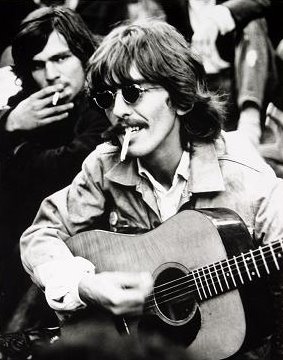
TUESDAY AUGUST 1 - Today we flew from London to Los Angeles by polarflight jet. We were George and Pattie, our electronic genius-type mate called Magic Alex and yours truly. The Harrisons travelled as "Mr. and Mrs. Weiss" -- which happened to be the name of the man who was going to meet us and look after us in California. I mean Nat Weiss, who manages The Cyrkle and directs the corporation known as Nemperor Artists in New York. First problem on arrival was the lack of one vital Aspinall suitcase, left 6,000 miles behind us in London. You gain time when you fly from Britain to America. We'd set off at lunchtime but it was only early afternoon in Los Angeles when we drove from the airport to the private house we had rented for the week.
HILL HOUSE
It was a smallish, very beautiful, compact place with a little, round swimming pool up in the hills of Hollywood in a street called Blue Jay Way. Don't they have picturesque names? The house belonged to a lawyer who was vacationing in Hawaii. The long flight had left everybody a bit tired but Pattie stayed up long enough to call her sister, Jenny, who was staying in San Francisco just up the West Coast a bit, and she said she'd fly down to join us. And George phoned our good friend Derek Taylor who started writing down the complicated instructions for getting from his place to ours.
NEW SONG
The Telephone conversation with Derek provided George with the inspiration to write a song called "Blue Jay Way", he sat there working it out on a mini-organ while he waited for Derek. You'll be hearing "Blue Jay Way" in the "Magical Mystery Tour" TV show if not before.
Wednesday August 2 - Slept late, then I did a bit of shopping, then we all went over to Ravi Shankar's Music School. Sat and watched Ravi teaching this huge class of about 50 people--very mixed crowd with people between the ages of about 16 and 30, all keen students of Indian music. Ravi's tabla drummer Alla Rahka gave a lesson which we watched for a bit before going out with Ravi to have a meal on Sunset Strip.
Thursday August 3 - Early in the morning--well, about eleven you know--George went over to the School with Alex and myself while Pattie and Jenny went sightseeing. Tomorrow night Ravi has his concert at the Hollywood Bowl so this morning he gave a press conference. All the local radio and press people knew George was about and, of course, they swooped on him with all sorts of questions ("What do you think of LSD?"..."Where are you staying, George?") during the conference. In the afternoon George and I went to a shop called Sidereal Time. There and elsewhere we picked up a load of shirts and things plus some moccasin-type boots and groovy posters. In the evening we heard Ravi give a lecture on the history of Indian music and then went over to a Mamas and Papas recording session with Derek Taylor.
NEW GUITAR
One of the session men there had this fantastic new guitar--a first prototype and something quite special. I daren't tell you what's so special about it because I've just arranged to have a couple of them made (one will be a bass guitar version) for the Beatles and it's all supposed to be very secret! Anyway it was now the middle of the night but George couldn't resist having a go on this sshh-you-don't know-what guitar.
Friday August 4 - Tonight at nine o'clock Ravi's 4-hour concert began at the Bowl. With him were a lot of his finest students, a marvellous night of music. First we watched Bismillah Khan and party with Bismillah playing an Indian flute called a shehnai. Whatever he played the rest of the party--students--would try to follow until his music got so advanced that they had to leave it to him! Then came a South Indian drummer playing an instrument known as a mridangam, a sort of old classical drum, which you bang at both ends. Then came Ali Akbar Khan and his son Ashish playing modern little drums they call sarods, each almost "talking" to the other via his drum. Finally, before Ravi himself, came the tabla player and teacher Alla Rahka, Ravi's own drummer, who stayed on stage to accompany Ravi's sitar for the final hour of the programme. I hope I've got all my spellings O.K.--I checked them all over with George when I was writing up this diary, but don't blame him if there are any mistakes because my own handwriting isn't that easy to read back!
Saturday August 5 - This morning we all went along to some recording studios opposite Ravi's school to watch Alla Rahka and a South Indian drummer recording a duet to fill one whole side of an LP disc. A South Indian singer--using his voice just like an instrument--is doing the whole of the second side of the LP. Which reminds me that George has been very pleased to accept an invitaiton to write the sleeve notes for another Indian LP which is being recorded here this week. By Ali Akbar Khans' son Ashish. Later in the day we saw Derek, his wife and his great bunch of kids. Went with them all to the downtown area of Los Angeles to visit Alvera Street, a very historic place. It's been preserved as a tourist attraction--complete with some of California's very earliest brick-built houses. Bands were playing and there were lots of little stalls selling souvenirs made in Hong Kong! We had a Mexican meal in one of the funny little restaurants in Alvera Street and bought a batch of wonderful Mexican pictures, paintings done on velvet. Mine shows a mournful old clown with a battered old hat holding a big flower and pulling the petals off one by one! They were very cheap--just a few dollars each--and yet very large. We also bought a matador one with a big green bull on it. George left Alex and myself buying colourful waistcoasts while he trotted over to Ravi's place to collect a sitar he was buying.
Sunday August 7 - George went off early on his own to see Ashish and talk about the LP sleeve notes and everything. So later on when the rest of us set off for Disneyland, George stayed behind. We didn't stay at Disneyland all that long but it's a fantastic place. We visited "Tomorrowland", "Fantasyland" and a bit of "Frontierland". I got into this telephone booth where you can phone up all the famous Disney cartoon characters. I phoned Pluto but a voice said "Sorry he's busy. This is Goofy,"!! In the evening we all went over to Ravi's house.
Monday August 8 - Today we went up to San Francisco and walked around Haight-Ashbury. Derek came with us. It got a bit bad after a time. There was this ridiculous procession of people following George as if he was the New Pied Piper. But he didn't lead them to the river. Anyway it was a good day, a good scene to see with things we were glad about and things we were sorry about (such as those beggars sitting in the street conning money out of tourists) and it was the first time we'd really looked at San Francisco as a place although we'd been before for Beatles concerts.
Tuesday August 9 - Packing and getting ready for tonight's flight home. Four little fans called at the house but they were O.K. and there wasn't any trouble and George enjoyed seeing them. Oh yes, I forgot to tell you--my case DID arrive from London so I HAVEN'T been wandering round for the last 8 days in the same sticky clothing!!!!
Visit California Today: Book flight + hotel together and save!
Subscribe to:
Comments (Atom)

 Posts
Posts


