
by Pete Shotton
Perhaps the most memorable evening I ever spent with John Lennon began routinely enough in the recording studio at the far end of his attic. We shared a piece of LSD, smoked a few joints, and idly amused ourselves with John's network of Brunell tape recorders.
Since John had recently become infatuated with the work of Karlheinz Stockhausen, one of our favorite pastimes at that particular juncture - May 1968 - was to improvise "music concrete" by fiddling about with feedback, running our recordings backwards, and constructing tape loops. This time we opened the windows to the spring air, and were shouting out whatever came into our heads at the uncomprehending trees while the tapes rolled in the room behind us. I, for one, had no inkling that this particular evening's lark was destined to be captured for posterity on the Beatles' "White Album," as part of "Revolution 9."
In due course we tired of "messing about with the tapes," and ended up sitting cross-legged on the floor. (Cyn, by the way, was off on holiday in Greece with Magic Alex.) Our conversation grew increasingly hushed and serious as John spoke of his disillusionment with the Maharishi, and with everyone else to whom he had ever looked for guidance. Then he lapsed into a long silence, leaving me to stare absent-mindedly at the wall, at a picture of Brigitte Bardot, thinking about the things I wouldn't have minded doing to her, flashing back to the way John and I used to talk about Brigitte when we were just kids.
Suddenly John began waving his arms in the air, making slow, swirling motions with his outstretched hands. And out of the blue he announced, in an awed whisper: "Pete, I think I'm Jesus Christ."
"What was that again, John?"
"Yeah," he said, and I could see he was dead serious. "I think I'm Jesus Christ. I'm . . . back again."
Accustomed as I was to the utter unpredictability of John Lennon, this was the one revelation I could never have anticipated. But, I said to myself, who am I to judge: even Jesus Christ had to decide he was Jesus Christ at some point. "Well, then," I finally ventured, "what are you gonna do about it?"
"I've got to tell everyone," he said, "I've got to let the world know . . . who I am."
"They'll fucking kill you," I said. "They won't accept that, John."
"That can't be hlped," he said firmly. "How old was Jesus when they killed him?"
"I'm not sure," I said. "I reckon he was about thirty-two."
Conquering his lifelong aversion to math, John paused a moment to make a simple calculation with his fingers. "Hell," he said, "at least I've got about four years."
"Well," I said. "What's brought all this on, then?"
"I just think this is it. This is my reason for being here on this earth." It was almost dawn, and John was growing increasingly agitated. I still felt at a total loss about what to make of John's latest vagary.
"Don't you think being John Lennon is enough?"
"Why?"
"You could do as much being John Lennon as being Jesus Christ. And look at all the trouble religion's caused. As John Lennon, you've been able to bring together people from all over the world, regardless of their religion, race, or creed."
But John was adamant, absolutely convinced he was Jesus. "First thing tomorrow," he concluded, "we'll go into Apple and tell the others."
The next thing we were aware of was the footsteps of Dot the housekeeper, who had just come in for the day. Somehow John and I had both managed to fall asleep in a heap on the floor, and opened our eyes as one to catch Dot gazing back at us.
Startled into wakefulness, John bounded to his feet. "Oh Christ," he said. "She'll think that we're fucking each other."
"Why on earth," I said groggily, "would she think something like that? We've got our clothes on, for a start."
Far from forgetting the previous night's metamorphosis, John quickly got down to business. The so-called inner circle - comprising the Beatles, Derek Taylor, Neil Aspinall, and myself - was summoned to a secret board meeting at Apple. All took their places in a state of keen suspence over the reason for this urgent conclave.
"Right," John began from behind his desk, "I've something very important to tell you all. I am . . . Jesus Christ come back again. This is my thing."
Paul, George, Ringo, and their closest aides stared back, stunned. I found the scene utterly surreal, and was half-laughing inwardly, thinking to myself with real affection, "What the fucking hell is he going to get up to next?" That was really the magic of the man - you never knew.
Even after regaining their powers of speech, nobody presumed to cross-examine John Lennon, or to make light of his announcement. On the other hand, no specific plans were made for the new Messiah, as all agreed that they would need some time to ponder John's announcement, and to decide upon appropriate further steps. The meeting was quickly adjourned, as it was also unanimously agreed that we should all have a drink and a bite to eat.
At the restaurant, while we were waiting for a table, an affable older fellow recognized John and said: "Really nice to meet you. How are you?"
"Actually," John replied, as sincere as I'd ever seen him, "I'm Jesus Christ."
"Oh, really," said the man blandly. "Well, I loved your last record. Thought it was great."
Saturday, June 10, 2006

Tuesday, June 06, 2006
Interview: Derek Taylor - 1995
Bob Hieronimus: About eight years ago, in 1987, when the 20th anniversaries of Sgt. Pepper and the Summer of Love were being celebrated on Baltimore TV, I was part of a panel that included Derek Taylor, author of "It Was Twenty Years Ago Today," and certainly Derek was the most knowledgeable soul before the cameras, but to my dismay, he was being ignored by the talk-show host. I wasn't amused. But, Derek...
Derek Taylor: The more I'm ignored, the better.
BH: I wasn't amused. But Derek appeared unconcerned, just as you said. Imagine, coming three thousand miles to relate his unparalleled experience with the pop and rock scene in the '60's and not being pursued by the host, and yet, that's my image of Baltimore's media, and that's one reason why Zoh and I decided to launch 21st Century Radio, the very next year.
From 1963 to December 31st, 1966, when he decided to live up to his New Year's resolution and drop out, Derek Taylor served as Beatles' press officer. Coming out of retirement a few months later, he co-founded the legendary Monterey Pop Festival. Today, Derek still serves as press officer for Apple and I'm still searching for a copy of his, "Fifty Years Adrift," a deluxe autobiography of his life with the Beatles. It took me only eleven years, eleven years to locate a copy of one of his other books, "As Time Goes By," but, it kept me smiling for months. Welcome to 21st Century Radio's Hieronimus & Co. Derek.
DT: Thank you Bob.
BH: Well, during the mid- to late-60's, consciousness was focused on the attempt to end all wars, and in particular, those in southeast Asia, fortunately, the musicians from that era worked nearly unanimously towards world peace. Would you evaluate consciousness in the 90's compared to that of thirty years ago?
DT: Consciousness in the '90's seems to directed largely to people doing the very best they can for themselves. Lining their own pockets, paying hardly any tax, and generally being selfish. But there are, of course vast exceptions to that rule. These are not the '60's or the '70's. Students now are not students then. And there has been, I think, quite a move towards selfishness. We've begun with a drift towards the "Me Generation." And this is not unusual, most people have been like this for most of history I believe. We did have a window though then, when we believed that the world would be a much, much nicer place.
BH: We certainly did. I thought it was going to last a lot longer than it did Derek.
DT: Well, it just shows how starry-eyed and foolish we were. However,
I'm not a cynic.
BH: Well, neither am I, but still you've got to...
DT: Nor, indeed, a pessimist.
BH: But, you've got to face what's coming up here. Now, perhaps one of the most misunderstood aspects of the '60's, was the use of natural herbs and products to elevate consciousness. The use of marijuana and mescaline, in my opinion, did wonders to open up the consciousness of millions of souls to gain a greater grasp of what it is to be a human.
Today, these natural plants are outlawed, and in the United States, those that are caught with a joint could not only be sent to prison for decades, but lose all, all of their personal possessions as well. What's the difference in how natural drugs were used 30 years ago, and how they are used today, and why do you believe the established powers would prevent the personal use of marijuana and mescaline, when the United States Government for one, has used the sale of drugs, heroine and cocaine, to fund its secret wars in southeast Asia and central America and elsewhere? That was a long question for you, Derek.
DT: It is a long question. The answer is, I don't know. I don't know to what extent there's evidence of the latter part of your question-statement. I'm not sure about that, that's something you may have more information on. As to why cannabis is still illegal, I just don't know. Even in England, where we have less oppressive laws, there's still a very negative climate against it, and the Labor party, of which I'm a member, it's official policy is to, that it should remain illegal, though it is a class two drug, and possession is punished very lightly. And even the growing thereof, which is not widespread, not to the same extent that it is per se in Hawaii or northern California, again, is not punished too brutally.
There are moves now, including an increased fine, the fine's gone up from 500 to 2,500 to collaborate a bit more. Because it's a very popular, it's a very popular law, the law against cannabis. More people believe in a law against cannabis, than believe it should be decriminalized. So, until politicians can see that there's a huge ground swell of popular opinion against it, ... there is, and the rationality is, of course because alcohol and tobacco are not only legal, but advertised, in some ways encouraged and heavily taxed and people profit thereby in all manner of ways.
There's always been paradox and ambivalence, ambiguity, hypocrisy and all that in administrative decisions. I don't personally understand it. And a lot of people now have given up on the decriminalization of cannabis and their making their own personal decisions without the same, certainly in England, without the same courage that they were in the very early '60's, when people were quite severely punished. Now, I know things are different in America, and I know that there are some draconian laws there.
BH: We sure have them here. But, again, the use of marijuana and mescaline were used much differently back in the '60's than they are in the '90's.
DT: It very well may be for all I know.
BH: Well, perhaps it has something to do with the emphasis that came later in the '70's and '80's of "me first" kind of stuff. People kind of maybe looked at themselves and said, "You know, I don't particularly like myself."
DT: Well, we have to... The constant battle is the ugly against the beautiful. And the ugly part of it is that which seeks to line our pockets and adorn ourselves and our lives with our own possessions, to the exclusion of our fellow man. It's always been the same, that's why we have to have some kind of a belief in a higher power or attempt to manifest some kind of divinity within ourselves or at least try to be decent human beings. And it's tough because selfishness is such a raging instinct.
BH: Indeed.
DT: Isn't it?
BH: It sure is. It's unbearable here in this country.
DT: Why, in all of us, in all of us. "I need this," and "I need that," "I got to have this," "I've got to have a vacation." "I've got to have a raise." And not sort of necessarily going up to somebody you know and saying "You better have a raise," "You better have a vacation." It's, I'm afraid, to me, the first thing is raise. Anyway...
BH: Well, let's get to the...
DT: Let's get to nut of the matter, whatever it is. And the nut of the matter is why are we here? How did we get here and where are we going?
BH: Well, we're going to find that out in a second. Now, we hear time and again that the youth of the United States and elsewhere feel that they can do nothing to stop the oncoming world fascism of the New World Order. What would you say to them, is it possible at this time to offer hope to the younger people?
DT: Oh we have to, yes. The hope has to come from the younger people. But, of course, terrible things are happening every day. We lost, I believe, a very great statesman in Rabin, yesterday. I was greatly knocked back by that. I'm not Jewish, but I think he was a changed man, cause he was a man of war, turned to a man of peace.
And these are the, there is always some kind of awful public world discouragement, if you like, some decent human being gets bumped off. And others who seem to thrive and live on into old age doing more and more harm. But anyway, my idea is that the young must, in their immediate lives, this is really the best that you can hope for I think, and with so much power in so few hands, of world global power, the young have to attend to their own immediate, domestic situation. And really try hard to be pleasant, even in just small day to day things. It's very difficult taking on global concerns if you, actually are behaving quite selfishly or badly in your own immediate environment.
BH: Good point.
DT: We have got enormous power within, each of us, within ourselves there's enormous power. See, but we only have our own power and the power we can derive from some kind of spiritual values, in the long run. I was looking at the paper on the way to work, and seeing so many things that I could, you know there's a saying, "I feel a letter coming on." If you could write to so and so about.... No matter how many letters you'd write, in fact the more letters you write, the more insane you'd need to be. Particularly if you use green ink.
BH: You like to use green ink, huh?
DT: We do have the power, I mean, I can come in here in some kind of raging panic, cause there's so much work going on, but if I can be reasonably pleasant to the people around me, at least I can make their day a little bit better. I hate to be so pious, but we can do it here right now. And of course the big thing to realize, I think, when all is said and done, is we have to be here now. There's not a lot we can do about tomorrow, there's nothing we can do about yesterday, but we can make the immediate moment a good deal better than it already is, I believe by an active role. Be here now.
BH: Well, Baba Ram Dass wasn't too far off from that perspective. Now according to numerous humanistic and Transpersonal psychologists like, Dr. Roland May, Dr. Abraham Maslow, Joseph Campbell, etc., the foundation of a social ills, is a lack of meaning in one's personal life, which was usually supported by civilization's myths and symbols. They refer to symbols and myths as the glue holding society together, and like it or not, the Beatles' Yellow Submarine movie is such a symbol and a mythological system that has inspired millions of souls to greater hope. Why do you believe it proved to be so successful, even though the input by the Beatles was minimal, at best?
DT: Well, the input of the Beatles was conceptual and there was this zeitgeist around, which they represented, which was extremely warmly disposed to the human race and to the mode of goodness. And of course, the songs, and the central song, is "All You Need Is Love." The theme, the title song, we know about, and the overall message of that is that "We All Live in a Yellow Submarine," and all our friends are all aboard, and there's no limit to the number of friends we can have aboard.
It's really like a kind of ark, where, at least that's how I saw it, a Yellow Submarine is a symbol for some kind of vessel which would take us all to safety, but, be that as it may, the message in that thing is that good can prevail over evil, which is quite an old one. And there's enormous hope and reassurance and color and vitality in the movie. And a right clear delineation between the naughty people and the nice people, Blue Meanies and our heroes, and the charming old man and in the end, it ends on a very high note. It makes people feel extremely good and full of energy.
BH: Do you remember the first time you saw, because you weren't with the Beatles at that time, were you?
DT: I was, yes, it was '68. I was there in '68, in that summer, I went to the premiere, I think it was July of '68, I rejoined them in April that year.
BH: Oh, I see.
DT: So, I do remember, and I remember thinking it was a terrific film, and of course it was quite coolly received over here by the public, the masses and the critics. It was very warmly received in the United States.
BH: How was it received by the Beatles?
DT: Well, they like it, and there was a hippie, psychedelic epic in Yellow Submarine, which may have seen by mid-'68 to be somewhat passe', however, it's acknowledged now by the band, as far as I know to have been a worthy effort. Ringo certainly liked it very much in a recent interview I read.
BH: Well, he did a series of interviews, no, no, radio programs in America called the Yellow Submarine.
DT: Did he?
BH: Are you familiar with that?
DT: No, I'm not.
BH: Well, ...
DT: At the time, when it came out, of course, things were, all kinds of things were happening around Apple. It was getting extremely busy, I had taken on too much, and to endeavor to enable people to get recording contracts and bring in paintings. We'll help you to get your paintings hung, we'll get your books and poems published, we'll get music recorded and all the promises that were made, which we were trying to fulfill, by the summer of '68, when the Yellow Submarine came out, there were great strains and stresses around the Beatles and Apple.
So it was difficult to concentrate on Yellow Submarine then, for me too. It came and went, I have to say, as it might not have done had it been at quieter times. It was a time of, an awful lot of office stress. And stress in offices can be quite extreme. Because working hours and the number of calls coming in, and the number of callers in the Apple building, so it was not a propitious time for a movie to be around. It was not as if all their efforts had gone into making it. And most people, when they're making a movie, or contributing to a movie, that is all they're doing. It absorbs all their time, they can think of nothing else, they can see nothing else.
But Yellow Submarine, in a sense is coming along, moving along past them, on a parallel track way away, with Brodax and all those people who were putting it together. So I say it suffered, in our internal world, it suffered from a lack of attention, our response to it suffered from inattention to it. Because the thing was happening anyway, the songs had been provided, the essence of the Beatles was undoubtedly conveyed in that they meant well, they were cheerful and all this, but I think that also perhaps, they felt, it certainly has been said since, that there was a lack of delineation between the individual characteristics. But this was an animated feature, and it was a wonderful piece of work and it looks great today.
BH: It sure does.
DT: And it will live forever, there's no doubt, Yellow Submarine is a real piece of goods and here we have it, hey!
BH: Well, the planet is standing by for the Beatles anthology to be aired next week on ABC TV in America, locally here on WMAR TV, channel 2, now we're especially looking forward to hearing the first new Beatles recordings in 25 years, such as Free As A Bird, and Real Love, what can you tell us about how these songs were discovered, and how the Beatles were reunited technologically?
DT: Yes, well I'll tell you what I know. I didn't go to the sessions because as a rule I've tended not to go to recording sessions because there's nothing much to do for people who aren't recording. So, what happened was, I believe, that from what I read in the transcripts for the anthology, from which the interviews were taken, the ones you see on the street, that there was a feeling around 1993 that they should do incidental music. The linking music for sections of the anthology. And a few of them considered this at some length, and there's no doubt that when they do get together that they can pick up instruments and get to it right away. All of that remains, all of that relationship and many other aspects of the relationship have been renewed very well.
But, the one element missing was that John was no longer around. So, there could not be Beatles' music in his absence. So, somewhere around 1993, towards the end, I could see this coming through on the transcripts as I had been looking through them and editing them. There's no mention of a single in the interviews, but there is a mention of "We may do incidental music." Now I know that somewhere towards the end of 1993, sometime anyway, John's demos were offered to them. And I'm not sure that Paul wasn't the one who had collected them from Yoko.
At any rate, she offered two John and piano tracts, two at least, maybe more. There is talk of it, but there hasn't been, nothing's been done to a third. And they went to the studio and, well they heard them. They went to a studio in the south of England, in Paul's studio with Jeff Lynn and considered how best to do these things. John was at the piano, and they were in the studio with their instruments and their old Beatles feelings.
Now, there were four, albeit John only on tape. And one way or another, this is very vague, I wasn't there, I only know what I've read, they stripped out John's voice, and did what they assumed what he would have wanted them to do had he been going on holiday leaving them with this cassette. And it had been said, "Well, I'm off now, finish this thing off, it's a nice tune and nice words and I trust you to do what you think would be best for it." And that's what they did, they put their voices in there, extra words were written and they put their instrumentation on it and made a nice song of it. And it's truly a great Beatle record of today.
Difficult for them to define it, but it seems to be best defined by George by saying, "Well, you know, as it's made in 1995, it sounds like now, but of course, it's the first record we've done since Abbey Road, so it has some of that feeling too." And I think he mentions the song Because, there's a very great deal of heart and soul and emotion in it. It will be a truly great Beatles record, and of course it will be Number One too.
Real Love, which I've also heard, is a fine piece of goods as well. But there was less to do to that I believe. I have a feeling the words were complete of Real Love. I think that's on one of the nights of the Anthology in America, that will also be on television. They don't feature in the main body of the Anthology, they will have their own videos accompany them, and they will come on I think at the end of one of the segments. Legitimate Beatle records, oh, they would never have been allowed to escape the studio, if there weren't proper representation of these four people. And with their essence and being and the kind of whatever, ethic they're in.
"They interviewed us, Neil and me and George Martin a bit. And I started to take phone calls from the production office, whom I know, I've known some of those people there for years, and got very friendly with them. And then the press thing started to build up, inquiries started to come in, and articles needed to be written and fixed and so on. So I've been really working a seven-day week for about three months, under enormous pressure and it's very familiar. It has happened again. There's no doubt, that these people are beyond compare in the amount of interest they attract."
Derek Taylor: The more I'm ignored, the better.
BH: I wasn't amused. But Derek appeared unconcerned, just as you said. Imagine, coming three thousand miles to relate his unparalleled experience with the pop and rock scene in the '60's and not being pursued by the host, and yet, that's my image of Baltimore's media, and that's one reason why Zoh and I decided to launch 21st Century Radio, the very next year.
From 1963 to December 31st, 1966, when he decided to live up to his New Year's resolution and drop out, Derek Taylor served as Beatles' press officer. Coming out of retirement a few months later, he co-founded the legendary Monterey Pop Festival. Today, Derek still serves as press officer for Apple and I'm still searching for a copy of his, "Fifty Years Adrift," a deluxe autobiography of his life with the Beatles. It took me only eleven years, eleven years to locate a copy of one of his other books, "As Time Goes By," but, it kept me smiling for months. Welcome to 21st Century Radio's Hieronimus & Co. Derek.
DT: Thank you Bob.
BH: Well, during the mid- to late-60's, consciousness was focused on the attempt to end all wars, and in particular, those in southeast Asia, fortunately, the musicians from that era worked nearly unanimously towards world peace. Would you evaluate consciousness in the 90's compared to that of thirty years ago?
DT: Consciousness in the '90's seems to directed largely to people doing the very best they can for themselves. Lining their own pockets, paying hardly any tax, and generally being selfish. But there are, of course vast exceptions to that rule. These are not the '60's or the '70's. Students now are not students then. And there has been, I think, quite a move towards selfishness. We've begun with a drift towards the "Me Generation." And this is not unusual, most people have been like this for most of history I believe. We did have a window though then, when we believed that the world would be a much, much nicer place.
BH: We certainly did. I thought it was going to last a lot longer than it did Derek.
DT: Well, it just shows how starry-eyed and foolish we were. However,
I'm not a cynic.
BH: Well, neither am I, but still you've got to...
DT: Nor, indeed, a pessimist.
BH: But, you've got to face what's coming up here. Now, perhaps one of the most misunderstood aspects of the '60's, was the use of natural herbs and products to elevate consciousness. The use of marijuana and mescaline, in my opinion, did wonders to open up the consciousness of millions of souls to gain a greater grasp of what it is to be a human.
Today, these natural plants are outlawed, and in the United States, those that are caught with a joint could not only be sent to prison for decades, but lose all, all of their personal possessions as well. What's the difference in how natural drugs were used 30 years ago, and how they are used today, and why do you believe the established powers would prevent the personal use of marijuana and mescaline, when the United States Government for one, has used the sale of drugs, heroine and cocaine, to fund its secret wars in southeast Asia and central America and elsewhere? That was a long question for you, Derek.
DT: It is a long question. The answer is, I don't know. I don't know to what extent there's evidence of the latter part of your question-statement. I'm not sure about that, that's something you may have more information on. As to why cannabis is still illegal, I just don't know. Even in England, where we have less oppressive laws, there's still a very negative climate against it, and the Labor party, of which I'm a member, it's official policy is to, that it should remain illegal, though it is a class two drug, and possession is punished very lightly. And even the growing thereof, which is not widespread, not to the same extent that it is per se in Hawaii or northern California, again, is not punished too brutally.
There are moves now, including an increased fine, the fine's gone up from 500 to 2,500 to collaborate a bit more. Because it's a very popular, it's a very popular law, the law against cannabis. More people believe in a law against cannabis, than believe it should be decriminalized. So, until politicians can see that there's a huge ground swell of popular opinion against it, ... there is, and the rationality is, of course because alcohol and tobacco are not only legal, but advertised, in some ways encouraged and heavily taxed and people profit thereby in all manner of ways.
There's always been paradox and ambivalence, ambiguity, hypocrisy and all that in administrative decisions. I don't personally understand it. And a lot of people now have given up on the decriminalization of cannabis and their making their own personal decisions without the same, certainly in England, without the same courage that they were in the very early '60's, when people were quite severely punished. Now, I know things are different in America, and I know that there are some draconian laws there.
BH: We sure have them here. But, again, the use of marijuana and mescaline were used much differently back in the '60's than they are in the '90's.
DT: It very well may be for all I know.
BH: Well, perhaps it has something to do with the emphasis that came later in the '70's and '80's of "me first" kind of stuff. People kind of maybe looked at themselves and said, "You know, I don't particularly like myself."
DT: Well, we have to... The constant battle is the ugly against the beautiful. And the ugly part of it is that which seeks to line our pockets and adorn ourselves and our lives with our own possessions, to the exclusion of our fellow man. It's always been the same, that's why we have to have some kind of a belief in a higher power or attempt to manifest some kind of divinity within ourselves or at least try to be decent human beings. And it's tough because selfishness is such a raging instinct.
BH: Indeed.
DT: Isn't it?
BH: It sure is. It's unbearable here in this country.
DT: Why, in all of us, in all of us. "I need this," and "I need that," "I got to have this," "I've got to have a vacation." "I've got to have a raise." And not sort of necessarily going up to somebody you know and saying "You better have a raise," "You better have a vacation." It's, I'm afraid, to me, the first thing is raise. Anyway...
BH: Well, let's get to the...
DT: Let's get to nut of the matter, whatever it is. And the nut of the matter is why are we here? How did we get here and where are we going?
BH: Well, we're going to find that out in a second. Now, we hear time and again that the youth of the United States and elsewhere feel that they can do nothing to stop the oncoming world fascism of the New World Order. What would you say to them, is it possible at this time to offer hope to the younger people?
DT: Oh we have to, yes. The hope has to come from the younger people. But, of course, terrible things are happening every day. We lost, I believe, a very great statesman in Rabin, yesterday. I was greatly knocked back by that. I'm not Jewish, but I think he was a changed man, cause he was a man of war, turned to a man of peace.
And these are the, there is always some kind of awful public world discouragement, if you like, some decent human being gets bumped off. And others who seem to thrive and live on into old age doing more and more harm. But anyway, my idea is that the young must, in their immediate lives, this is really the best that you can hope for I think, and with so much power in so few hands, of world global power, the young have to attend to their own immediate, domestic situation. And really try hard to be pleasant, even in just small day to day things. It's very difficult taking on global concerns if you, actually are behaving quite selfishly or badly in your own immediate environment.
BH: Good point.
DT: We have got enormous power within, each of us, within ourselves there's enormous power. See, but we only have our own power and the power we can derive from some kind of spiritual values, in the long run. I was looking at the paper on the way to work, and seeing so many things that I could, you know there's a saying, "I feel a letter coming on." If you could write to so and so about.... No matter how many letters you'd write, in fact the more letters you write, the more insane you'd need to be. Particularly if you use green ink.
BH: You like to use green ink, huh?
DT: We do have the power, I mean, I can come in here in some kind of raging panic, cause there's so much work going on, but if I can be reasonably pleasant to the people around me, at least I can make their day a little bit better. I hate to be so pious, but we can do it here right now. And of course the big thing to realize, I think, when all is said and done, is we have to be here now. There's not a lot we can do about tomorrow, there's nothing we can do about yesterday, but we can make the immediate moment a good deal better than it already is, I believe by an active role. Be here now.
BH: Well, Baba Ram Dass wasn't too far off from that perspective. Now according to numerous humanistic and Transpersonal psychologists like, Dr. Roland May, Dr. Abraham Maslow, Joseph Campbell, etc., the foundation of a social ills, is a lack of meaning in one's personal life, which was usually supported by civilization's myths and symbols. They refer to symbols and myths as the glue holding society together, and like it or not, the Beatles' Yellow Submarine movie is such a symbol and a mythological system that has inspired millions of souls to greater hope. Why do you believe it proved to be so successful, even though the input by the Beatles was minimal, at best?
DT: Well, the input of the Beatles was conceptual and there was this zeitgeist around, which they represented, which was extremely warmly disposed to the human race and to the mode of goodness. And of course, the songs, and the central song, is "All You Need Is Love." The theme, the title song, we know about, and the overall message of that is that "We All Live in a Yellow Submarine," and all our friends are all aboard, and there's no limit to the number of friends we can have aboard.
It's really like a kind of ark, where, at least that's how I saw it, a Yellow Submarine is a symbol for some kind of vessel which would take us all to safety, but, be that as it may, the message in that thing is that good can prevail over evil, which is quite an old one. And there's enormous hope and reassurance and color and vitality in the movie. And a right clear delineation between the naughty people and the nice people, Blue Meanies and our heroes, and the charming old man and in the end, it ends on a very high note. It makes people feel extremely good and full of energy.
BH: Do you remember the first time you saw, because you weren't with the Beatles at that time, were you?
DT: I was, yes, it was '68. I was there in '68, in that summer, I went to the premiere, I think it was July of '68, I rejoined them in April that year.
BH: Oh, I see.
DT: So, I do remember, and I remember thinking it was a terrific film, and of course it was quite coolly received over here by the public, the masses and the critics. It was very warmly received in the United States.
BH: How was it received by the Beatles?
DT: Well, they like it, and there was a hippie, psychedelic epic in Yellow Submarine, which may have seen by mid-'68 to be somewhat passe', however, it's acknowledged now by the band, as far as I know to have been a worthy effort. Ringo certainly liked it very much in a recent interview I read.
BH: Well, he did a series of interviews, no, no, radio programs in America called the Yellow Submarine.
DT: Did he?
BH: Are you familiar with that?
DT: No, I'm not.
BH: Well, ...
DT: At the time, when it came out, of course, things were, all kinds of things were happening around Apple. It was getting extremely busy, I had taken on too much, and to endeavor to enable people to get recording contracts and bring in paintings. We'll help you to get your paintings hung, we'll get your books and poems published, we'll get music recorded and all the promises that were made, which we were trying to fulfill, by the summer of '68, when the Yellow Submarine came out, there were great strains and stresses around the Beatles and Apple.
So it was difficult to concentrate on Yellow Submarine then, for me too. It came and went, I have to say, as it might not have done had it been at quieter times. It was a time of, an awful lot of office stress. And stress in offices can be quite extreme. Because working hours and the number of calls coming in, and the number of callers in the Apple building, so it was not a propitious time for a movie to be around. It was not as if all their efforts had gone into making it. And most people, when they're making a movie, or contributing to a movie, that is all they're doing. It absorbs all their time, they can think of nothing else, they can see nothing else.
But Yellow Submarine, in a sense is coming along, moving along past them, on a parallel track way away, with Brodax and all those people who were putting it together. So I say it suffered, in our internal world, it suffered from a lack of attention, our response to it suffered from inattention to it. Because the thing was happening anyway, the songs had been provided, the essence of the Beatles was undoubtedly conveyed in that they meant well, they were cheerful and all this, but I think that also perhaps, they felt, it certainly has been said since, that there was a lack of delineation between the individual characteristics. But this was an animated feature, and it was a wonderful piece of work and it looks great today.
BH: It sure does.
DT: And it will live forever, there's no doubt, Yellow Submarine is a real piece of goods and here we have it, hey!
BH: Well, the planet is standing by for the Beatles anthology to be aired next week on ABC TV in America, locally here on WMAR TV, channel 2, now we're especially looking forward to hearing the first new Beatles recordings in 25 years, such as Free As A Bird, and Real Love, what can you tell us about how these songs were discovered, and how the Beatles were reunited technologically?
DT: Yes, well I'll tell you what I know. I didn't go to the sessions because as a rule I've tended not to go to recording sessions because there's nothing much to do for people who aren't recording. So, what happened was, I believe, that from what I read in the transcripts for the anthology, from which the interviews were taken, the ones you see on the street, that there was a feeling around 1993 that they should do incidental music. The linking music for sections of the anthology. And a few of them considered this at some length, and there's no doubt that when they do get together that they can pick up instruments and get to it right away. All of that remains, all of that relationship and many other aspects of the relationship have been renewed very well.
But, the one element missing was that John was no longer around. So, there could not be Beatles' music in his absence. So, somewhere around 1993, towards the end, I could see this coming through on the transcripts as I had been looking through them and editing them. There's no mention of a single in the interviews, but there is a mention of "We may do incidental music." Now I know that somewhere towards the end of 1993, sometime anyway, John's demos were offered to them. And I'm not sure that Paul wasn't the one who had collected them from Yoko.
At any rate, she offered two John and piano tracts, two at least, maybe more. There is talk of it, but there hasn't been, nothing's been done to a third. And they went to the studio and, well they heard them. They went to a studio in the south of England, in Paul's studio with Jeff Lynn and considered how best to do these things. John was at the piano, and they were in the studio with their instruments and their old Beatles feelings.
Now, there were four, albeit John only on tape. And one way or another, this is very vague, I wasn't there, I only know what I've read, they stripped out John's voice, and did what they assumed what he would have wanted them to do had he been going on holiday leaving them with this cassette. And it had been said, "Well, I'm off now, finish this thing off, it's a nice tune and nice words and I trust you to do what you think would be best for it." And that's what they did, they put their voices in there, extra words were written and they put their instrumentation on it and made a nice song of it. And it's truly a great Beatle record of today.
Difficult for them to define it, but it seems to be best defined by George by saying, "Well, you know, as it's made in 1995, it sounds like now, but of course, it's the first record we've done since Abbey Road, so it has some of that feeling too." And I think he mentions the song Because, there's a very great deal of heart and soul and emotion in it. It will be a truly great Beatles record, and of course it will be Number One too.
Real Love, which I've also heard, is a fine piece of goods as well. But there was less to do to that I believe. I have a feeling the words were complete of Real Love. I think that's on one of the nights of the Anthology in America, that will also be on television. They don't feature in the main body of the Anthology, they will have their own videos accompany them, and they will come on I think at the end of one of the segments. Legitimate Beatle records, oh, they would never have been allowed to escape the studio, if there weren't proper representation of these four people. And with their essence and being and the kind of whatever, ethic they're in.
"They interviewed us, Neil and me and George Martin a bit. And I started to take phone calls from the production office, whom I know, I've known some of those people there for years, and got very friendly with them. And then the press thing started to build up, inquiries started to come in, and articles needed to be written and fixed and so on. So I've been really working a seven-day week for about three months, under enormous pressure and it's very familiar. It has happened again. There's no doubt, that these people are beyond compare in the amount of interest they attract."
Sunday, June 04, 2006
Interview: Aunt Mimi Smith, Bournemouth - 1970
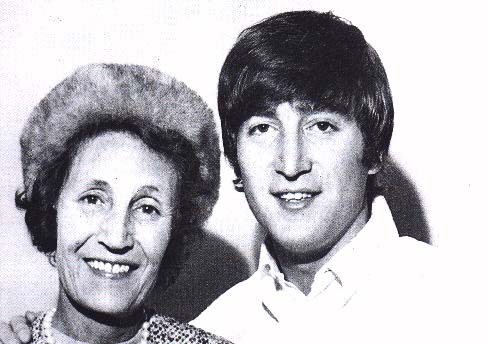 Q: What do you really think of the Beatles?
Mimi Smith: The boys had talent, yes, but they also had a lot of luck as well. When they first played "Love Me Do" I didn't think much of it.
Q: How did you view the troubles the Beatles have been going through these last few years?
Smith: I don't know all this business between John and Paul is about and I don't dare ask John. I did ring Paul about it, and he told me things would straighten up. The boys have been friends so long. I remember them coming home from school together on their bikes, begging biscuits. I'm sure they'll get back together soon. This is just a phase they're passing through.
Q: These days your nephew is very involved in a variety of social, political, and avant-garde causes. How do you feel about that?
Smith: I've just quit reading the papers these days. Apple sends me his records, but I won't play them. And I've asked my friends not to tell me about them. The shameful album cover and that [erotic] art show of his. He's been naughty and the public doesn't like it, and he's sorry for it. Now he wants sympathy. That's why he's come out with all these fantastic stories about an unhappy childhood. It's true that his mother wasn't there and there was no father around, but my husband and I gave him a wonderful home. John didn't buy me these furnishings, my husband did. John, Paul, and George wrote many songs together sitting on the sofa you're sitting on now, long before you'd ever heard of the Beatles. Why, John even had a pony when he was a little boy! He certainly didn't come from a slum! None of the boys did. The Harrisons weren't as well off as the other families, perhaps, but George wasn't from a slum, either, the way the press had it. And that's why you never saw photographs of John's boyhood home. We certainly weren't impoverished, the way John's talking now?
Q: What do you think changed John so much from his early days as a carefree kid?
Smith: She's responsible for all this, Yoko. She changed him, and I'm sure she and Linda are behind the split between John and Paul. Cynthia was such a nice girl. When she and John were in art college, she'd come to my house and say, "Oh, Mimi, what am I going to do about John?" She'd sit there until he came home. Cynthia really pursued him. He'd walk up the road and back until she got tired of waiting and went home. I think he was afraid of her, actually.
Q: You realize, of course, that to many people John is something of a political leader with such songs as, "Power to the People," for example ...
Smith: Don't talk to me about such things! I know that boy. He doesn't know what he's saying! It's all an act. If there were a revolution, John would be the first in the queue to run! Why, he's scared to death of things like that! That's Yoko talking, not John! Yoko is not exactly right in the head. Every time John does something bad and gets his picture in the papers he rings up to smooth me over. See that new color television? It was a Christmas present, but he had it delivered early. A big present arrives every time he's been naughty. I usually have a huge photograph of John hanging in the lounge. When he's a good boy, it'll go back up again!
Saturday, June 03, 2006
Why Is George In New York?
Sunrise doesn't last all morning
The cloudburst doesn't last all day
Seems my love is up and has left with no warning
But it's not always gonna be this gray
By Al Aronowitz
NEW YORK - Come walk with George Harrison in New York's parade, brightening the city's sidewalks as he leaves a trail of doubletakes behind him, a long-bearded figure in faded denim while the sun puts a halo through the spray of his flowing hair. When George smiles, golden palaces materialize on the hillsides of your brain. Poor George, the forgotten Beatle, seeking asylum in our garbage air, a refugee from Paul McCartney's declared war on his brethren.
Why is George in New York? He really has no answer to that question. He awakes before dawn for his first full day in our town, a victim of London's sunrise, only five hours away but still clinging to him like the last few burning words that Paul had spoken into his ear over the telephone. The sparkle in George's eyes blinds you to the jet fatigue on his face. I take him a borrowed guitar and he sings me a song he has written: ". . . Sunrise doesn't last all morning . . ." I tell him I feel privileged to hear it.
It has been 18 months since George was allowed in this country, barred because of a marijuana bust of questionable notoriety. Would they have done the same to Princess Margaret? The Beatles are another kind of royalty, and maybe George has come just to celebrate the fact that he is permitted to. "I had to pick up my visa, anyway," he says. Of course he will spend time with Allen Klein, the Beatles' business manager, but on this day Allen is at the funeral of his 74-year-old father. "Allen is the first to really take a personal interest in me," George says. There is no bitterness when he talks of Paul. There is only hurt.
Our first stop is at the cigar store at 54th and Broadway to buy sunglasses. Derek Taylor, the Beatles' press officer, is with us, talking about how unexpected Paul's attack had been. "He was only supposed to write out information explaining how he made his album," Derek says. "Instead he hands us this interview with himself asking questions such as would he miss Ringo. It was entirely gratuitous. Nobody asked him that question. He asked that question of himself."
Outside the cigar store, a black woman with a shaved head is arguing with a white woman who has objected to her appearance. "Stay out of it, wench!" the black woman shouts, walking away. "Well, that's New York for you," Derek says. George is amazed at the city's floor show. "Om Hari Om," he begins chanting, like somebody crossing himself after just seeing something awful. "Gopala Krishna, Om Hari Om . . ." At the Underwriters' Trust Co. across the street, a teller refuses to cash one of Derek's traveller's checks. The guard looks at George suspiciously. "How are you today?" he says.
Ah, New York, you give with one hand and pick pockets with the other. At every street corner, George watches the parade. "If I saw any one of these people in England, I'd think they were sick," he says. "But in New York, they all look like that." He talks about the time he visited here before the Beatles became famous. He stayed at the Pickwick and took a trip to the Statue of Liberty. Is there a city alive with more garbage in the streets? George wonders where Lee Eastman, Paul's father-in-law, lives.
At Kauffman's on E. 24th St., George buys some shirts. Charles Kauffman, one of the owners, also sells him a white denim outfit, saying, "I think I've just revolutionized the music industry." Derek says the whiteness drains all the color out of George and hands him a bright scarf. Kauffman stands there with a tweedy smile. "Just call me Chuck," he says. George asks Chuck if he is any relation to Murray the K. Back in the car, George brushes his long hair out of his face, pinning it behind his ears. He talks about how much Allen Klein has done for Apple Records. "I wish he was our manager nine years ago," he says. For the first year of Apple's existence, Paul ran the company almost single-handedly and Apple lost more than $1 million.
We head down Second Ave. past the theater where Oh! Calcutta is playing. Derek wants tickets but doesn't know if he can cross George's puritanical streak. John Lennon wrote one of the skits for the play, but George remains silent. On the sidewalks, we notice that none of the girls looks very healthy in this part of town. Ah, New York, is this a way to treat such an honored guest? "Om Hari, Om," George chants. According to the figures, the Beatles earned a total of $17,000,000 in their first seven years. Since Allen Klein took over, the Beatles have earned $17,000,000 in seven months. "How could anyone have anything bad to say about Ringo?" George says. I ask him if there's a group he'd like to tour with. "Yes," he says, "the Beatles."
You can see from the way George looks up at the emerald towers that he can feast on New York as well as anyone who comes here just to sit in the audience of the Johnny Carson Show. As a Beatle, the best he could do was to visit the city under house arrest. George dances down the sidewalk like a kid on a field trip but he also knows you can't get to heaven on an express elevator. A member of the parade? They look at him, most of them not even knowing who he is but because his glow tells them he is somebody. The spires of the city point to vanity, but George finds God in the streets.
"Everybody's doing, all the time," he says, "and it's very difficult to stop doing, but that's my ambition. I thought after moving into my new house, I wouldn't do a stroke. Instead, I'm here. If you don't just go out, you don't get in trouble." Trouble? We walk into Hudson's on Third Avenue, where they're always too busy to wait on you if they don't feel like it. George wants a pair of crepe-soled work shoes, but the blond-haired kid in the cellar footwear department refuses to budge until George goes back upstairs, looks in the window and gets the catalogue number of exactly what he wants. "You can't have me pulling out a dozen pair of shoes just to find the right one," the kid says. George hasn't been treated so rudely since the last time Paul McCartney talked to him.
Back in the car, George laughs and wonders if he shouldn't also have bought a baseball bat to carry into the next store he visits. "Om Hari Om," he chants, this time under his breath, "Gopala Krishna . . ." George talks about the road he is on, knowing it must lead to God. The Beatles? As a director of Apple, he had to sign a letter which he wrote with John ordering Paul not to release his McCartney album on a day that would conflict with the release of the next Beatles record, Let It Be. When the letter was finished, Ringo had volunteered to deliver it because he didn't want Paul to suffer the indignity of having it handed to him by some impersonal messenger. At Paul's house, he gave the letter to Paul and said, "I agree with it." Then he had to stand there while both Paul and his wife, Linda, screamed at him. When Ringo returned from delivering the letter, he was so drained his face was white.
Inside Manny's music store on W. 48th Street, all the kids buying instruments crowd around George like Little Leaguers on a visit to Mickey Mantle. "I've got a lot of toys for you to try out," says Henry, one of the owners, and he breaks open a box with an electronic mixer that can make your voice sound like horns or cellos or strings or a bassoon. George samples a few guitars while everybody listens. When Miriam Makeba and Stokely Carmichael walk in, Henry pulls George over and introduces them. Miriam smiles sweetly. Stokely offers a stiff hello. George borrows an electric guitar and a practice amp and we head uptown for a look at Central Park. In all these years, George has yet to set foot in it. "They tell me the best time to visit it is after 11 PM," George says, and he laughs.
When we get there, we walk into the zoo, but have to turn back. "You can't make it?" I say. "No," says George. The squirrels look as if they are dying, the grass seems to be gasping for breath, the foliage is cancered. "Now I know what Bob Dylan meant by 'haunted, frightened trees,'" George says. We walk back to the car discussing where to go for lunch. Derek wants some place where he doesn't have to look into Anglo-Saxon eyes. Riding in the car with George, I could see him laughing at the city like some holy man just in from the mountains. Where else can you witness sin in all directions only to see it committed by clowns? Ah, George, you were the first Beatle I ever met back there in 1964, and now look at you, with your Indian guru's hair flowing over your shoulders like wisdom from a fountain.
On the dashboard radio, American troops are crossing the border into Cambodia, and Paul's Rubicon suddenly becomes a trickle in the gutter. George listens to the news and starts chanting his mantra, "Om Hari Om." What can you expect from a country that had refused to buy his Doris Troy record? We decide to go to the Brasserie on E. 53rd Street, and on the way we pass a girl in a tight jersey dress swinging her way up Lexington Avenue. She isn't wearing a bra and we have to rush around the block for a second look. "Tell her I'll put her into the movies," George chuckles. Ah, New York, your squirrels suffer from emphysema, but you're still a garden. We pass her again just in time to see a man in a checked jacket come up from behind. Through the open window, Derek hears the man ask her, "Where are you from?" We pull away laughing. "Where are you from?" Derek keeps repeating, "Where are you from?" At the Brasserie, George tells the waitress he's a vegetarian and she orders him grilled filet of sole. I ask George what he wants to say about Paul. "I don't want to say anything about him, really," he answers. At the Brasserie, the tables are all empty except for that handful of fortunate who can afford the leisure of sitting over lunch at 4 PM. "The thing about Paul," George says, "is that apart from the personal problem of it all, he's having a wonderful time. He's going riding and he's got horses and he's got a farm in Scotland and he's happier with his family and I can dig that." The waitress brings the filet of sole and George digs in. He'd rather talk about his own house, Friar Park, a 40-room mansion in a 36-acre estate in Henley on Thames.
For 16 years it had been a convent and someone had found it necessary to protect the nuns' sensitivities by painting clothes on all the bare bottoms of the seraphim that decorate it. There are secret passageways and two lakes connected by a series of grottoes and an Alpine garden and a maze you can actually get lost in and electric light switches that have friars' faces smiling at you. You click the friars' noses to turn on the lights. "It also has a thousand telephones that won't ring," George says. "It's like a horror movie but it really doesn't have bad vibes. I've got over any of those dark corners in the back of my mind. It's had Christ in it for 16 years, after all."
He orders espresso and when it arrives he realizes he should have asked for cappuccino. Instant Karma. It's been a long road from Liverpool's Cast Iron Shore to saying that he still loves the Maharishi, but George is a religious man. "We're all just characters in the same play, aren't we?" he says. "And He's writing the script up there." One of India's greatest wise men had once told George that success had come too cheaply for him, but now George knows it was meant to be that way. We lean back in our chairs and talk about the first time we met, I, a writer for the Saturday Evening Post, and George just arrived from England to promote Beatlemania. It had been on the Beatles' second day in New York and George was alone in his room at the Plaza, bedded down with a sore throat while the others went to Central Park to pose for pictures and then over to the Ed Sullivan Show to rehearse for the next night's performance. His sister had let me in to see him and I had found him with his throat wrapped in a towel and a transistor radio in his hands, raising and lowering the volume according to his interest in the conversation. As for me, all I could do was pace the floor, unable to speak until I demanded a glass of scotch and got it. Afterwards, George had told me he thought I was some sort of a junkie weirdo. Now we laugh about it. "You kept asking me, 'what's bugging you?'" George remembers. "You wouldn't say a word until I gave you the scotch and then you kept asking, 'I want to know what's bugging you?'"
Outside the sun hangs overhead mellow and benevolent, almost enough to make New York's chuckle, but then how can concrete crack a smile and not come tumbling down? "I thought after I moved into my new house, I'd take a year off and do nothing," George says again, "but here I am getting ready to make my own album in two weeks. The point is that we're all of us writing too much now to put it all onto one Beatle record anyway." On the sidewalk afterwards, someone with a mustache comes up and asks George if he's George Harrison. "No," George answers and the mustache walks away. "We've got to explain to them that we're not these bodies," George laughs.
In the car again, we pass a group of Hare Krishna chanters dancing down Fifth Avenue with their shaved heads and yellow dhoties. George has already produced two records by their London counterparts from the Radha Krishna Temple and he now has three of them working at Friar Park. George jumps in his seat when he sees them. One of the reasons he's come to New York is to find out why their records aren't selling.
It isn't that he's sick and tired of being Beatle George. It's just that he knows he's stuck with it. Paul can have his quarter of Apple, but he'll have to leave the core. George talks about the days when the Beatles were touring and he remembers flying to Seattle in a Constellation so out of practice that they had to burn open the luggage hatch with an acetylene torch. "Everyone else on the tour got off, they refused to fly on it, but we - we just sat on the floor and got wiped out," he says. "We didn't give a damn."
On the radio, they're playing Paul's album now. George may be the youngest of the Beatles but his attitude toward Paul is the same as a big brother trying to wait out a kid's tantrum because the kid can't get the candy he wants. He talks about the last time Paul spoke to him on the phone. "He came on like Atilla the Hun," George says. "I had to hold the receiver away from my ear."
We look for a parking space and I race another driver to get one, nearly knocking over someone on a motorbike. George is appalled. "That's New York for you," I explain. He steps out of the car, a tall, gaunt figure who once conquered the world, with the help of three partners. "It's great being a tourist," he says, and I suddenly remember the song he sang that morning:
Darkness only stays a nighttime
In the morning it will fade away
The daylight is good in arriving at the right time
You know it's not always gonna be this gray
The cloudburst doesn't last all day
Seems my love is up and has left with no warning
But it's not always gonna be this gray
By Al Aronowitz
NEW YORK - Come walk with George Harrison in New York's parade, brightening the city's sidewalks as he leaves a trail of doubletakes behind him, a long-bearded figure in faded denim while the sun puts a halo through the spray of his flowing hair. When George smiles, golden palaces materialize on the hillsides of your brain. Poor George, the forgotten Beatle, seeking asylum in our garbage air, a refugee from Paul McCartney's declared war on his brethren.
Why is George in New York? He really has no answer to that question. He awakes before dawn for his first full day in our town, a victim of London's sunrise, only five hours away but still clinging to him like the last few burning words that Paul had spoken into his ear over the telephone. The sparkle in George's eyes blinds you to the jet fatigue on his face. I take him a borrowed guitar and he sings me a song he has written: ". . . Sunrise doesn't last all morning . . ." I tell him I feel privileged to hear it.
It has been 18 months since George was allowed in this country, barred because of a marijuana bust of questionable notoriety. Would they have done the same to Princess Margaret? The Beatles are another kind of royalty, and maybe George has come just to celebrate the fact that he is permitted to. "I had to pick up my visa, anyway," he says. Of course he will spend time with Allen Klein, the Beatles' business manager, but on this day Allen is at the funeral of his 74-year-old father. "Allen is the first to really take a personal interest in me," George says. There is no bitterness when he talks of Paul. There is only hurt.
Our first stop is at the cigar store at 54th and Broadway to buy sunglasses. Derek Taylor, the Beatles' press officer, is with us, talking about how unexpected Paul's attack had been. "He was only supposed to write out information explaining how he made his album," Derek says. "Instead he hands us this interview with himself asking questions such as would he miss Ringo. It was entirely gratuitous. Nobody asked him that question. He asked that question of himself."
Outside the cigar store, a black woman with a shaved head is arguing with a white woman who has objected to her appearance. "Stay out of it, wench!" the black woman shouts, walking away. "Well, that's New York for you," Derek says. George is amazed at the city's floor show. "Om Hari Om," he begins chanting, like somebody crossing himself after just seeing something awful. "Gopala Krishna, Om Hari Om . . ." At the Underwriters' Trust Co. across the street, a teller refuses to cash one of Derek's traveller's checks. The guard looks at George suspiciously. "How are you today?" he says.
Ah, New York, you give with one hand and pick pockets with the other. At every street corner, George watches the parade. "If I saw any one of these people in England, I'd think they were sick," he says. "But in New York, they all look like that." He talks about the time he visited here before the Beatles became famous. He stayed at the Pickwick and took a trip to the Statue of Liberty. Is there a city alive with more garbage in the streets? George wonders where Lee Eastman, Paul's father-in-law, lives.
At Kauffman's on E. 24th St., George buys some shirts. Charles Kauffman, one of the owners, also sells him a white denim outfit, saying, "I think I've just revolutionized the music industry." Derek says the whiteness drains all the color out of George and hands him a bright scarf. Kauffman stands there with a tweedy smile. "Just call me Chuck," he says. George asks Chuck if he is any relation to Murray the K. Back in the car, George brushes his long hair out of his face, pinning it behind his ears. He talks about how much Allen Klein has done for Apple Records. "I wish he was our manager nine years ago," he says. For the first year of Apple's existence, Paul ran the company almost single-handedly and Apple lost more than $1 million.
We head down Second Ave. past the theater where Oh! Calcutta is playing. Derek wants tickets but doesn't know if he can cross George's puritanical streak. John Lennon wrote one of the skits for the play, but George remains silent. On the sidewalks, we notice that none of the girls looks very healthy in this part of town. Ah, New York, is this a way to treat such an honored guest? "Om Hari, Om," George chants. According to the figures, the Beatles earned a total of $17,000,000 in their first seven years. Since Allen Klein took over, the Beatles have earned $17,000,000 in seven months. "How could anyone have anything bad to say about Ringo?" George says. I ask him if there's a group he'd like to tour with. "Yes," he says, "the Beatles."
You can see from the way George looks up at the emerald towers that he can feast on New York as well as anyone who comes here just to sit in the audience of the Johnny Carson Show. As a Beatle, the best he could do was to visit the city under house arrest. George dances down the sidewalk like a kid on a field trip but he also knows you can't get to heaven on an express elevator. A member of the parade? They look at him, most of them not even knowing who he is but because his glow tells them he is somebody. The spires of the city point to vanity, but George finds God in the streets.
"Everybody's doing, all the time," he says, "and it's very difficult to stop doing, but that's my ambition. I thought after moving into my new house, I wouldn't do a stroke. Instead, I'm here. If you don't just go out, you don't get in trouble." Trouble? We walk into Hudson's on Third Avenue, where they're always too busy to wait on you if they don't feel like it. George wants a pair of crepe-soled work shoes, but the blond-haired kid in the cellar footwear department refuses to budge until George goes back upstairs, looks in the window and gets the catalogue number of exactly what he wants. "You can't have me pulling out a dozen pair of shoes just to find the right one," the kid says. George hasn't been treated so rudely since the last time Paul McCartney talked to him.
Back in the car, George laughs and wonders if he shouldn't also have bought a baseball bat to carry into the next store he visits. "Om Hari Om," he chants, this time under his breath, "Gopala Krishna . . ." George talks about the road he is on, knowing it must lead to God. The Beatles? As a director of Apple, he had to sign a letter which he wrote with John ordering Paul not to release his McCartney album on a day that would conflict with the release of the next Beatles record, Let It Be. When the letter was finished, Ringo had volunteered to deliver it because he didn't want Paul to suffer the indignity of having it handed to him by some impersonal messenger. At Paul's house, he gave the letter to Paul and said, "I agree with it." Then he had to stand there while both Paul and his wife, Linda, screamed at him. When Ringo returned from delivering the letter, he was so drained his face was white.
Inside Manny's music store on W. 48th Street, all the kids buying instruments crowd around George like Little Leaguers on a visit to Mickey Mantle. "I've got a lot of toys for you to try out," says Henry, one of the owners, and he breaks open a box with an electronic mixer that can make your voice sound like horns or cellos or strings or a bassoon. George samples a few guitars while everybody listens. When Miriam Makeba and Stokely Carmichael walk in, Henry pulls George over and introduces them. Miriam smiles sweetly. Stokely offers a stiff hello. George borrows an electric guitar and a practice amp and we head uptown for a look at Central Park. In all these years, George has yet to set foot in it. "They tell me the best time to visit it is after 11 PM," George says, and he laughs.
When we get there, we walk into the zoo, but have to turn back. "You can't make it?" I say. "No," says George. The squirrels look as if they are dying, the grass seems to be gasping for breath, the foliage is cancered. "Now I know what Bob Dylan meant by 'haunted, frightened trees,'" George says. We walk back to the car discussing where to go for lunch. Derek wants some place where he doesn't have to look into Anglo-Saxon eyes. Riding in the car with George, I could see him laughing at the city like some holy man just in from the mountains. Where else can you witness sin in all directions only to see it committed by clowns? Ah, George, you were the first Beatle I ever met back there in 1964, and now look at you, with your Indian guru's hair flowing over your shoulders like wisdom from a fountain.
On the dashboard radio, American troops are crossing the border into Cambodia, and Paul's Rubicon suddenly becomes a trickle in the gutter. George listens to the news and starts chanting his mantra, "Om Hari Om." What can you expect from a country that had refused to buy his Doris Troy record? We decide to go to the Brasserie on E. 53rd Street, and on the way we pass a girl in a tight jersey dress swinging her way up Lexington Avenue. She isn't wearing a bra and we have to rush around the block for a second look. "Tell her I'll put her into the movies," George chuckles. Ah, New York, your squirrels suffer from emphysema, but you're still a garden. We pass her again just in time to see a man in a checked jacket come up from behind. Through the open window, Derek hears the man ask her, "Where are you from?" We pull away laughing. "Where are you from?" Derek keeps repeating, "Where are you from?" At the Brasserie, George tells the waitress he's a vegetarian and she orders him grilled filet of sole. I ask George what he wants to say about Paul. "I don't want to say anything about him, really," he answers. At the Brasserie, the tables are all empty except for that handful of fortunate who can afford the leisure of sitting over lunch at 4 PM. "The thing about Paul," George says, "is that apart from the personal problem of it all, he's having a wonderful time. He's going riding and he's got horses and he's got a farm in Scotland and he's happier with his family and I can dig that." The waitress brings the filet of sole and George digs in. He'd rather talk about his own house, Friar Park, a 40-room mansion in a 36-acre estate in Henley on Thames.
For 16 years it had been a convent and someone had found it necessary to protect the nuns' sensitivities by painting clothes on all the bare bottoms of the seraphim that decorate it. There are secret passageways and two lakes connected by a series of grottoes and an Alpine garden and a maze you can actually get lost in and electric light switches that have friars' faces smiling at you. You click the friars' noses to turn on the lights. "It also has a thousand telephones that won't ring," George says. "It's like a horror movie but it really doesn't have bad vibes. I've got over any of those dark corners in the back of my mind. It's had Christ in it for 16 years, after all."
He orders espresso and when it arrives he realizes he should have asked for cappuccino. Instant Karma. It's been a long road from Liverpool's Cast Iron Shore to saying that he still loves the Maharishi, but George is a religious man. "We're all just characters in the same play, aren't we?" he says. "And He's writing the script up there." One of India's greatest wise men had once told George that success had come too cheaply for him, but now George knows it was meant to be that way. We lean back in our chairs and talk about the first time we met, I, a writer for the Saturday Evening Post, and George just arrived from England to promote Beatlemania. It had been on the Beatles' second day in New York and George was alone in his room at the Plaza, bedded down with a sore throat while the others went to Central Park to pose for pictures and then over to the Ed Sullivan Show to rehearse for the next night's performance. His sister had let me in to see him and I had found him with his throat wrapped in a towel and a transistor radio in his hands, raising and lowering the volume according to his interest in the conversation. As for me, all I could do was pace the floor, unable to speak until I demanded a glass of scotch and got it. Afterwards, George had told me he thought I was some sort of a junkie weirdo. Now we laugh about it. "You kept asking me, 'what's bugging you?'" George remembers. "You wouldn't say a word until I gave you the scotch and then you kept asking, 'I want to know what's bugging you?'"
Outside the sun hangs overhead mellow and benevolent, almost enough to make New York's chuckle, but then how can concrete crack a smile and not come tumbling down? "I thought after I moved into my new house, I'd take a year off and do nothing," George says again, "but here I am getting ready to make my own album in two weeks. The point is that we're all of us writing too much now to put it all onto one Beatle record anyway." On the sidewalk afterwards, someone with a mustache comes up and asks George if he's George Harrison. "No," George answers and the mustache walks away. "We've got to explain to them that we're not these bodies," George laughs.
In the car again, we pass a group of Hare Krishna chanters dancing down Fifth Avenue with their shaved heads and yellow dhoties. George has already produced two records by their London counterparts from the Radha Krishna Temple and he now has three of them working at Friar Park. George jumps in his seat when he sees them. One of the reasons he's come to New York is to find out why their records aren't selling.
It isn't that he's sick and tired of being Beatle George. It's just that he knows he's stuck with it. Paul can have his quarter of Apple, but he'll have to leave the core. George talks about the days when the Beatles were touring and he remembers flying to Seattle in a Constellation so out of practice that they had to burn open the luggage hatch with an acetylene torch. "Everyone else on the tour got off, they refused to fly on it, but we - we just sat on the floor and got wiped out," he says. "We didn't give a damn."
On the radio, they're playing Paul's album now. George may be the youngest of the Beatles but his attitude toward Paul is the same as a big brother trying to wait out a kid's tantrum because the kid can't get the candy he wants. He talks about the last time Paul spoke to him on the phone. "He came on like Atilla the Hun," George says. "I had to hold the receiver away from my ear."
We look for a parking space and I race another driver to get one, nearly knocking over someone on a motorbike. George is appalled. "That's New York for you," I explain. He steps out of the car, a tall, gaunt figure who once conquered the world, with the help of three partners. "It's great being a tourist," he says, and I suddenly remember the song he sang that morning:
Darkness only stays a nighttime
In the morning it will fade away
The daylight is good in arriving at the right time
You know it's not always gonna be this gray
Peter Sellers Meets The Beatles
 Peter Sellers visited the Beatles (minus George) at Twickenham Film Studios on January 14, 1969, during filming of Let It Be:
Michael Lindsay-Hogg: Tony, Denis is going to be worried about the footage again, don’t tell him you’re shooting.
Paul: No, no, we’re not shooting.
Michael: Tony, don’t tell him you’re shooting, tell him a lie.
Paul: He knows that little red light’s shooting.
John: Good evening!
?: We got some more casting to do this afternoon Paul?
John: Welcome to panorama.
Peter Sellers: Hello there.
Yoko: Hello.
Peter: How are you? Nice to meet you.
Paul: We need your help.
John: Pull up a star’s seat.
Paul: We’d like to do a little introduction for the Ed Sullivan Show.
Peter: Oh yeah. Very good.
John: We’ve been lucky enough this evening to secure the talents of Mr. Peter Sellers here, who’s going to give us “Number Three.”
Peter: Yes. Number three, folks, number three. Number three.
John: How about that, folks? That was “Number Three” from Peter Sellers! Now onto the next round.
Peter: Number three, folks. And there’s more where that came from.
John: It’s not often you get a chance . . . If we ask him really nicely, he’ll probably do “Number Five.”
Peter: Yes, I might. [laughs]
John: Over to you, Peter!
Paul: He is doing “Number Five.”
Peter: I can’t count that far these days.
John: Never mind.
Peter: I used to be able to. [laughs] So, what are we . . .
Paul: This is the. . .
John: It’s a documentary of how the Beatles work.
Michael: It’s a spontaneous documentary.
Paul: This is just. . .
Kevin: Uh, M.L.H.?
Michael: Yeah?
Kevin: You’re wanted on the pipe.
Michael: On the telephone? Okay.
Paul: You meet everybody on film these days to keep them at their ease, you know. We meet a lot of film people.
John: We want to share with the world what we have Peter, and this is what we have.
Yoko: Or what we haven’t.
John: We feel we shouldn’t keep it all to ourselves, we should spread it out, you know.
Peter: Yes, yes, yes.
John: You und- . . . you know what I mean.
Peter: In line with the new thought, yes.
John: Oh yes.
Paul: Number nine.
Peter: [laughs] Yeah. I’m notoriously bad at this type of thing.
Paul: You noticed we are too. It’s half of the fun. Whoever gets the worst joke. . .
Ringo: Not me.
Peter: No.
Ringo: Not me, son.
John: Of Eamonn Andrews’ flow of these situations.
Paul: I think you’re vain, untalented, and singularly unglamorous.
John: And also, I should get my hair straightened.
Paul: Wake up, Lennon.
John: Wake up, Lennon, it’s about time.
Peter: What . . . what are we discussing at this moment? What’s the . . .
Paul: The film.
Yoko: The issue.
Paul: What would you like, Denis?
Joe McGrath: Say hello to your dad!
Ringo: Hello, father!
Peter: Oh, hello Youngman. Ah, that’s an interesting . . .
Paul: Don’t tell me it’s a plug, don’t tell me it’s a plug. Yes.
Peter: You’re the casting director again . . .
Ringo: Don’t tell me it’s a plug.
Paul: Part Phoenix for the Anglican vicar.
Peter: [laughs] That’s very good, very good.
Paul: Music by Fender? Athen by guard? There’s just no stopping us. No, it’s the sets, you know, they inspire me.
Joe: Any music now?
Paul: No, no. At the moment?
Joe: Yeah.
Paul: No, not really. We’re just . . . it’s a script conference.
Joe: Yeah, I heard the interview.
Paul: No, this is . . . we just sort of sit here and allow ourselves to be embarrassed, about this time every day. We just sort of put ourselves through the torture of being filmed. Having nothing to say, and just sort of wiggling nervously. This is the film, I think we’ve got the format, you know. Just a line of chairs. . .
John: If I could change the tempo a little now, and go into a faster kind of number, called. . .
Denis O’Dell: We were going to ask John to the mixing of the film, at the end.
John: What?
Peter: Number nine, there you go.
Ringo: A tape for them.
Paul: A little something we’d like to ask you, John.
Ringo: Or for us, being in the film.
John: What kind of tape?
Paul: Now, I had another idea, which is Ringo could do it himself.
Ringo: Like “number nine.”
John: Oh sure, you know.
Ringo: Sure.
John: It depends how much you’ve got, you know, and how long you want.
Denis: Yeah, it’s not that much, it’s about . . .
Paul: John doesn’t deliver the goods. John is known not to deliver the goods.
John: Denis O’Dell deals where I get ten per cent if it’s shown in Afghanistan, otherwise I don’t get anything. But if you want some sounds . . .
Denis: Well, this is okay, because this is ten per cent of it shown in Mars. This one, because it is in Mars.
John: Well, I’m a progressive, Denis, as you know, and I have great hope for the future.
Denis: That’s why we came here, number nine.
John: How long do you want?
Denis: I think it’s about a minute and a half.
John: A minute and a half? Well, we just made it.
Denis: Two minutes, though, John.
John: Okay.
Denis: And it’s exactly that. Because that was super.
John: Okay.
Denis: Yeah, great.
John: I specialize in that field, you know?
Denis: Yeah, great. Tops in his field.
John: Oh yes. Ninth best-dressed male pop singer in the world, you know, you’re talking to. No mean city, yes.
Peter: No nervous breakdowns.
John: Look out Tom Jones, I say.
Peter: [laughs]
John: I do, you know.
Peter: Don’t mention that to me. I went through that the other night.
Ringo: Has it been on?
Peter: What?
Ringo: When is it on?
Peter: I did it.
Ringo: It’s on?
Peter: Oh, it was murder. It was stop and start all the way. No, I don’t know. And when I turned my cut on there was nothing left. [laughs] I went through in silence.
Denis: No, it’s no use. I’m leaving.
John: That’s my fear.
Peter: What’s that?
John: Doing a Mickey Rooney, or a Joe Louis. Wrestling on the Eamonn Andrews Show. They’ll pay your tax back. A fortunate position to put ourselves in.
Paul: We’ve still got our trade.
John: Yeah. How do you get out of it?
Peter: Right.
John: You just sort of roll out.
Peter: I think the best way is to put the phone down and say, “no thank you,” you know.
Paul: Jimmy Edwards speaking.
John: This is an answering service and I refuse to answer.
Yoko: This is where it is, isn’t it?
John: Oh, no that’s got to go to the office.
Yoko: So how shall we do that?
John: Uh, Kevin, Joe?
Kevin: Hello?
John: Oh, this has got to go to the office now, actually.
Yoko: To Derek, right?
John: To Derek.
Ringo: Can we have some tea?
John: Unaccustomed as I am to pubic hair, I’d just like to say. . .
Peter: That’s very kind of you all, but I must be off.
Paul: This is the bit they always cut. About this time.
Michael: No, no, keep it in.
John: It’s the most exciting thing that’s happened.
Yoko: There’s no business like no business.
Michael: Like show business or there’s no business like writing to the Hogg.
John: Would you like to run through your lines, you two? I’d love to see it.
Ringo: I’d like to see them.
John: Oh, you haven’t seen the lines.
Ringo: I saw last year’s lines.
Peter: Last year’s lines were great.
Ringo: Yes. They were the funniest lines, I hope we keep to them. All right, Joe.
Paul: Meet with Mac, the new Stones?
Joe: What was that?
Ringo: I was just talking about you.
Joe: What? What did you say?
Ringo: I said, “Hello Joe.”
Joe: I knew I heard that somewhere.
Paul: It’s a happiest belated Hogmanay for Marmalade.
Joe: Scottish Marmalade.
Paul: It’s a bra feeling, it’s enough to make haggis grow legs. But tonight we’ll celebrate on Irish whiskey, said Gene Pitney. I’m the only Sassenach in the group.
John: I married her because she was there, says Gene Pitney.
Paul: Says Marmalade. Says Tiny Tim.
John: Of course, if it wasn’t for Negroes, we wouldn’t be here, you see. None of us, no. That’s what they forget.
Cameraman: Roll 143A slate 244A.
John: Is it Ethel?
Joe: Is Miranda there?
Denis: They don’t get any smaller, Mike.
Michael: No, would you like one?
Denis: No thanks. Don’t think I could keep my balance with them.
Peter: Well, I’d like to let you fellows. . .
John: Peter, it’s been. . .
Paul: Peter.
John: You know, a long time I’ve been . . .
Peter: John, I really. . .
John: Remember when I gave you that grass in Piccadilly?
Peter: I do, man, it really stoned me out of my mind. It’s really Acapulco gold, wasn’t it?
John: Exactly.
Peter: That was really fantastic. I’m not selling any, right now. I’m sorry.
John: No, which they have now given up, you know, as stated by Hunter Damier [sic] in the Beatles’ actual life story.
Peter: [laughs] Well, I’m sorry about that fellows, but I, you know, I find it if I’d known I was going to see you quick I would have had some on me.
Paul: Yeah.
Peter: Because I know how you love it.
Paul: Yeah, yeah.
John: Dig.
Peter: Sure, I dig.
Paul: Sure. Gotcha Pete.
Peter: You got it? And. . .
Paul: Can you dig it?
Peter: Oh yes, dig it dig it.
Paul: Got it.
Joe: Do you want to make the scene for the gents’ lavatory?
Peter: That’s a groove, as they say. Well guys, see you.
John: Bye bye.
Paul: Too much, Pete.
Ringo: Bye.
John: Way out.
Peter: Way out.
Joe: Exit.
Paul: Yes.
John: Just don’t leave the needles lying around, you know, we’ve got a bad reputation now with John getting busted and that. I know what it’s like for showbiz people, they’re under a great strain and they need a little relaxation.
Ringo: That’s why he’s going to bed.
John: It’s a choice between that and exercise, you know, and drugs win hand down, I say hand down.
Yoko: Well, shooting is exercise.
John: Shooting is exercise, oh yeah.
Ringo: Especially for the birds.
Mal Evans' Diaries
By Mark Edmonds
 The Beatles were his life. He was their mate, driver, skivvy — even co-musician. Mal Evans's diaries, seen here for the first time, reveal the everyday secrets of pop's greatest band
Mal Evans began the 1960s as a Post Office engineer in Liverpool. By the end of the decade, he'd appeared in three out of five Beatles films and was an occasional musician on their albums. It was Mal playing the organ on Rubber Soul, Mal who sounded the alarm clock in A Day in the Life. On Abbey Road, it was Mal, not Maxwell, who banged the Silver Hammer.
Part of the Beatles' small but exceptionally protective inner sanctum, Mal was one of just two witnesses at Paul McCartney's first wedding. Among the hundreds of claimants to that threadbare title "fifth Beatle", he was arguably the most deserving. Wherever the Beatles went, Mal would never be far behind.
In the 10 years he spent as their road manager, Mal was blessed with a greater insight than most into the group's spectacular rise, their domination of pop in the middle years, and their painful implosion in a welter of recriminations. Throughout the decade, he kept a series of diaries and wrote an unpublished autobiography; all of this has until now remained unseen, part of an archive that went missing when Mal himself died in bizarre circumstances in 1976.
For many years, an ever-growing number of Beatles historians have regarded the Mal Evans archive as the holy grail. Last year, rumours surfaced that it had turned up in a suitcase in a Sydney street market (not true) and that it contained outtakes of unreleased Beatles songs (ditto). The reality is rather more prosaic: 10 years after Mal's death, Yoko Ono was told about a trunk full of his effects that had been found by a temp clearing out files in the basement of a New York publisher; she arranged for them to be shipped back to his family in London. Among those effects were the diaries, which his widow, Lily, kept for years in an attic at her home.
Together with some photographs, most of them taken by Mal himself, they amount to a fascinating collection: the unwitting historic recollections of a Forrest Gump of a man, who by sheer good fortune ended up in the right place at the right time.
The story, inevitably, begins in Liverpool. A keen rock'n'roll fan, Mal would while away what he called his "extended lunchtimes" at the Cavern Club before putting in a brief appearance at the Post Office and then heading off to his house in Hillside Road, Mossley Hill.
In 1961 he had married a local girl, Lily, whom he had met at the funfair at New Brighton. Their first child, Gary, was born in the same year. Mal's life was settled, mundane and ordinary; nobody could have predicted that the bizarre twists and turns of his life in the next 15 years would lead to a premature and avoidable death at the hands of the police in California.
At the Cavern, Mal was soon noticed by the Beatles, who had a lunchtime residency at the club. George Harrison felt that Mal, at 6ft 3in, would make an ideal bouncer. He was also of an exceptionally gentle disposition, and Harrison was canny enough to realise that this too would be useful in the years ahead.
In the first few pages of his 1963 Post Office Engineering Union-issue diary, which includes information about Ohm's law and Post Office pay rates, he reflects upon his good fortune. Looking back on the previous year, he writes: "1962 a wonderful year... Could I wish for more beautiful wife, Gary, house, car... guess I was born with a silver canteen of cutlery in my mouth. Wanted a part time job for long time — now bouncing... Lost a tooth in 1962."
With this, Mal sets the tone. We soon find he is more Pooter than Pepys. As the Beatles' road manager — and trusted implicitly by all four — he is presented with an "access all areas" ticket to one of the best parties of the century. Yet somehow he never quite realises it.
The year 1963 is crucial for the Beatles, ergo for Mal. At the start of the year it is becoming clear that working with them, particularly on tour, is a more engaging diversion for him than family life in Mossley Hill. The band, now managed by Brian Epstein, are beginning to realise their potential. Mal drives them to London for one of their early BBC appearances, and later they make the most of the capital.
January 21, 1963: "Lads went shopping. Paul and George bought slacks. George a shirt in Regent St. This was before the Sat Club recording and we lost them for a while. Back to Lower Regent Studios for recording talent spot. Met Patsy Ann Noble, Rog Whittaker, Gary Marshall, a really good show. Also on the bill was a Birkenhead singer. At about 8.15 the boys went to Brians room in the Mayfair for a Daily Mail interview. I parked the gear and joined them later... We left London at about 10 o'clock, stopping at 'Fortes' on M1 for large dinner — bought by the Beatles — and so homeward bound. Met a lot of fog... suddenly after leaving M1 short time windscreen cracked with a terrible bang. Had to break hole in windscreen to see... Stopped for tea at transport cafe... and arrived home at about five o'clock. I was up at 7.45 but lads laid in till about five that night. Lucky devils. They were on that night at Cavern as fresh as ever with no after effects. The Beatles have certainly gone up in my estimation. They are all great blokes with a sense of humour and giving one the feeling they are a real team."
For much of the early 1960s, touring became Mal's life. Against the wishes of Lily, left at home with Gary, Mal gave up his job at the Post Office in order to be at the Beatles' beck and call full time, clocking up industrial levels of mileage driving from Liverpool to London. He was also expected to attend to almost every personal whim.
John Lennon, who had a predilection for enigmatic silences, would punctuate these with murmured requests such as "Socks, Mal" — at which point Mal would scoot off to Marks & Spencer to fetch six pairs in navy cotton.
By the spring of that year, Beatlemania was under way; Mal and Neil Aspinall, another old friend from Liverpool, accompanied the Beatles on all of their tours, making up what was an astonishingly pared-down entourage. Aspinall still runs the Beatles' Apple organisation.
The Beatles' first European tour began in Paris in January 1964. The ever-loyal Mal was on hand, this time accompanied by Lily and their young son. Mal writes about a "big punch-up" with photographers in Paris. In the manuscript of his unpublished book he recalls that this was "the only fight I got involved in on behalf of the Beatles" — although he was terrified when he and the band were nearly beaten up by Ferdinand Marcos's thugs in Manila in 1966.
To mark the news in 1964 that the Beatles had reached No 1 in the US for the first time, Mal writes that Epstein threw a party at the hotel. Some journalists then hired prostitutes to provide a lesbian show for the Beatles in the room next to Epstein's. "It was a little unnerving to have these ladies performing before our eyes with each other in one room, with Brian, George Martin and his wife and the rather more staid members of the press in the adjoining living room. I guess celebration caters to everybody's different tastes."
With Beatlemania in full swing, Mal seems strangely oblivious: there is no sense in any of the diaries that he is working for the most famous, most successful pop stars of the time. But odd, intimate little moments are recorded:
March 18, 1964: "Had plastic cups in top pocket — milk poured in by George. John says after sarnies: Mal you are my favourite animal."
After two further exhausting years on the road, the Beatles were ready to give up touring: the whole tiresome process had ceased to be of interest to the group. The Beatles, and Mal, for that matter, were just about worn out.
But there was now a larger role for Mal as a studio "fixer": as the music became more complicated, he was dealing with an increasingly outlandish inventory of instruments and equipment, and he sometimes contributed as a musician. More than any other year so far, 1967 presented Mal and the Beatles with undreamt-of possibilities: it was the year of satin tunics, Carnaby Street and Sgt Pepper; the band was at its creative, cohesive peak. On a more mundane level, Paul found himself without a housekeeper at his house in St John's Wood — so Mal moved in with him. Mal writes of this time fondly, but complains of Paul's dog, Martha, fouling the beds.
Within a few months, Mal had moved his family — his second child, Julie, had been born in 1966 — from Liverpool to Sunbury-on-Thames, about equidistant from Paul's house and the homes of the other three in the Surrey stockbroker belt — another indication of how he'd let the band take over his life. Mal was also beginning to enjoy some of the more illicit aspects of the mid-1960s rock'n'roll lifestyle.
January 1, 1967: "Well diary — hope it will be a great 1967. Have not slept... Friday night's recording session and journey to Liverpool. Late afternoon went over to the McCartneys in Wirral, and had dinner with them. Paul and Jane [Asher, McCartney's then girlfriend] had travelled up for the New Year — also Martha. Fan belt broke."
January 19 and 20: "Ended up smashed in Bag O' Nails with Paul and Neil. Quite a number of people attached themselves, oh that it would happen to me... freak out time baby for Mal.
"Eventually I spewed but this because of omelette I reckon. I was just nowhere floating around. Slept till 5pm. Flowers arrived for George for his anniversary tomorrow. Made up yesterday with new number for I'm counting on it and ringing alarm [he is referring to A Day in the Life, Sgt Pepper's closing opus]. So George came back to flat for tea tonight that is before we went home. He was in bedroom reading International Times. I was asleep on bed, very bad mannered. Left for home with Neil driving... On M6, starter jammed. 10/- to free it. Hertz van still no comfort... I spent some time in rest room."
Mal's diary describes the recording of the Sgt Pepper album in some detail, referring to the song Fixing a Hole as "where the rain comes in". But there are soon signs that he is beginning to feel a little hard done by.
The rest of 1967 was as busy for Mal as it was for the Beatles: the overblown, complicated Sgt Pepper was time-consuming. As soon as it was completed, Mal flew with Paul to LA to see Jane Asher, who was touring with the Old Vic company. The three took a trip to the Rockies and returned to LA by private jet. Mal took up the story:
"We left Denver in Frank Sinatra's Lear Jet, which he very kindly loaned us. A beautiful job with dark black leather upholstery and, to our delight, a well-stocked bar."
When they arrived, they went to Michelle and John Phillips's [of the Mamas and the Papas] house and Brian Wilson [of the Beach Boys] came round. Mal writes of joining in on a guitar for a rendition of On Top of Old Smokey with Paul and Wilson. Mal, however, was not impressed by Wilson's avant-garde tendencies; at the time he was putting together the Smile album. "Brian then put a damper on the spontaneity of the whole affair by walking in with a tray of water-filled glasses, trying to arrange it into some sort of session." Mal wasn't keen on glass harmonicas — he would have preferred Elvis.
When they returned in April 1967, the Beatles began work on what was to become the ill-fated Magical Mystery Tour project. The band, with Paul taking an increasingly dominant role, was showing signs of stress. Mal wrote:
"I would get requests from the four of them to do six different things at one time and it was always a case of relying on instinct and experience in awarding priorities. They used to be right sods for the first few days until they realised that everything was going to go smoothly and they could get into the routine of recording... Then I would find time between numerous cups of tea and salad sandwiches and baked beans on toast to listen to the recording in the control room."
Once they'd completed the recording, Mal, Neil and their families were whisked to Greece by the Beatles at George Harrison's expense. They spent a month under sunny skies on a wooden yacht in the Aegean. By their return, however, darker clouds were forming on the horizon. Before the summer was out, Epstein was dead after an overdose. Without his guiding hand, the Beatles plunged further into the chaotic Magical Mystery Tour project. As ever, Mal was a crucial element, organising the coach tour that formed the centrepiece of the film, recruiting actors and extras, then flying to Nice with Paul to film the Fool on the Hill sequence.
According to Mal, this trip, as did many, took place on an impulse; without luggage or papers. Paul sailed through immigration with no passport, but they were refused entry to the hotel restaurant because they didn't look the part. They headed off to a nightclub. "We had dinner in my room... The only money we had between us had been spent on clothes, on the understanding that money was to be forwarded from England by the Beatles office. After the first round of drinks... we arranged with the manager for us to get credit."
The next day, Mal and Paul returned to the club. "We took advantage of our credit standing, as money had still not arrived from England. News about Paul's visit to the club the previous night had spread, and the place was jammed. Now Paul, being a generous sort of person, had built up quite a bar bill, when the real manager of the club arrived demanding that we pay immediately. On explaining who Paul was and what had happened, he answered, 'You either pay the bill, or I call the police.' It certainly looked like we were going to get thrown in jail. It was ironical, sitting in a club with a millionaire, unable to pay the bill." Eventually the hotel manager agreed to cover the money.
Paul and Mal returned to London, where Paul was to edit the film. But it was panned by the critics when televised that Christmas.
The year 1968 saw the genesis of Apple, the group's trip to Rishikesh in the Himalayas at the invitation of the Maharishi Mahesh Yogi — and increasing tensions.
By the time the band arrives in India, Mal is already there, having carried out a recce a few days earlier. Ringo demands a doctor as soon as he gets off the plane. From Mal's memoir from February: "'Mal, my arm's killing me, please take me to a doctor right away.' So off we go looking for one, our driver leaving us to a dead end in the middle of a field, soon to be filled with press cars as they blindly follow us; so we explain to them that it's only Ringo's inoculation giving him trouble. When we arrived at the local hospital, I tried to get immediate treatment for him, to be told curtly by the Indian doctor, 'He is not a special case and will have to wait his turn.' So off we go to pay a private doctor ten rupees for the privilege of hearing him say it will be all right."
The Beatles, accompanied by an entourage that included Mia Farrow, Donovan and the Beach Boy Mike Love, write half a dozen songs in India, most of which are to end up on the White Album they release later that year. Mal's diary comments favourably on the sense of karma that seemed to have settled upon them. "It is hard to believe that a week has already passed. I suppose the peace of mind and the serenity one achieves through meditation makes the time fly." He even enjoyed the food, unlike Ringo, who famously turned up with a case of baked beans.
But the tranquillity does not last. "Suddenly... excitement... Ringo wants to leave... Maureen can't stand the flies any longer." Mal himself spent a month in India, before returning to London to help out with the White Album sessions.
Later in the year, Mal travels to New York with George. They go to visit Bob Dylan and the Band, who are rehearsing at Big Pink, the Band's upstate retreat.
November 28: "Up at 10.30 into Woodstock... To Bob [Dylan] for Thanksgiving. Meet Levon [Helm] of the band, he is drummer plays great guitar. Around the table after turkey, cranberry sauce etc. & also Pecan pie. Bob, George, Rich, Happy, Levon... around the guitars while many children play; Sarah [Dylan] great — turkey sandwich & beer. To Richard [Manuel] & Garths [Hudson] home for farm sessions — home to bed."
At this point, Mal's 1968 diary comes to an end; it has been an action-packed year with two hit singles and a sprawling double album — but the Beatles are no longer a cohesive unit.
In the midst of a miserably cold winter, the band and Mal set off for Twickenham Studios, where they are to start work on the project that is to become Let It Be, a filmed record of the Beatles at work. Already there is discord within the group, and in front of the cameras they begin to disintegrate; from Mal we also get the first murmurings of real discontent.
January 13, 1969: "Paul is really cutting down on the Apple staff members. I was elevated to office boy [Mal had briefly been made MD of Apple] and I feel very hurt and sad inside — only big boys don't cry. Why I should feel hurt and reason for writing this is ego... I thought I was different from other people in my relationship with the Beatles and being loved by them and treated so nice, I felt like one of the family. Seems I fetch and carry. I find it difficult to live on the £38 I take home each week and would love to be like their other friends who buy fantastic homes and have all the alterations done by them, and are still going to ask for a rise. I always tell myself — look, everybody wants to take from, be satisfied, try to give and you will receive. After all this time I have about £70 to my name, but was content and happy. Loving them as I do, nothing is too much trouble, because I want to serve them. "Feel a bit better now — EGO?"
The Let It Be film is to feature the Beatles in what is to become their last public performance, on the rooftop of the Apple office building in London's Savile Row. Squabbles put to one side, the band, accompanied by Billy Preston on keyboards, are clearly enjoying themselves. Mal is unusually perky too.
January 24, 1969: "Skiffling 'Maggie May'; Beatles really playing together. Atmosphere is lovely in the studio — everyone seems so much happier than of recent times."
January 27: "Today we had the engineer to look at the roof of No. 3. 5lbs sq. in is all it will take weight wise. Needs scaffolding to make platform. Getting helicopter for shot of roof. Should get good shot of crowds in street, who knows police might try to stop us. Asked Alistair [Taylor, Apple office manager] to get toasted sandwich machine."
January 29: "Show on the roof of Apple. 4 policemen kept at bay for 40 minutes while the show goes on."
With the Beatles in free fall, Mal busies himself with jobs for other Apple artists and fetching and carrying for individual Beatles. Throughout the 1960s he and Paul had an affinity, and in March 1969, Mal was one of just two witnesses at Paul's wedding to Linda Eastman in London. The same day, George Harrison's home is raided for drugs.
March 13: "Big drama, last night about 7.30pm Pattie rang the office from home for George to say '8 or 10 policeman including Sergeant Pilcher had arrived with search warrants looking for cannabis'. George went home with Derek and lawyer, and was released on £200 bail each."
Mal, meanwhile, has financial worries.
April 24: "Had to tell George — 'I'm broke'. Really miserable and down because I'm in the red, and the bills are coming in, poor old Lil suffers as I don't want to get a rise. Not really true don't want to ask for a rise, fellows are having a pretty tough time as it is."
The Beatles record their last album, Abbey Road, in the summer of that year. Mal's diaries note that four alternative titles were mooted before the band settled on a title that celebrated the home of EMI studios. "Titles suggested: Four in the Bar; All Good Children Go to Heaven; Turn Ups; Inclinations." Mal helps with John's Instant Karma, but he is finding Paul distant.
The next year, 1970, sees the Beatles continuing with their solo projects. The band is no longer recording together.
January 27: "Seem to be losing Paul — really got the stick from him today."
February 4: "To bed at 4.30am to rise at 7.45 to help get the children dressed... Lil had a driving lesson at 8am, then driving test at 9am which she passed. Bed after a couple of hours. Feel a cold coming on again. Walk into office late afternoon to meet Ringo go to shake he says 'Give us a cuddle then' its worth a million pounds that is and feel really recharged. George & Steve bass & guitar. Nanette. Ringo Drums."
February 5: "Bed this morning late. Up at 1 to phone. Conversation with Paul, something like this: 'Malcolm Evans' 'Yeah Paul' 'I've got the EMI [Abbey Road studio] over this weekend — I would like you to pick up some gear from the house' 'Great man, that's lovely. Session at EMI?' 'Yes but I don't want any one there to make me tea, I have the family, wife and kids there.'"
Mal clearly took Paul's distance to heart. There was now no group to look after. Mal continued to work with John, Ringo and George on their solo efforts and with the small stable of Apple musicians he had helped to build up. But for him, the adventure was pretty much over. When the Beatles broke up, there was a very strong chance that he would too.
Mal remained an employee of Apple until 1974, when he moved to LA, ostensibly to work as a record producer. He left Lily and the children the same year, moving in with Fran Hughes, whom he had met at the Record Plant studio in Los Angeles. The split from Lily had depressed Mal, and it was clear that he continued to miss the family, long after he walked out on them. Neither his family nor the Beatles, his second family, were now close. "The times I had with him were brilliant. He was an extraordinary person," says his son, Gary. "But from the moment he met the Beatles to the moment he died, he wanted to live two parallel lives. He would have lived six months in the States and six months here if he'd been able to get away with it."
On the morning of January 5, 1976, exactly two years after Mal had walked out, Lily took a call from Neil Aspinall. He told her that Mal had been shot in LA. "I immediately thought he'd been shot in a bank," says Lily. "I had to wake up the kids and tell them. I didn't know he was low. He must have been missing the kids, depressed."
Mal had been killed by an officer of the Los Angeles Police Department, who had been called to a disturbance at his home in LA after it had been reported that he had been brandishing a weapon, which may or may not have been an air rifle. Fran had called the police. Gary believes he was drinking heavily and may have been on cocaine at the time: "It was all part of the rock'n'roll, '70s lifestyle." Gary added that he thinks his father may have been behaving like that in the knowledge that even if he was unwilling to end his own life, the LA police would show no such hesitance.
George arranged for Mal's family to receive £5,000 on his death; he had no pension and he had not kept up his life-assurance premiums. Lily and Gary have met Paul twice to discuss the ownership of some Beatles lyrics Mal had tidied up, which she wanted to sell. Paul appears to have reached generous out-of-court settlements with her. Over the years, the Mal Evans archive has dwindled as Lily has been forced to sell other parts of it piecemeal.
As she looks back on the 1960s, Lily regrets the amount of time Mal gave up for the Beatles, but has fond memories: she and the children adored the huge firework parties that Ringo organised at his homes in Weybridge and Ascot. For Gary, who was 14 when his father died, memories of the 1960s are also bittersweet. "The Greek holiday was wonderful... There were good times interspersed among the 'Where is he's?'"
"I'd go to school on the Monday, and the teacher would say, "What did you do at the weekend?' I'd say, 'I went round to John Lennon's house.' I thought that was normal. Sometimes I found it all a bit too much. I'd be picked up from school by my dad in Lennon's psychedelic Rolls-Royce, He'd be wearing a cowboy hat, surrounded by kids. I thought, 'I don't need this.'"
Ultimately, Gary remains disappointed about the fact that the Beatles did not make proper provision for his father or his family. When Mal left, Lily had to return to work to pay the mortgage and keep the children going. "It was very tight," Gary recalls. "We were on free school meals. It's very galling when you look back at what my dad's input was into that band and we ended up like that." We asked Sir Paul McCartney to comment, but a spokesperson said he was "unavailable".
It's difficult to properly evaluate Mal's contribution to the Beatles, but for a long period he was regarded as indispensable. He was trusted, universally liked and desperately loyal: his diaries give away no indiscretions, though he would certainly have been party to them. Even Lily acknowledges that "he would have had a few flings". But none of that bothered her: she always seemed more concerned that he was "too nice for his own good" and that the band would treat him "like a dishcloth".
If he had followed her advice and remained a Post Office engineer in Mossley Hill, he would have missed out on Sgt Pepper, the Beatles in India and his meetings with Elvis, his hero. And his passing, too, in the sprawling suburbs of Los Angeles, might also have turned out to be just a little less rock'n'roll.
 The Beatles were his life. He was their mate, driver, skivvy — even co-musician. Mal Evans's diaries, seen here for the first time, reveal the everyday secrets of pop's greatest band
Mal Evans began the 1960s as a Post Office engineer in Liverpool. By the end of the decade, he'd appeared in three out of five Beatles films and was an occasional musician on their albums. It was Mal playing the organ on Rubber Soul, Mal who sounded the alarm clock in A Day in the Life. On Abbey Road, it was Mal, not Maxwell, who banged the Silver Hammer.
Part of the Beatles' small but exceptionally protective inner sanctum, Mal was one of just two witnesses at Paul McCartney's first wedding. Among the hundreds of claimants to that threadbare title "fifth Beatle", he was arguably the most deserving. Wherever the Beatles went, Mal would never be far behind.
In the 10 years he spent as their road manager, Mal was blessed with a greater insight than most into the group's spectacular rise, their domination of pop in the middle years, and their painful implosion in a welter of recriminations. Throughout the decade, he kept a series of diaries and wrote an unpublished autobiography; all of this has until now remained unseen, part of an archive that went missing when Mal himself died in bizarre circumstances in 1976.
For many years, an ever-growing number of Beatles historians have regarded the Mal Evans archive as the holy grail. Last year, rumours surfaced that it had turned up in a suitcase in a Sydney street market (not true) and that it contained outtakes of unreleased Beatles songs (ditto). The reality is rather more prosaic: 10 years after Mal's death, Yoko Ono was told about a trunk full of his effects that had been found by a temp clearing out files in the basement of a New York publisher; she arranged for them to be shipped back to his family in London. Among those effects were the diaries, which his widow, Lily, kept for years in an attic at her home.
Together with some photographs, most of them taken by Mal himself, they amount to a fascinating collection: the unwitting historic recollections of a Forrest Gump of a man, who by sheer good fortune ended up in the right place at the right time.
The story, inevitably, begins in Liverpool. A keen rock'n'roll fan, Mal would while away what he called his "extended lunchtimes" at the Cavern Club before putting in a brief appearance at the Post Office and then heading off to his house in Hillside Road, Mossley Hill.
In 1961 he had married a local girl, Lily, whom he had met at the funfair at New Brighton. Their first child, Gary, was born in the same year. Mal's life was settled, mundane and ordinary; nobody could have predicted that the bizarre twists and turns of his life in the next 15 years would lead to a premature and avoidable death at the hands of the police in California.
At the Cavern, Mal was soon noticed by the Beatles, who had a lunchtime residency at the club. George Harrison felt that Mal, at 6ft 3in, would make an ideal bouncer. He was also of an exceptionally gentle disposition, and Harrison was canny enough to realise that this too would be useful in the years ahead.
In the first few pages of his 1963 Post Office Engineering Union-issue diary, which includes information about Ohm's law and Post Office pay rates, he reflects upon his good fortune. Looking back on the previous year, he writes: "1962 a wonderful year... Could I wish for more beautiful wife, Gary, house, car... guess I was born with a silver canteen of cutlery in my mouth. Wanted a part time job for long time — now bouncing... Lost a tooth in 1962."
With this, Mal sets the tone. We soon find he is more Pooter than Pepys. As the Beatles' road manager — and trusted implicitly by all four — he is presented with an "access all areas" ticket to one of the best parties of the century. Yet somehow he never quite realises it.
The year 1963 is crucial for the Beatles, ergo for Mal. At the start of the year it is becoming clear that working with them, particularly on tour, is a more engaging diversion for him than family life in Mossley Hill. The band, now managed by Brian Epstein, are beginning to realise their potential. Mal drives them to London for one of their early BBC appearances, and later they make the most of the capital.
January 21, 1963: "Lads went shopping. Paul and George bought slacks. George a shirt in Regent St. This was before the Sat Club recording and we lost them for a while. Back to Lower Regent Studios for recording talent spot. Met Patsy Ann Noble, Rog Whittaker, Gary Marshall, a really good show. Also on the bill was a Birkenhead singer. At about 8.15 the boys went to Brians room in the Mayfair for a Daily Mail interview. I parked the gear and joined them later... We left London at about 10 o'clock, stopping at 'Fortes' on M1 for large dinner — bought by the Beatles — and so homeward bound. Met a lot of fog... suddenly after leaving M1 short time windscreen cracked with a terrible bang. Had to break hole in windscreen to see... Stopped for tea at transport cafe... and arrived home at about five o'clock. I was up at 7.45 but lads laid in till about five that night. Lucky devils. They were on that night at Cavern as fresh as ever with no after effects. The Beatles have certainly gone up in my estimation. They are all great blokes with a sense of humour and giving one the feeling they are a real team."
For much of the early 1960s, touring became Mal's life. Against the wishes of Lily, left at home with Gary, Mal gave up his job at the Post Office in order to be at the Beatles' beck and call full time, clocking up industrial levels of mileage driving from Liverpool to London. He was also expected to attend to almost every personal whim.
John Lennon, who had a predilection for enigmatic silences, would punctuate these with murmured requests such as "Socks, Mal" — at which point Mal would scoot off to Marks & Spencer to fetch six pairs in navy cotton.
By the spring of that year, Beatlemania was under way; Mal and Neil Aspinall, another old friend from Liverpool, accompanied the Beatles on all of their tours, making up what was an astonishingly pared-down entourage. Aspinall still runs the Beatles' Apple organisation.
The Beatles' first European tour began in Paris in January 1964. The ever-loyal Mal was on hand, this time accompanied by Lily and their young son. Mal writes about a "big punch-up" with photographers in Paris. In the manuscript of his unpublished book he recalls that this was "the only fight I got involved in on behalf of the Beatles" — although he was terrified when he and the band were nearly beaten up by Ferdinand Marcos's thugs in Manila in 1966.
To mark the news in 1964 that the Beatles had reached No 1 in the US for the first time, Mal writes that Epstein threw a party at the hotel. Some journalists then hired prostitutes to provide a lesbian show for the Beatles in the room next to Epstein's. "It was a little unnerving to have these ladies performing before our eyes with each other in one room, with Brian, George Martin and his wife and the rather more staid members of the press in the adjoining living room. I guess celebration caters to everybody's different tastes."
With Beatlemania in full swing, Mal seems strangely oblivious: there is no sense in any of the diaries that he is working for the most famous, most successful pop stars of the time. But odd, intimate little moments are recorded:
March 18, 1964: "Had plastic cups in top pocket — milk poured in by George. John says after sarnies: Mal you are my favourite animal."
After two further exhausting years on the road, the Beatles were ready to give up touring: the whole tiresome process had ceased to be of interest to the group. The Beatles, and Mal, for that matter, were just about worn out.
But there was now a larger role for Mal as a studio "fixer": as the music became more complicated, he was dealing with an increasingly outlandish inventory of instruments and equipment, and he sometimes contributed as a musician. More than any other year so far, 1967 presented Mal and the Beatles with undreamt-of possibilities: it was the year of satin tunics, Carnaby Street and Sgt Pepper; the band was at its creative, cohesive peak. On a more mundane level, Paul found himself without a housekeeper at his house in St John's Wood — so Mal moved in with him. Mal writes of this time fondly, but complains of Paul's dog, Martha, fouling the beds.
Within a few months, Mal had moved his family — his second child, Julie, had been born in 1966 — from Liverpool to Sunbury-on-Thames, about equidistant from Paul's house and the homes of the other three in the Surrey stockbroker belt — another indication of how he'd let the band take over his life. Mal was also beginning to enjoy some of the more illicit aspects of the mid-1960s rock'n'roll lifestyle.
January 1, 1967: "Well diary — hope it will be a great 1967. Have not slept... Friday night's recording session and journey to Liverpool. Late afternoon went over to the McCartneys in Wirral, and had dinner with them. Paul and Jane [Asher, McCartney's then girlfriend] had travelled up for the New Year — also Martha. Fan belt broke."
January 19 and 20: "Ended up smashed in Bag O' Nails with Paul and Neil. Quite a number of people attached themselves, oh that it would happen to me... freak out time baby for Mal.
"Eventually I spewed but this because of omelette I reckon. I was just nowhere floating around. Slept till 5pm. Flowers arrived for George for his anniversary tomorrow. Made up yesterday with new number for I'm counting on it and ringing alarm [he is referring to A Day in the Life, Sgt Pepper's closing opus]. So George came back to flat for tea tonight that is before we went home. He was in bedroom reading International Times. I was asleep on bed, very bad mannered. Left for home with Neil driving... On M6, starter jammed. 10/- to free it. Hertz van still no comfort... I spent some time in rest room."
Mal's diary describes the recording of the Sgt Pepper album in some detail, referring to the song Fixing a Hole as "where the rain comes in". But there are soon signs that he is beginning to feel a little hard done by.
The rest of 1967 was as busy for Mal as it was for the Beatles: the overblown, complicated Sgt Pepper was time-consuming. As soon as it was completed, Mal flew with Paul to LA to see Jane Asher, who was touring with the Old Vic company. The three took a trip to the Rockies and returned to LA by private jet. Mal took up the story:
"We left Denver in Frank Sinatra's Lear Jet, which he very kindly loaned us. A beautiful job with dark black leather upholstery and, to our delight, a well-stocked bar."
When they arrived, they went to Michelle and John Phillips's [of the Mamas and the Papas] house and Brian Wilson [of the Beach Boys] came round. Mal writes of joining in on a guitar for a rendition of On Top of Old Smokey with Paul and Wilson. Mal, however, was not impressed by Wilson's avant-garde tendencies; at the time he was putting together the Smile album. "Brian then put a damper on the spontaneity of the whole affair by walking in with a tray of water-filled glasses, trying to arrange it into some sort of session." Mal wasn't keen on glass harmonicas — he would have preferred Elvis.
When they returned in April 1967, the Beatles began work on what was to become the ill-fated Magical Mystery Tour project. The band, with Paul taking an increasingly dominant role, was showing signs of stress. Mal wrote:
"I would get requests from the four of them to do six different things at one time and it was always a case of relying on instinct and experience in awarding priorities. They used to be right sods for the first few days until they realised that everything was going to go smoothly and they could get into the routine of recording... Then I would find time between numerous cups of tea and salad sandwiches and baked beans on toast to listen to the recording in the control room."
Once they'd completed the recording, Mal, Neil and their families were whisked to Greece by the Beatles at George Harrison's expense. They spent a month under sunny skies on a wooden yacht in the Aegean. By their return, however, darker clouds were forming on the horizon. Before the summer was out, Epstein was dead after an overdose. Without his guiding hand, the Beatles plunged further into the chaotic Magical Mystery Tour project. As ever, Mal was a crucial element, organising the coach tour that formed the centrepiece of the film, recruiting actors and extras, then flying to Nice with Paul to film the Fool on the Hill sequence.
According to Mal, this trip, as did many, took place on an impulse; without luggage or papers. Paul sailed through immigration with no passport, but they were refused entry to the hotel restaurant because they didn't look the part. They headed off to a nightclub. "We had dinner in my room... The only money we had between us had been spent on clothes, on the understanding that money was to be forwarded from England by the Beatles office. After the first round of drinks... we arranged with the manager for us to get credit."
The next day, Mal and Paul returned to the club. "We took advantage of our credit standing, as money had still not arrived from England. News about Paul's visit to the club the previous night had spread, and the place was jammed. Now Paul, being a generous sort of person, had built up quite a bar bill, when the real manager of the club arrived demanding that we pay immediately. On explaining who Paul was and what had happened, he answered, 'You either pay the bill, or I call the police.' It certainly looked like we were going to get thrown in jail. It was ironical, sitting in a club with a millionaire, unable to pay the bill." Eventually the hotel manager agreed to cover the money.
Paul and Mal returned to London, where Paul was to edit the film. But it was panned by the critics when televised that Christmas.
The year 1968 saw the genesis of Apple, the group's trip to Rishikesh in the Himalayas at the invitation of the Maharishi Mahesh Yogi — and increasing tensions.
By the time the band arrives in India, Mal is already there, having carried out a recce a few days earlier. Ringo demands a doctor as soon as he gets off the plane. From Mal's memoir from February: "'Mal, my arm's killing me, please take me to a doctor right away.' So off we go looking for one, our driver leaving us to a dead end in the middle of a field, soon to be filled with press cars as they blindly follow us; so we explain to them that it's only Ringo's inoculation giving him trouble. When we arrived at the local hospital, I tried to get immediate treatment for him, to be told curtly by the Indian doctor, 'He is not a special case and will have to wait his turn.' So off we go to pay a private doctor ten rupees for the privilege of hearing him say it will be all right."
The Beatles, accompanied by an entourage that included Mia Farrow, Donovan and the Beach Boy Mike Love, write half a dozen songs in India, most of which are to end up on the White Album they release later that year. Mal's diary comments favourably on the sense of karma that seemed to have settled upon them. "It is hard to believe that a week has already passed. I suppose the peace of mind and the serenity one achieves through meditation makes the time fly." He even enjoyed the food, unlike Ringo, who famously turned up with a case of baked beans.
But the tranquillity does not last. "Suddenly... excitement... Ringo wants to leave... Maureen can't stand the flies any longer." Mal himself spent a month in India, before returning to London to help out with the White Album sessions.
Later in the year, Mal travels to New York with George. They go to visit Bob Dylan and the Band, who are rehearsing at Big Pink, the Band's upstate retreat.
November 28: "Up at 10.30 into Woodstock... To Bob [Dylan] for Thanksgiving. Meet Levon [Helm] of the band, he is drummer plays great guitar. Around the table after turkey, cranberry sauce etc. & also Pecan pie. Bob, George, Rich, Happy, Levon... around the guitars while many children play; Sarah [Dylan] great — turkey sandwich & beer. To Richard [Manuel] & Garths [Hudson] home for farm sessions — home to bed."
At this point, Mal's 1968 diary comes to an end; it has been an action-packed year with two hit singles and a sprawling double album — but the Beatles are no longer a cohesive unit.
In the midst of a miserably cold winter, the band and Mal set off for Twickenham Studios, where they are to start work on the project that is to become Let It Be, a filmed record of the Beatles at work. Already there is discord within the group, and in front of the cameras they begin to disintegrate; from Mal we also get the first murmurings of real discontent.
January 13, 1969: "Paul is really cutting down on the Apple staff members. I was elevated to office boy [Mal had briefly been made MD of Apple] and I feel very hurt and sad inside — only big boys don't cry. Why I should feel hurt and reason for writing this is ego... I thought I was different from other people in my relationship with the Beatles and being loved by them and treated so nice, I felt like one of the family. Seems I fetch and carry. I find it difficult to live on the £38 I take home each week and would love to be like their other friends who buy fantastic homes and have all the alterations done by them, and are still going to ask for a rise. I always tell myself — look, everybody wants to take from, be satisfied, try to give and you will receive. After all this time I have about £70 to my name, but was content and happy. Loving them as I do, nothing is too much trouble, because I want to serve them. "Feel a bit better now — EGO?"
The Let It Be film is to feature the Beatles in what is to become their last public performance, on the rooftop of the Apple office building in London's Savile Row. Squabbles put to one side, the band, accompanied by Billy Preston on keyboards, are clearly enjoying themselves. Mal is unusually perky too.
January 24, 1969: "Skiffling 'Maggie May'; Beatles really playing together. Atmosphere is lovely in the studio — everyone seems so much happier than of recent times."
January 27: "Today we had the engineer to look at the roof of No. 3. 5lbs sq. in is all it will take weight wise. Needs scaffolding to make platform. Getting helicopter for shot of roof. Should get good shot of crowds in street, who knows police might try to stop us. Asked Alistair [Taylor, Apple office manager] to get toasted sandwich machine."
January 29: "Show on the roof of Apple. 4 policemen kept at bay for 40 minutes while the show goes on."
With the Beatles in free fall, Mal busies himself with jobs for other Apple artists and fetching and carrying for individual Beatles. Throughout the 1960s he and Paul had an affinity, and in March 1969, Mal was one of just two witnesses at Paul's wedding to Linda Eastman in London. The same day, George Harrison's home is raided for drugs.
March 13: "Big drama, last night about 7.30pm Pattie rang the office from home for George to say '8 or 10 policeman including Sergeant Pilcher had arrived with search warrants looking for cannabis'. George went home with Derek and lawyer, and was released on £200 bail each."
Mal, meanwhile, has financial worries.
April 24: "Had to tell George — 'I'm broke'. Really miserable and down because I'm in the red, and the bills are coming in, poor old Lil suffers as I don't want to get a rise. Not really true don't want to ask for a rise, fellows are having a pretty tough time as it is."
The Beatles record their last album, Abbey Road, in the summer of that year. Mal's diaries note that four alternative titles were mooted before the band settled on a title that celebrated the home of EMI studios. "Titles suggested: Four in the Bar; All Good Children Go to Heaven; Turn Ups; Inclinations." Mal helps with John's Instant Karma, but he is finding Paul distant.
The next year, 1970, sees the Beatles continuing with their solo projects. The band is no longer recording together.
January 27: "Seem to be losing Paul — really got the stick from him today."
February 4: "To bed at 4.30am to rise at 7.45 to help get the children dressed... Lil had a driving lesson at 8am, then driving test at 9am which she passed. Bed after a couple of hours. Feel a cold coming on again. Walk into office late afternoon to meet Ringo go to shake he says 'Give us a cuddle then' its worth a million pounds that is and feel really recharged. George & Steve bass & guitar. Nanette. Ringo Drums."
February 5: "Bed this morning late. Up at 1 to phone. Conversation with Paul, something like this: 'Malcolm Evans' 'Yeah Paul' 'I've got the EMI [Abbey Road studio] over this weekend — I would like you to pick up some gear from the house' 'Great man, that's lovely. Session at EMI?' 'Yes but I don't want any one there to make me tea, I have the family, wife and kids there.'"
Mal clearly took Paul's distance to heart. There was now no group to look after. Mal continued to work with John, Ringo and George on their solo efforts and with the small stable of Apple musicians he had helped to build up. But for him, the adventure was pretty much over. When the Beatles broke up, there was a very strong chance that he would too.
Mal remained an employee of Apple until 1974, when he moved to LA, ostensibly to work as a record producer. He left Lily and the children the same year, moving in with Fran Hughes, whom he had met at the Record Plant studio in Los Angeles. The split from Lily had depressed Mal, and it was clear that he continued to miss the family, long after he walked out on them. Neither his family nor the Beatles, his second family, were now close. "The times I had with him were brilliant. He was an extraordinary person," says his son, Gary. "But from the moment he met the Beatles to the moment he died, he wanted to live two parallel lives. He would have lived six months in the States and six months here if he'd been able to get away with it."
On the morning of January 5, 1976, exactly two years after Mal had walked out, Lily took a call from Neil Aspinall. He told her that Mal had been shot in LA. "I immediately thought he'd been shot in a bank," says Lily. "I had to wake up the kids and tell them. I didn't know he was low. He must have been missing the kids, depressed."
Mal had been killed by an officer of the Los Angeles Police Department, who had been called to a disturbance at his home in LA after it had been reported that he had been brandishing a weapon, which may or may not have been an air rifle. Fran had called the police. Gary believes he was drinking heavily and may have been on cocaine at the time: "It was all part of the rock'n'roll, '70s lifestyle." Gary added that he thinks his father may have been behaving like that in the knowledge that even if he was unwilling to end his own life, the LA police would show no such hesitance.
George arranged for Mal's family to receive £5,000 on his death; he had no pension and he had not kept up his life-assurance premiums. Lily and Gary have met Paul twice to discuss the ownership of some Beatles lyrics Mal had tidied up, which she wanted to sell. Paul appears to have reached generous out-of-court settlements with her. Over the years, the Mal Evans archive has dwindled as Lily has been forced to sell other parts of it piecemeal.
As she looks back on the 1960s, Lily regrets the amount of time Mal gave up for the Beatles, but has fond memories: she and the children adored the huge firework parties that Ringo organised at his homes in Weybridge and Ascot. For Gary, who was 14 when his father died, memories of the 1960s are also bittersweet. "The Greek holiday was wonderful... There were good times interspersed among the 'Where is he's?'"
"I'd go to school on the Monday, and the teacher would say, "What did you do at the weekend?' I'd say, 'I went round to John Lennon's house.' I thought that was normal. Sometimes I found it all a bit too much. I'd be picked up from school by my dad in Lennon's psychedelic Rolls-Royce, He'd be wearing a cowboy hat, surrounded by kids. I thought, 'I don't need this.'"
Ultimately, Gary remains disappointed about the fact that the Beatles did not make proper provision for his father or his family. When Mal left, Lily had to return to work to pay the mortgage and keep the children going. "It was very tight," Gary recalls. "We were on free school meals. It's very galling when you look back at what my dad's input was into that band and we ended up like that." We asked Sir Paul McCartney to comment, but a spokesperson said he was "unavailable".
It's difficult to properly evaluate Mal's contribution to the Beatles, but for a long period he was regarded as indispensable. He was trusted, universally liked and desperately loyal: his diaries give away no indiscretions, though he would certainly have been party to them. Even Lily acknowledges that "he would have had a few flings". But none of that bothered her: she always seemed more concerned that he was "too nice for his own good" and that the band would treat him "like a dishcloth".
If he had followed her advice and remained a Post Office engineer in Mossley Hill, he would have missed out on Sgt Pepper, the Beatles in India and his meetings with Elvis, his hero. And his passing, too, in the sprawling suburbs of Los Angeles, might also have turned out to be just a little less rock'n'roll.
Friday, June 02, 2006
Lennon on Elections
By Ray Coleman
Disc Weekly - April 2, 1966
John Lennon has been thinking about elections and politics and the state of the country generally. And he has come up with some firm opinions which strike a controversial note during election week.
"The trouble with government as it is," said the Beatle, "is that it doesn't represent the people. It controls them. All they seem to want to do - the people who run the country - is keep themselves in power and stop us knowing what's going on. The motto seems to be: 'Keep the people happy with a few (cigarettes) and beer and they won't ask any questions.' I always wondered what it was about politics and government that was wrong. Now, since reading some books by Aldous Huxley, I've suddenly found out what it's all about.
"I'm not saying politicians are all terrible men. It's just the system of government that I don't like. It's been going on for hundreds of years and it'll be hard to change. I'm not an anarchist and I don't want to appear to be one. But it would be good if more people started realizing the difference between political propaganda and the truth. The only possible reason they have had so many TV election broadcasts is because they've got to force the public to watch them. Otherwise, people couldn't care less - because at the back of their minds most thinking people know there's something wrong with the present form of government.
"We're being conned into thinking everything's okay, but all these bloody politicians seem the same to me. All they can talk about is the economy and that - what about people, and freedom? These things that matter more don't seem to worry them."
The Beatle said politicians wrongly thought that provided everyone had a TV set, a bed and a car, and enough money for smokes and drinks, "they'll keep quiet." "But what can you do about it?" John asked. He was sitting in the lounge of his Weybridge home. Ringo was sprawled across a settee, nodding occasionally and saying, "He's right - you just can't win."
Lennon continued: "There's nothing you can do about it - it's too big. What I would really like to see is people generally getting more say in what goes on. From what you hear, none of the politicians has any intention of giving ordinary people complete freedom. Just keep them down - that's all they really want. I'm not suggesting I know what the answer is - I just know there's something wrong with the present way of governing the country, and the more people like us realize it, at least we are on the way to changing it. What I don't like is this bit - politicians are politicians because they genuinely want to do the people good. They're politicians because they want power.
"What we need to change things is a bloody revolution. I'm bored by politics because the three of them - Harold, Ted and Jo - all seem the same to me. They know all the tricks. It's a drag, but I can't see the way out."
Subscribe to:
Comments (Atom)

 Posts
Posts


